AQA · GCSE · Combined Science
Course version: 8464 · Version from Sept 2018
The energy change of reactions (HT only): Students should be able to calculate the energy transferred in chemical reactions using bond energies supplied.
Bond breaking takes in energy; bond making releases it.
- 3 key terms
Study notes
From the checked teaching notes for this specification point.
The idea
Bond breaking takes in energy; bond making releases it. To find the overall energy transferred, add the energies of all bonds broken in the reactants, add the energies of all bonds made in the products, then subtract: energy transferred = energy of bonds broken − energy of bonds made. A negative result means more energy is released than absorbed, so the reaction is exothermic.
For example: In H₂ + Cl₂ → 2HCl, breaking H–H and Cl–Cl absorbs energy, while forming two H–Cl bonds releases energy; the difference gives the overall change.
What earns the marks
- Identify every bond broken in the reactants and every bond formed in the products from supplied displayed formulae or structural formulae.
- Sum the bond energies for all bonds broken, multiplying each bond energy by how many times that bond appears.
- Sum the bond energies for all bonds made, again multiplying by the number of each bond formed.
- Subtract the total energy of bonds made from the total energy of bonds broken to obtain the overall energy transferred.
- Interpret the sign of the answer: a negative value indicates an exothermic reaction and a positive value indicates an endothermic reaction.
- Higher Tier candidates must correctly apply bond energy calculations to determine the overall energy change.
Common mistakes and how to put them right
Adding bonds made to bonds broken instead of subtracting.
Put it right by using energy transferred = bonds broken − bonds made.
Counting a bond only once when it appears multiple times, such as two H–Cl bonds in 2HCl.
Put it right by multiplying each bond energy by its number of occurrences.
Reversing the subtraction, for example bonds made − bonds broken.
Put it right by checking that an exothermic reaction gives a negative value.
Exam tips
- Write out a clear table of bonds broken and bonds made before doing any arithmetic, so nothing is missed.
- Show each multiplication and the two totals, because method marks are often available even if the final value is wrong.
- As a Higher Tier student, check the sign and unit of your final answer, and state whether the reaction is exothermic or endothermic in the context of the question.
Try the lesson
The start of the The energy change of reactions (HT only): Students should be able to calculate the energy transferred in chemical reactions using bond energies supplied. lesson, made from checked teaching notes for this specification point.
Have a go first
In a reaction, the bonds broken need 500 kJ and the bonds formed release 850 kJ. What is the overall energy change of the reaction?
Listen
Bond breaking takes in energy; bond making releases it. To find the overall energy transferred, add the energies of all bonds broken in the reactants, add the energies of all bonds made in the products, then subtract: energy transferred = energy of bonds broken − energy of bonds made. A negative result means more energy is released than absorbed, so the reaction is exothermic. For example, in H₂ + Cl₂ → 2HCl, breaking H–H and Cl–Cl absorbs energy, while forming two H–Cl bonds releases energy; the difference gives the overall change. A strong answer earns marks for these points. Identify every bond broken in the reactants and every bond formed in the products from supplied displayed formulae or structural formulae. Sum the bond energies for all bonds broken, multiplying each bond energy by how many times that bond appears. Sum the bond energies for all bonds made, again multiplying by the number of each bond formed. Subtract the total energy of bonds made from the total energy of bonds broken to obtain the overall energy transferred. A common slip: Adding bonds made to bonds broken instead of subtracting. Instead, using energy transferred = bonds broken − bonds made. Exam tip: Write out a clear table of bonds broken and bonds made before doing any arithmetic, so nothing is missed.
See it
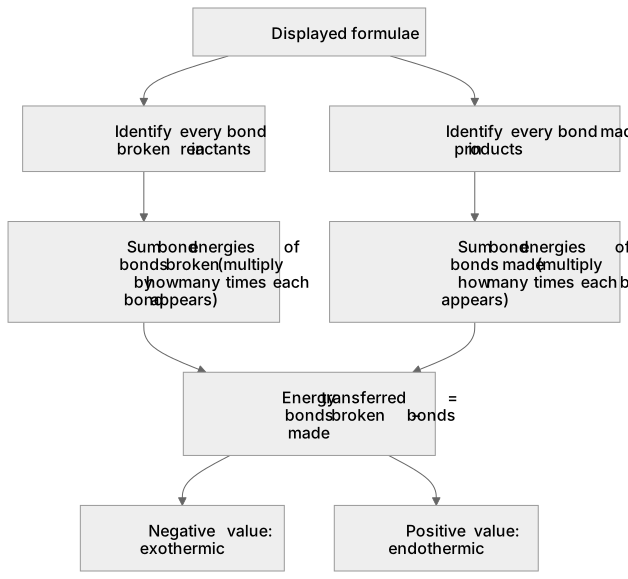
Key words
Say what each word means before you turn the card.
Bond breaking and bond making
Try answering aloud or in your head before turning the card.
Exothermic and endothermic processes
Try answering aloud or in your head before turning the card.
Quantitative calculation using supplied data
Try answering aloud or in your head before turning the card.
See every definition
- Bond breaking and bond making
- Bond breaking takes in energy, while bond making releases it.
- Exothermic and endothermic processes
- A negative result means more energy is released than absorbed, so the reaction is exothermic; a positive value indicates an endothermic reaction.
- Quantitative calculation using supplied data
- Add the energies of all bonds broken in the reactants, add the energies of all bonds made in the products, then subtract: energy transferred = energy of bonds broken − energy of bonds made.
Label the diagram
Some boxes have lost their names. Pick the right name for each number.
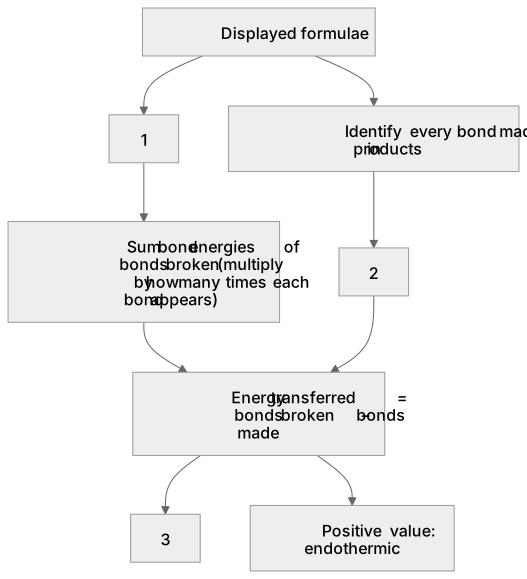
1Box 1
2Box 2
3Box 3
There is more to this lesson
The full lesson goes on to check your understanding and help you earn the marks. Create a free account to carry on, with your progress saved.
A week of Premium from your first lesson · Then the free plan continues · No card, no charge
Test your understanding of The energy change of reactions (HT only): Students should be able to calculate the energy transferred in chemical reactions using bond energies supplied.
Active recall beats re-reading. Take an instant quiz now to test what you’ve learned and lock it into long-term memory.
A week of Premium from your first lesson · Then the free plan continues · No card, no charge