AQA · GCSE · Combined Science
Course version: 8464 · Version from Sept 2018
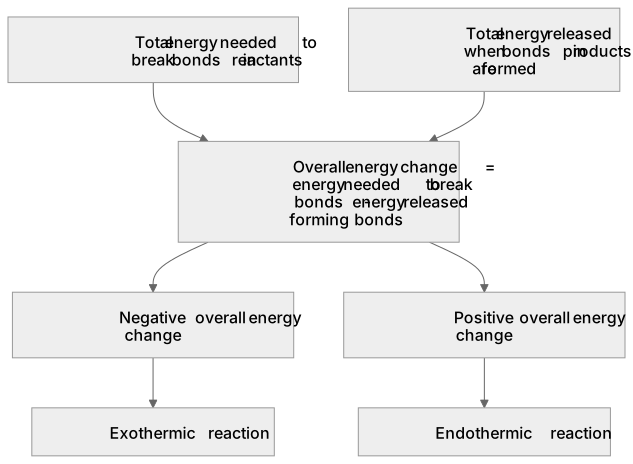
The energy change of reactions (HT only): The difference between the sum of the energy needed to break bonds in the reactants and the sum of the energy released when bonds in the products are formed is the overall energy change of the reaction.
The overall energy change of a chemical reaction is calculated by finding the difference between the energy required to break reactant bonds and the energy released when product bonds form.
- 3 key terms
Study notes
From the checked teaching notes for this specification point.
The idea
The overall energy change of a chemical reaction is calculated by finding the difference between the energy required to break reactant bonds and the energy released when product bonds form. The formula used is: Overall energy change = Total energy needed to break bonds - Total energy released forming bonds. For instance, if breaking bonds requires 678 kJ/mol and forming bonds releases 862 kJ/mol, the overall change is 678 - 862 = -184 kJ/mol. A negative overall energy change indicates an exothermic reaction, as more energy is released than absorbed. A positive value indicates an endothermic reaction. These calculations use average bond energies, meaning the results are approximations. This topic is exclusively assessed at Higher Tier.
What earns the marks
- Calculate the total energy required to break all bonds in the reactants (energy in).
- Calculate the total energy released when all bonds in the products are formed (energy out).
- Subtract the total energy released from the total energy required to find the overall energy change.
- Deduce that a negative overall energy change corresponds to an exothermic reaction.
- Deduce that a positive overall energy change corresponds to an endothermic reaction.
Common mistakes and how to put them right
Subtracting the energy required from the energy released (Energy out - Energy in).
Put it right: Use the formula: Overall energy change = Energy required to break bonds - Energy released forming bonds.
Ignoring the negative sign in the final answer for an exothermic reaction.
Put it right: The sign is crucial; always include the negative sign to denote an exothermic overall energy change.
Assuming that average bond energies give an exact value for the enthalpy change of a specific reaction.
Put it right: Recognise that average bond energies are averaged across different molecules, so the calculated energy change is an approximation.
Exam tips
- Write down the formula 'Energy change = Energy in - Energy out' before substituting your calculated values to avoid reversing the subtraction.
- Check if the question asks you to state whether the reaction is exothermic or endothermic based on your calculated sign.
- As this is Higher Tier content, be prepared to rearrange the formula to find an unknown bond energy if the overall energy change is given.
Try the lesson
The start of the The energy change of reactions (HT only): The difference between the sum of the energy needed to break bonds in the reactants and the sum of the energy released when bonds in the products are formed is the overall energy change of the reaction. lesson, made from checked teaching notes for this specification point.
Have a go first
For a specific reaction, the energy needed to break the bonds in the reactants is 850 kJ and the energy released when the bonds in the products are formed is 630 kJ. Which statement about this reaction is correct?
Listen
The overall energy change of a chemical reaction is calculated by finding the difference between the energy required to break reactant bonds and the energy released when product bonds form. The formula used is: Overall energy change = Total energy needed to break bonds - Total energy released forming bonds. For instance, if breaking bonds requires 678 kJ/mol and forming bonds releases 862 kJ/mol, the overall change is 678 - 862 = -184 kJ/mol. A negative overall energy change indicates an exothermic reaction, as more energy is released than absorbed. A positive value indicates an endothermic reaction. These calculations use average bond energies, meaning the results are approximations. This topic is exclusively assessed at Higher Tier. A strong answer earns marks for these points. Calculate the total energy required to break all bonds in the reactants (energy in). Calculate the total energy released when all bonds in the products are formed (energy out). Subtract the total energy released from the total energy required to find the overall energy change. Deduce that a negative overall energy change corresponds to an exothermic reaction. A common slip: Subtracting the energy required from the energy released (Energy out - Energy in). Instead, use the formula: Overall energy change = Energy required to break bonds - Energy released forming bonds. Exam tip: Write down the formula 'Energy change = Energy in - Energy out' before substituting your calculated values to avoid reversing the subtraction.
See it
Key words
Say what each word means before you turn the card.
Overall energy change of reactions
Try answering aloud or in your head before turning the card.
Exothermic and endothermic reactions
Try answering aloud or in your head before turning the card.
Application of average bond energies
Try answering aloud or in your head before turning the card.
See every definition
- Overall energy change of reactions
- The difference between the sum of the energy needed to break bonds in the reactants and the sum of the energy released when bonds in the products are formed.
- Exothermic and endothermic reactions
- A negative overall energy change indicates an exothermic reaction, as more energy is released than absorbed, while a positive value indicates an endothermic reaction.
- Application of average bond energies
- These calculations use average bond energies, meaning the results are approximations.
Label the diagram
Some boxes have lost their names. Pick the right name for each number.
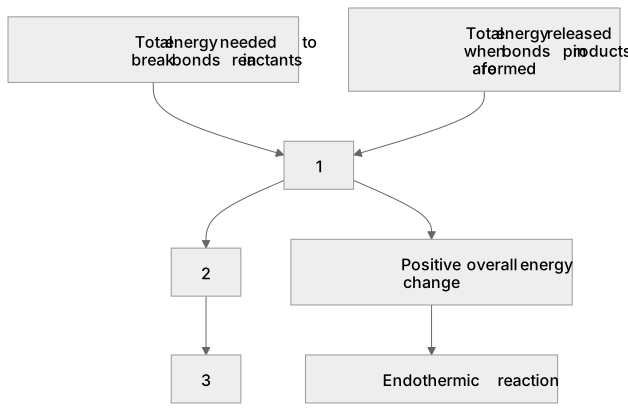
1Box 1
2Box 2
3Box 3
There is more to this lesson
The full lesson goes on to check your understanding and help you earn the marks. Create a free account to carry on, with your progress saved.
A week of Premium from your first lesson · Then the free plan continues · No card, no charge
Test your understanding of The energy change of reactions (HT only): The difference between the sum of the energy needed to break bonds in the reactants and the sum of the energy released when bonds in the products are formed is the overall energy change of the reaction.
Active recall beats re-reading. Take an instant quiz now to test what you’ve learned and lock it into long-term memory.
A week of Premium from your first lesson · Then the free plan continues · No card, no charge