AQA · GCSE · Combined Science
Course version: 8464 · Version from Sept 2018
The human nervous system: Required practical activity 6: plan and carry out an investigation into the effect of a factor on human reaction time.
In this required practical, a ruler-drop test measures reaction time: a partner holds a ruler vertically between your thumb and finger, releases it without warning, and you catch it as quickly as…
Study notes
From the checked teaching notes for this specification point.
The idea
In this required practical, a ruler-drop test measures reaction time: a partner holds a ruler vertically between your thumb and finger, releases it without warning, and you catch it as quickly as possible. The distance fallen, s, converts to time using t = √(2s ÷ g). You choose one independent variable, such as caffeine intake, time of day, handedness or background noise, and control others including the same ruler, the same release height, the same hand and the same person catching. Repeat each condition several times, discard anomalies, and compare means. A valid plan states the hypothesis, identifies variables, describes a safe and repeatable procedure, and explains how results will be recorded and analysed.
What earns the marks
- State a testable hypothesis linking one named independent variable to reaction time, for example that reaction time decreases after a caffeinated drink.
- Identify the independent variable, dependent variable and at least three control variables such as hand used, ruler start position and room conditions.
- Describe the ruler-drop procedure clearly, including a random release with no countdown and catching with thumb and finger.
- Explain that each condition is repeated and a mean calculated to reduce the effect of random variation in human response.
- Describe how distance data will be converted to time using t = √(2s ÷ g) and how results will be compared or displayed.
- Include a relevant safety or ethical point, such as avoiding caffeine if it causes adverse effects or obtaining consent from participants.
Common mistakes and how to put them right
Changing more than one factor between conditions.
Put it right: Keep all variables constant except the chosen independent variable.
Using a countdown before releasing the ruler.
Put it right: Release without warning so the response is genuinely reactive.
Recording only one measurement per condition.
Put it right: Repeat trials and use a mean, identifying and excluding anomalies.
Exam tips
- Write the plan as a logical sequence: hypothesis, variables, method, repeats, analysis, safety.
- Name specific control variables rather than saying 'keep it fair', and explain briefly why each is controlled.
- State how many repeats you would take and how you would treat anomalous results before calculating a mean.
Try the lesson
The start of the The human nervous system: Required practical activity 6: plan and carry out an investigation into the effect of a factor on human reaction time. lesson, made from checked teaching notes for this specification point.
Have a go first
In the reaction time practical, a ruler is dropped between a student's thumb and finger. What is measured to give a value for the student's reaction time?
Listen
In this required practical, a ruler-drop test measures reaction time: a partner holds a ruler vertically between your thumb and finger, releases it without warning, and you catch it as quickly as possible. The distance fallen, s, converts to time using t = √(2s ÷ g). You choose one independent variable, such as caffeine intake, time of day, handedness or background noise, and control others including the same ruler, the same release height, the same hand and the same person catching. Repeat each condition several times, discard anomalies, and compare means. A valid plan states the hypothesis, identifies variables, describes a safe and repeatable procedure, and explains how results will be recorded and analysed. A strong answer earns marks for these points. State a testable hypothesis linking one named independent variable to reaction time, for example that reaction time decreases after a caffeinated drink. Identify the independent variable, dependent variable and at least three control variables such as hand used, ruler start position and room conditions. Describe the ruler-drop procedure clearly, including a random release with no countdown and catching with thumb and finger. Explain that each condition is repeated and a mean calculated to reduce the effect of random variation in human response. A common slip: Changing more than one factor between conditions. Instead, keep all variables constant except the chosen independent variable. Exam tip: Write the plan as a logical sequence: hypothesis, variables, method, repeats, analysis, safety.
See it
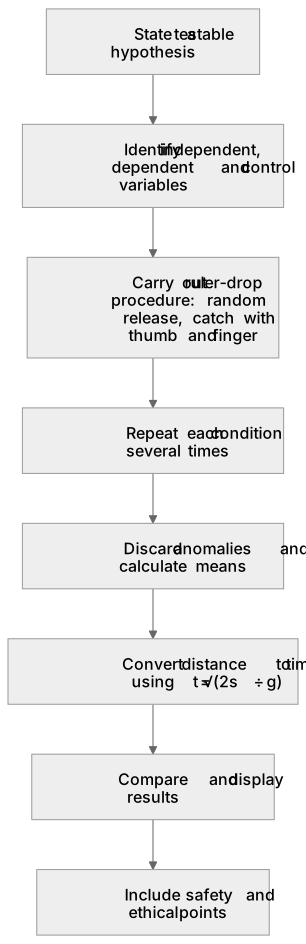
Put it in order
Put these steps in the order they happen.
- 1. Identify independent, dependent and control variables
- 2. Carry out ruler-drop procedure: random release, catch with thumb and finger
- 3. Repeat each condition several times
- 4. Discard anomalies and calculate means
- 5. Convert distance to time using t = √(2s ÷ g)
- 6. Compare and display results
- 7. Include safety and ethical points
- 8. State a testable hypothesis
Label the diagram
Some boxes have lost their names. Pick the right name for each number.
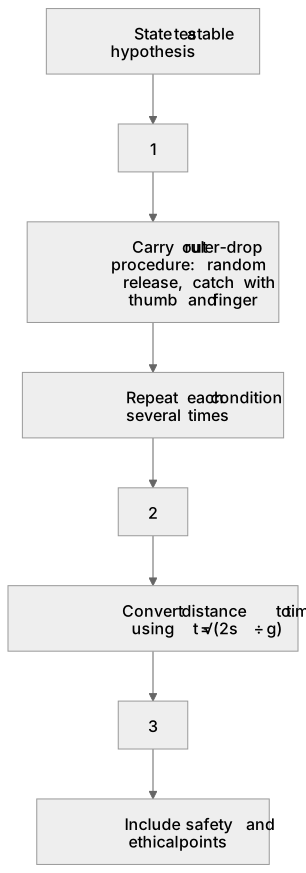
1Box 1
2Box 2
3Box 3
There is more to this lesson
The full lesson goes on to check your understanding and help you earn the marks. Create a free account to carry on, with your progress saved.
A week of Premium from your first lesson · Then the free plan continues · No card, no charge
Test your understanding of The human nervous system: Required practical activity 6: plan and carry out an investigation into the effect of a factor on human reaction time.
Active recall beats re-reading. Take an instant quiz now to test what you’ve learned and lock it into long-term memory.
A week of Premium from your first lesson · Then the free plan continues · No card, no charge