AQA · GCSE · Combined Science
Course version: 8464 · Version from Sept 2018
The human nervous system: Students should be able to explain how the various structures in a reflex arc – including the sensory neurone, synapse relay neurone and motor neurone – relate to their function. Students should understand why reflex actions are important.
A reflex arc begins when a receptor detects a stimulus and a sensory neurone carries the impulse to the central nervous system.
- 3 key terms
Study notes
From the checked teaching notes for this specification point.
The idea
A reflex arc begins when a receptor detects a stimulus and a sensory neurone carries the impulse to the central nervous system. The sensory neurone has a cell body beside the spinal cord and a long dendron, allowing rapid transmission. At a synapse, the impulse triggers release of a neurotransmitter that diffuses across the gap and stimulates the next neurone. A relay neurone inside the spinal cord links the sensory and motor neurones, and the motor neurone carries the impulse to an effector, such as a muscle, which contracts. Reflex actions are automatic and do not involve conscious thought, so they are rapid and protect the body from harm.
What earns the marks
- The sensory neurone carries impulses from receptors to the central nervous system and has a cell body positioned alongside the spinal cord.
- The relay neurone is located inside the spinal cord or brain and connects the sensory neurone to the motor neurone.
- The motor neurone carries impulses from the central nervous system to an effector, such as a muscle or gland.
- At a synapse, a neurotransmitter is released from the presynaptic neurone, diffuses across the synaptic gap and binds to receptors on the postsynaptic neurone.
- Reflex actions are rapid and automatic because the pathway does not pass through the conscious areas of the brain.
- Reflex actions are important because they protect the body from damage, for example withdrawing a hand from a hot object or blinking in response to a bright light.
Common mistakes and how to put them right
Saying that the relay neurone carries impulses from the receptor to the spinal cord.
Put it right: The sensory neurone does that; the relay neurone connects sensory and motor neurones inside the central nervous system.
Describing the synapse as a direct electrical connection.
Put it right: The impulse crosses the synapse by diffusion of a neurotransmitter, which takes a small amount of time.
Claiming that reflex actions are slow because they involve the brain.
Put it right: Reflex actions are rapid because the impulse is coordinated by the spinal cord and does not require conscious processing by the brain.
Exam tips
- Label a reflex arc diagram using the terms receptor, sensory neurone, relay neurone, motor neurone, synapse and effector.
- When explaining the synapse, state that a neurotransmitter diffuses across the gap and binds to receptors on the next neurone.
- Link the speed and automatic nature of reflexes to their protective function, using a named example such as withdrawing a hand from a hot surface.
Try the lesson
The start of the The human nervous system: Students should be able to explain how the various structures in a reflex arc – including the sensory neurone, synapse relay neurone and motor neurone – relate to their function. Students should understand why reflex actions are important. lesson, made from checked teaching notes for this specification point.
Have a go first
Which structure carries electrical impulses from a receptor to the coordinator?
Listen
A reflex arc begins when a receptor detects a stimulus and a sensory neurone carries the impulse to the central nervous system. The sensory neurone has a cell body beside the spinal cord and a long dendron, allowing rapid transmission. At a synapse, the impulse triggers release of a neurotransmitter that diffuses across the gap and stimulates the next neurone. A relay neurone inside the spinal cord links the sensory and motor neurones, and the motor neurone carries the impulse to an effector, such as a muscle, which contracts. Reflex actions are automatic and do not involve conscious thought, so they are rapid and protect the body from harm. A strong answer earns marks for these points. The sensory neurone carries impulses from receptors to the central nervous system and has a cell body positioned alongside the spinal cord. The relay neurone is located inside the spinal cord or brain and connects the sensory neurone to the motor neurone. The motor neurone carries impulses from the central nervous system to an effector, such as a muscle or gland. At a synapse, a neurotransmitter is released from the presynaptic neurone, diffuses across the synaptic gap and binds to receptors on the postsynaptic neurone. A common slip: Saying that the relay neurone carries impulses from the receptor to the spinal cord. Instead, the sensory neurone does that; the relay neurone connects sensory and motor neurones inside the central nervous system. Exam tip: Label a reflex arc diagram using the terms receptor, sensory neurone, relay neurone, motor neurone, synapse and effector.
See it
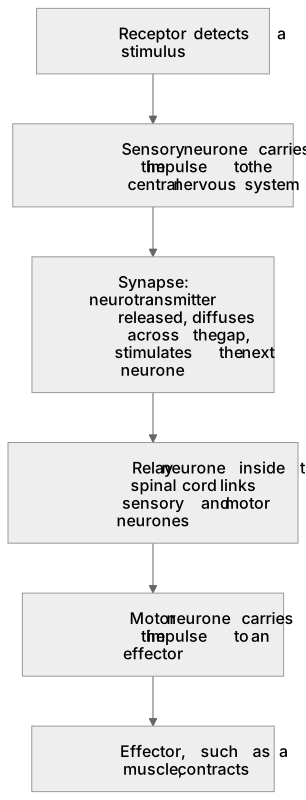
Put it in order
Put these steps in the order they happen.
- 1. Sensory neurone carries the impulse to the central nervous system
- 2. Synapse: neurotransmitter released, diffuses across the gap, stimulates the next neurone
- 3. Relay neurone inside the spinal cord links sensory and motor neurones
- 4. Motor neurone carries the impulse to an effector
- 5. Effector, such as a muscle, contracts
- 6. Receptor detects a stimulus
Key words
Say what each word means before you turn the card.
Sensory neurone
Try answering aloud or in your head before turning the card.
Relay neurone
Try answering aloud or in your head before turning the card.
Motor neurone
Try answering aloud or in your head before turning the card.
See every definition
- Sensory neurone
- Carries impulses from receptors to the central nervous system and has a cell body positioned alongside the spinal cord.
- Relay neurone
- Located inside the spinal cord or brain and connects the sensory neurone to the motor neurone.
- Motor neurone
- Carries impulses from the central nervous system to an effector, such as a muscle or gland.
Label the diagram
Some boxes have lost their names. Pick the right name for each number.
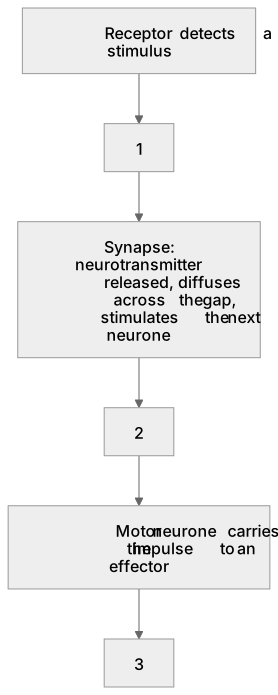
1Box 1
2Box 2
3Box 3
There is more to this lesson
The full lesson goes on to check your understanding and help you earn the marks. Create a free account to carry on, with your progress saved.
A week of Premium from your first lesson · Then the free plan continues · No card, no charge
Test your understanding of The human nervous system: Students should be able to explain how the various structures in a reflex arc – including the sensory neurone, synapse relay neurone and motor neurone – relate to their function. Students should understand why reflex actions are important.
Active recall beats re-reading. Take an instant quiz now to test what you’ve learned and lock it into long-term memory.
A week of Premium from your first lesson · Then the free plan continues · No card, no charge