AQA · GCSE · Combined Science
Course version: 8464 · Version from Sept 2018
The human nervous system: The nervous system enables humans to react to their surroundings and to coordinate their behaviour.
The nervous system is a rapid communication network that detects changes in the internal and external environment and produces coordinated responses.
- 4 key terms
Study notes
From the checked teaching notes for this specification point.
The idea
The nervous system is a rapid communication network that detects changes in the internal and external environment and produces coordinated responses. Receptors, such as temperature receptors in the skin or light receptors in the retina, detect a stimulus. This information travels as electrical impulses along neurones to the central nervous system, which processes it and triggers a response by effectors. For example, touching a hot object is detected by receptors in the hand; impulses travel to the spinal cord, which coordinates a rapid withdrawal of the hand by muscles. This coordination allows humans to avoid danger, maintain internal conditions and carry out complex behaviours. The nervous system therefore links detection of a stimulus to a response, and its speed and specificity make it essential for survival.
What earns the marks
- Receptors detect stimuli in the surroundings or inside the body.
- Electrical impulses travel along neurones to the central nervous system.
- The central nervous system coordinates the response.
- Effectors such as muscles or glands carry out the response.
- Coordination allows rapid, appropriate reactions that help humans survive and function.
Common mistakes and how to put them right
Thinking the nervous system only deals with external surroundings.
Put it right: It also coordinates internal conditions and behaviour.
Confusing receptors with effectors.
Put it right: Receptors detect stimuli, whereas effectors produce responses.
Believing impulses travel along the blood.
Put it right: Impulses travel along neurones as electrical signals.
Exam tips
- Use the sequence stimulus → receptor → coordinator → effector → response when explaining a nervous reaction.
- Name a specific receptor and effector in examples, such as temperature receptors in the skin and muscles in the arm.
- Link coordination to a benefit, such as avoiding injury or maintaining a stable internal environment.
Try the lesson
The start of the The human nervous system: The nervous system enables humans to react to their surroundings and to coordinate their behaviour. lesson, made from checked teaching notes for this specification point.
Have a go first
Which statement best describes the overall function of the human nervous system?
Listen
The nervous system is a rapid communication network that detects changes in the internal and external environment and produces coordinated responses. Receptors, such as temperature receptors in the skin or light receptors in the retina, detect a stimulus. This information travels as electrical impulses along neurones to the central nervous system, which processes it and triggers a response by effectors. For example, touching a hot object is detected by receptors in the hand; impulses travel to the spinal cord, which coordinates a rapid withdrawal of the hand by muscles. This coordination allows humans to avoid danger, maintain internal conditions and carry out complex behaviours. The nervous system therefore links detection of a stimulus to a response, and its speed and specificity make it essential for survival. A strong answer earns marks for these points. Receptors detect stimuli in the surroundings or inside the body. Electrical impulses travel along neurones to the central nervous system. The central nervous system coordinates the response. Effectors such as muscles or glands carry out the response. A common slip: Thinking the nervous system only deals with external surroundings. Instead, it also coordinates internal conditions and behaviour. Exam tip: Use the sequence stimulus → receptor → coordinator → effector → response when explaining a nervous reaction.
See it
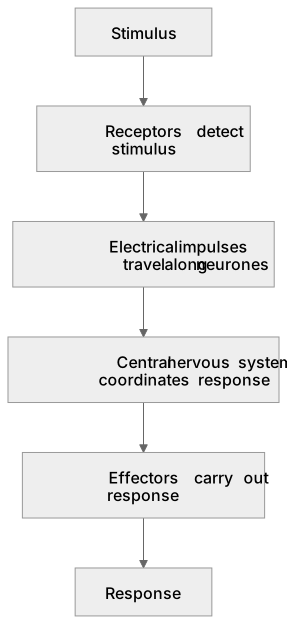
Put it in order
Put these steps in the order they happen.
- 1. Receptors detect stimulus
- 2. Electrical impulses travel along neurones
- 3. Central nervous system coordinates response
- 4. Effectors carry out response
- 5. Response
- 6. Stimulus
Key words
Say what each word means before you turn the card.
Stimulus and response
Try answering aloud or in your head before turning the card.
Receptors and effectors
Try answering aloud or in your head before turning the card.
Coordination by the central nervous system
Try answering aloud or in your head before turning the card.
Survival and homeostasis
Try answering aloud or in your head before turning the card.
See every definition
- Stimulus and response
- A stimulus is a change detected by receptors, and a response is what effectors carry out after the central nervous system coordinates it.
- Receptors and effectors
- Receptors detect stimuli in the surroundings or inside the body, whereas effectors such as muscles or glands carry out the response.
- Coordination by the central nervous system
- Electrical impulses travel along neurones to the central nervous system, which processes the information and coordinates the response.
- Survival and homeostasis
- Coordination allows rapid, appropriate reactions that help humans survive, maintain internal conditions and function.
Label the diagram
Some boxes have lost their names. Pick the right name for each number.
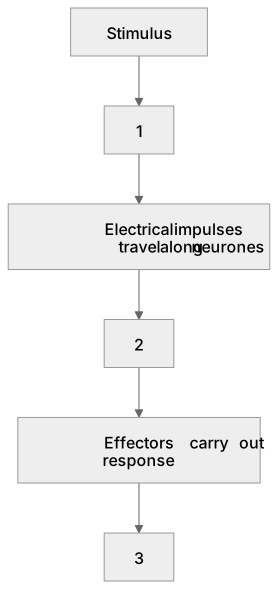
1Box 1
2Box 2
3Box 3
There is more to this lesson
The full lesson goes on to check your understanding and help you earn the marks. Create a free account to carry on, with your progress saved.
A week of Premium from your first lesson · Then the free plan continues · No card, no charge
Test your understanding of The human nervous system: The nervous system enables humans to react to their surroundings and to coordinate their behaviour.
Active recall beats re-reading. Take an instant quiz now to test what you’ve learned and lock it into long-term memory.
A week of Premium from your first lesson · Then the free plan continues · No card, no charge