AQA · GCSE · Combined Science
Course version: 8464 · Version from Sept 2018
The periodic table: Elements in the same group in the periodic table have the same number of electrons in their outer shell (outer electrons) and this gives them similar chemical properties.
Elements in the same group have identical numbers of outer-shell electrons.
- 3 key terms
Study notes
From the checked teaching notes for this specification point.
The idea
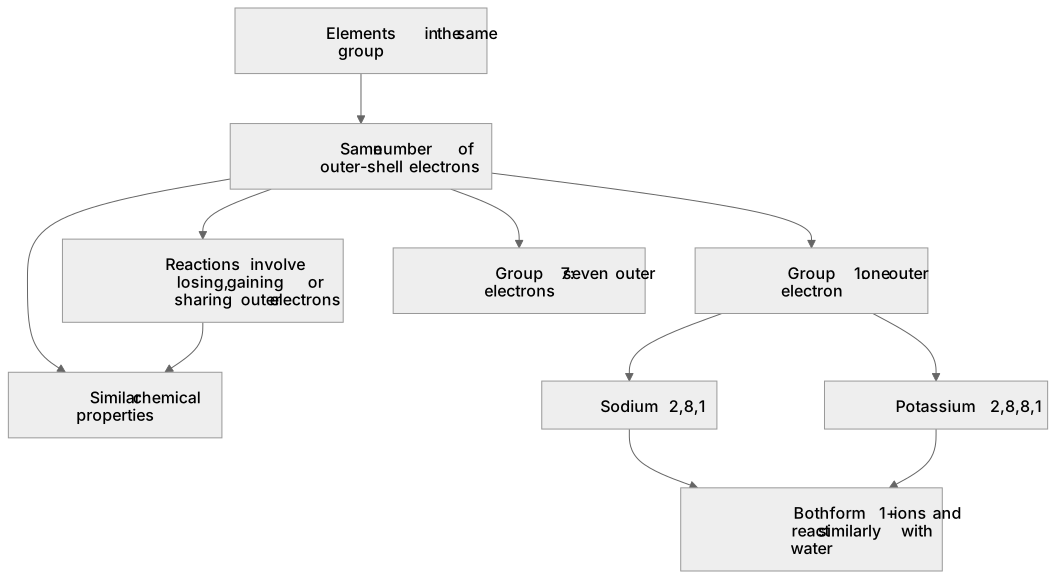
Elements in the same group have identical numbers of outer-shell electrons. For example, Group 1 elements each have one outer electron, and Group 7 elements each have seven. Chemical properties depend mainly on outer electrons because reactions involve losing, gaining or sharing these electrons to achieve a stable electron arrangement. Sodium (2,8,1) and potassium (2,8,8,1) both have one outer electron, so both form 1⁺ ions and react similarly with water, even though potassium reacts more vigorously. The shared outer-electron count explains why group members behave alike, while the increasing number of inner shells down a group explains trends in reactivity.
What earns the marks
- States that elements in the same group have the same number of outer-shell electrons.
- Links outer-shell electron number to similar chemical properties.
- Gives a correct example, such as Group 1 elements having one outer electron or Group 7 elements having seven.
- Explains that reactions involve outer electrons being lost, gained or shared.
- Uses electron configurations to show the shared outer-electron count, for example sodium 2,8,1 and potassium 2,8,8,1.
Common mistakes and how to put them right
Saying elements in the same group have the same total number of electrons.
Put it right by specifying outer-shell electrons only.
Claiming all group members react with identical vigour.
Put it right by explaining that reactivity changes down a group even though the type of reaction is similar.
Confusing group number with outer-electron number for every group.
Put it right by noting the link works for main-group elements, such as Group 1 and Group 7, but transition metals do not follow it simply.
Exam tips
- Write electron configurations such as 2,8,1 to make the outer-electron count visible in your answer.
- When explaining similar properties, always connect outer electrons to how elements lose, gain or share electrons in reactions.
- If asked about a trend down a group, separate the similar outer-electron count from the changing reactivity.
Try the lesson
The start of the The periodic table: Elements in the same group in the periodic table have the same number of electrons in their outer shell (outer electrons) and this gives them similar chemical properties. lesson, made from checked teaching notes for this specification point.
Have a go first
Sodium and potassium are both in Group 1 of the periodic table. Why do these two elements react in a similar way?
Listen
Elements in the same group have identical numbers of outer-shell electrons. For example, Group 1 elements each have one outer electron, and Group 7 elements each have seven. Chemical properties depend mainly on outer electrons because reactions involve losing, gaining or sharing these electrons to achieve a stable electron arrangement. Sodium (2,8,1) and potassium (2,8,8,1) both have one outer electron, so both form 1⁺ ions and react similarly with water, even though potassium reacts more vigorously. The shared outer-electron count explains why group members behave alike, while the increasing number of inner shells down a group explains trends in reactivity. A strong answer earns marks for these points. States that elements in the same group have the same number of outer-shell electrons. Links outer-shell electron number to similar chemical properties. Gives a correct example, such as Group 1 elements having one outer electron or Group 7 elements having seven. Explains that reactions involve outer electrons being lost, gained or shared. A common slip: Saying elements in the same group have the same total number of electrons. Instead, specifying outer-shell electrons only. Exam tip: Write electron configurations such as 2,8,1 to make the outer-electron count visible in your answer.
See it
Key words
Say what each word means before you turn the card.
Electron configuration
Try answering aloud or in your head before turning the card.
Group chemistry
Try answering aloud or in your head before turning the card.
Reactivity trends
Try answering aloud or in your head before turning the card.
See every definition
- Electron configuration
- The arrangement of electrons written as numbers such as 2,8,1, which makes the outer-electron count visible.
- Group chemistry
- Elements in the same group have the same number of outer electrons, which gives them similar chemical properties.
- Reactivity trends
- The increasing number of inner shells down a group explains trends in reactivity, even though the type of reaction is similar.
Label the diagram
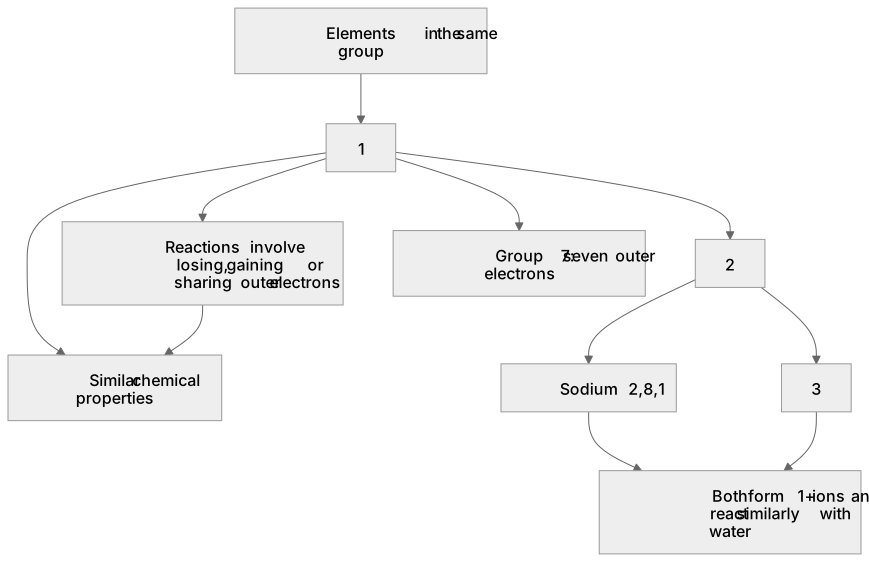
Some boxes have lost their names. Pick the right name for each number.
1Box 1
2Box 2
3Box 3
There is more to this lesson
The full lesson goes on to check your understanding and help you earn the marks. Create a free account to carry on, with your progress saved.
A week of Premium from your first lesson · Then the free plan continues · No card, no charge
Test your understanding of The periodic table: Elements in the same group in the periodic table have the same number of electrons in their outer shell (outer electrons) and this gives them similar chemical properties.
Active recall beats re-reading. Take an instant quiz now to test what you’ve learned and lock it into long-term memory.
A week of Premium from your first lesson · Then the free plan continues · No card, no charge