AQA · GCSE · Combined Science
Course version: 8464 · Version from Sept 2018
The periodic table: explain how the position of an element in the periodic table is related to the arrangement of electrons in its atoms and hence to its atomic number
The periodic table is arranged in order of increasing atomic number, and this order reflects the number of protons and electrons in each atom.
- 4 key terms
Study notes
From the checked teaching notes for this specification point.
The idea
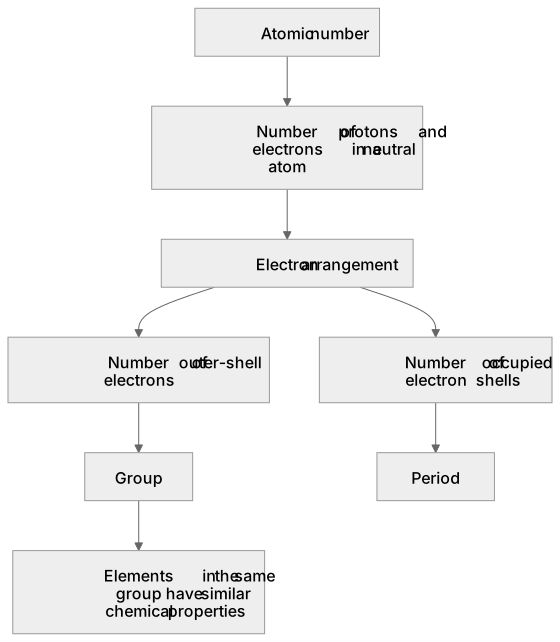
The periodic table is arranged in order of increasing atomic number, and this order reflects the number of protons and electrons in each atom. Elements in the same group have the same number of outer-shell electrons, which is why they show similar chemical properties. Elements in the same period have the same number of occupied electron shells. For example, chlorine has atomic number 17, so it has 17 protons and 17 electrons, with arrangement 2,8,7; it is in Group 7 and Period 3, so it has seven outer electrons and three occupied shells. You should be able to move between atomic number, electron arrangement and periodic table position in either direction, and use this to explain similarities within groups and trends across periods.
What earns the marks
- State that elements are arranged in order of increasing atomic number.
- Link atomic number to the number of protons and electrons in a neutral atom.
- Explain that elements in the same group have the same number of outer-shell electrons.
- Explain that elements in the same period have the same number of occupied electron shells.
- Use electron arrangement to explain why elements in a group have similar chemical properties.
- Deduce the position of an element from a given electron arrangement or atomic number.
Common mistakes and how to put them right
Saying elements are arranged by relative atomic mass.
Put it right: The modern periodic table is ordered by increasing atomic number.
Assuming all atoms of an element have the same number of neutrons.
Put it right: Atomic number gives protons, while isotopes differ in neutrons.
Thinking group number always equals outer electrons for every element.
Put it right: The simple group-number rule applies to main-group elements.
Exam tips
- When explaining a similarity, name the group and state the number of outer electrons before linking to reactivity.
- If asked to explain the position of an element, work from atomic number to electron arrangement to group and period in a clear sequence.
- Check that your electron arrangement uses commas between shell numbers and does not exceed 2, 8, 8 for the first three shells.
Try the lesson
The start of the The periodic table: explain how the position of an element in the periodic table is related to the arrangement of electrons in its atoms and hence to its atomic number lesson, made from checked teaching notes for this specification point.
Have a go first
An atom of an element has the electron arrangement 2,8,1. In which group of the periodic table is this element placed?
Listen
The periodic table is arranged in order of increasing atomic number, and this order reflects the number of protons and electrons in each atom. Elements in the same group have the same number of outer-shell electrons, which is why they show similar chemical properties. Elements in the same period have the same number of occupied electron shells. For example, chlorine has atomic number 17, so it has 17 protons and 17 electrons, with arrangement 2,8,7; it is in Group 7 and Period 3, so it has seven outer electrons and three occupied shells. You should be able to move between atomic number, electron arrangement and periodic table position in either direction, and use this to explain similarities within groups and trends across periods. A strong answer earns marks for these points. State that elements are arranged in order of increasing atomic number. Link atomic number to the number of protons and electrons in a neutral atom. Explain that elements in the same group have the same number of outer-shell electrons. Explain that elements in the same period have the same number of occupied electron shells. A common slip: Saying elements are arranged by relative atomic mass: the error is ignoring the modern basis of the table. Instead, the modern periodic table is ordered by increasing atomic number. Exam tip: When explaining a similarity, name the group and state the number of outer electrons before linking to reactivity.
See it
Key words
Say what each word means before you turn the card.
Atomic number
Try answering aloud or in your head before turning the card.
Group
Try answering aloud or in your head before turning the card.
Period
Try answering aloud or in your head before turning the card.
Electron arrangement
Try answering aloud or in your head before turning the card.
See every definition
- Atomic number
- Gives the number of protons and electrons in a neutral atom, and elements are arranged in order of increasing atomic number.
- Group
- Elements in the same group have the same number of outer-shell electrons, which is why they show similar chemical properties.
- Period
- Elements in the same period have the same number of occupied electron shells.
- Electron arrangement
- The arrangement of electrons in the shells of an atom, which can be used to deduce the position of an element in the periodic table.
Label the diagram
Some boxes have lost their names. Pick the right name for each number.
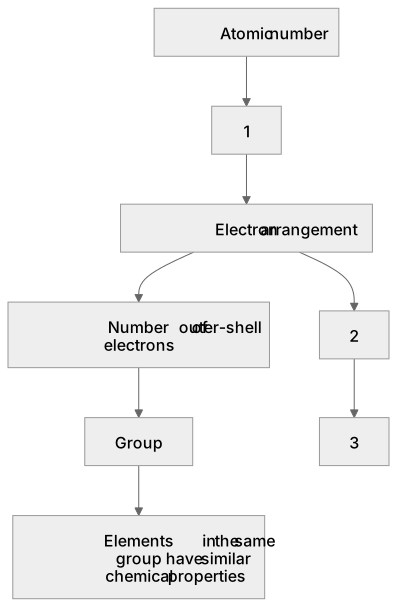
1Box 1
2Box 2
3Box 3
There is more to this lesson
The full lesson goes on to check your understanding and help you earn the marks. Create a free account to carry on, with your progress saved.
A week of Premium from your first lesson · Then the free plan continues · No card, no charge
Test your understanding of The periodic table: explain how the position of an element in the periodic table is related to the arrangement of electrons in its atoms and hence to its atomic number
Active recall beats re-reading. Take an instant quiz now to test what you’ve learned and lock it into long-term memory.
A week of Premium from your first lesson · Then the free plan continues · No card, no charge