AQA · GCSE · Combined Science
Course version: 8464 · Version from Sept 2018
The pH scale and neutralisation: Acids produce hydrogen ions (H⁺) in aqueous solutions.
Acids produce hydrogen ions, H⁺, when dissolved in water.
- 4 key terms
Study notes
From the checked teaching notes for this specification point.
The idea
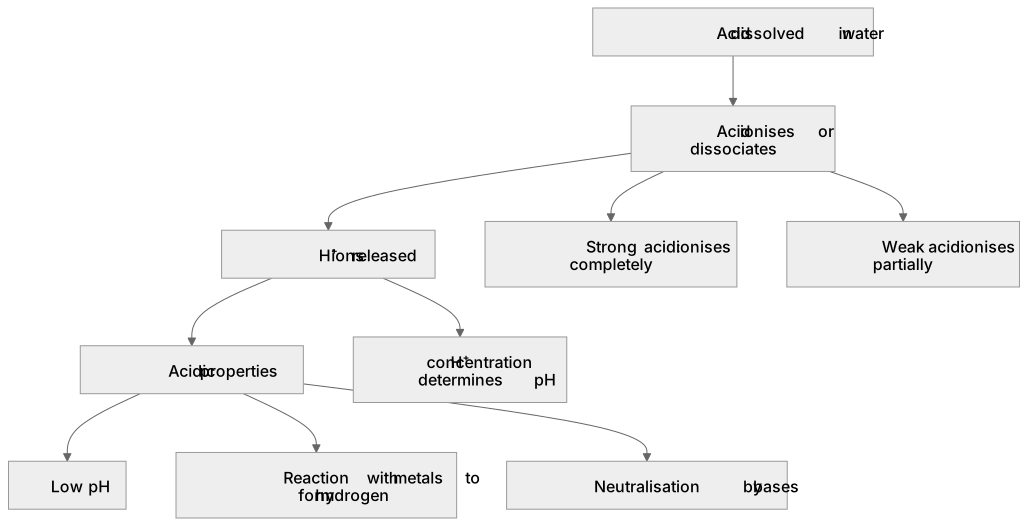
Acids produce hydrogen ions, H⁺, when dissolved in water. In aqueous solution, an acid releases H⁺ ions, which are responsible for acidic properties such as low pH, reaction with metals to form hydrogen, and neutralisation by bases. For example, hydrochloric acid in water forms H⁺ and Cl⁻ ions; the H⁺ ions make the solution acidic. The concentration of H⁺ ions determines pH: higher H⁺ concentration gives lower pH. Strong acids ionise completely, while weak acids ionise partially, but both produce H⁺ in aqueous solution. This idea explains why acids only show acidic behaviour when water is present.
What earns the marks
- Acids produce hydrogen ions, H⁺, when dissolved in water.
- The H⁺ ion is responsible for acidic properties, including low pH and neutralisation.
- In aqueous solution, an acid ionises or dissociates to release H⁺ ions.
- The concentration of H⁺ ions determines the pH of the solution.
- Strong acids ionise completely in water, while weak acids ionise partially, but both produce H⁺ ions.
Common mistakes and how to put them right
Writing H⁺ as H+ or H plus.
Put it right: Use the correct ion symbol H⁺.
Confusing strong and concentrated.
Put it right: Use the terms precisely.
Exam tips
- Define an acid as a source of H⁺ ions in aqueous solution, and link this to acidic properties.
- Use the formula H⁺ correctly in equations and explanations, including state symbols where appropriate.
- When comparing strong and weak acids, refer to the extent of ionisation and the concentration of H⁺ ions.
Try the lesson
The start of the The pH scale and neutralisation: Acids produce hydrogen ions (H⁺) in aqueous solutions. lesson, made from checked teaching notes for this specification point.
Have a go first
Which ion is produced by all acids when they are dissolved in water to form an aqueous solution?
Listen
Acids produce hydrogen ions, H⁺, when dissolved in water. In aqueous solution, an acid releases H⁺ ions, which are responsible for acidic properties such as low pH, reaction with metals to form hydrogen, and neutralisation by bases. For example, hydrochloric acid in water forms H⁺ and Cl⁻ ions; the H⁺ ions make the solution acidic. The concentration of H⁺ ions determines pH: higher H⁺ concentration gives lower pH. Strong acids ionise completely, while weak acids ionise partially, but both produce H⁺ in aqueous solution. This idea explains why acids only show acidic behaviour when water is present. A strong answer earns marks for these points. Acids produce hydrogen ions, H⁺, when dissolved in water. The H⁺ ion is responsible for acidic properties, including low pH and neutralisation. In aqueous solution, an acid ionises or dissociates to release H⁺ ions. The concentration of H⁺ ions determines the pH of the solution. A common slip: Writing H⁺ as H+ or H plus: the charge must be shown as a superscript, H⁺. Instead, use the correct ion symbol H⁺. Exam tip: Define an acid as a source of H⁺ ions in aqueous solution, and link this to acidic properties.
See it
Key words
Say what each word means before you turn the card.
Acids
Try answering aloud or in your head before turning the card.
pH
Try answering aloud or in your head before turning the card.
Strong acids
Try answering aloud or in your head before turning the card.
Neutralisation
Try answering aloud or in your head before turning the card.
See every definition
- Acids
- Substances that produce hydrogen ions, H⁺, when dissolved in water, and only show acidic behaviour when water is present.
- pH
- A measure determined by the concentration of H⁺ ions, where a higher H⁺ concentration gives a lower pH.
- Strong acids
- Acids that ionise completely in water, while weak acids ionise partially, but both produce H⁺ ions.
- Neutralisation
- An acidic property for which the H⁺ ion is responsible, alongside low pH, and which involves reaction with bases.
Label the diagram
Some boxes have lost their names. Pick the right name for each number.
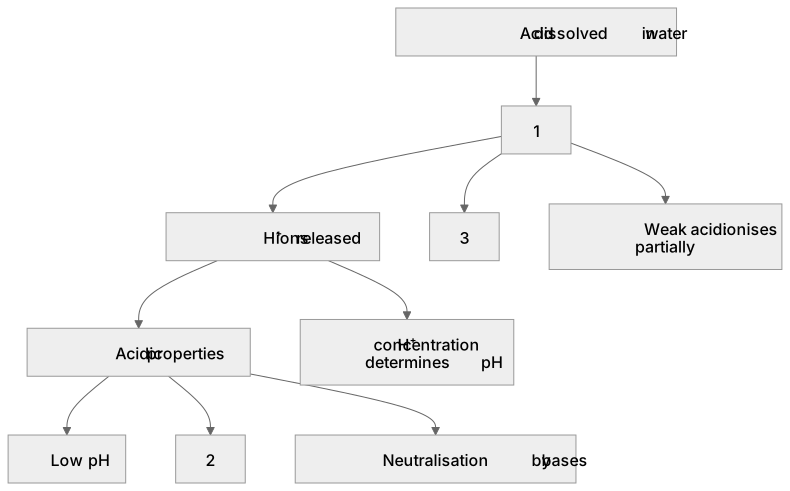
1Box 1
2Box 2
3Box 3
There is more to this lesson
The full lesson goes on to check your understanding and help you earn the marks. Create a free account to carry on, with your progress saved.
A week of Premium from your first lesson · Then the free plan continues · No card, no charge
Test your understanding of The pH scale and neutralisation: Acids produce hydrogen ions (H⁺) in aqueous solutions.
Active recall beats re-reading. Take an instant quiz now to test what you’ve learned and lock it into long-term memory.
A week of Premium from your first lesson · Then the free plan continues · No card, no charge