AQA · GCSE · Combined Science
Course version: 8464 · Version from Sept 2018
The pH scale and neutralisation: In neutralisation reactions between an acid and an alkali, hydrogen ions react with hydroxide ions to produce water.
When an acid reacts with an alkali, the reaction is called neutralisation.
Study notes
From the checked teaching notes for this specification point.
The idea
When an acid reacts with an alkali, the reaction is called neutralisation. In aqueous solution, the acid provides hydrogen ions, H⁺, and the alkali provides hydroxide ions, OH⁻. These ions react together to produce water: H⁺ + OH⁻ → H₂O. For example, hydrochloric acid reacts with sodium hydroxide solution to form sodium chloride and water: HCl + NaOH → NaCl + H₂O. The hydrogen ions and hydroxide ions are the reacting species, while the sodium ions and chloride ions are spectator ions that remain in solution. Because the hydrogen ions and hydroxide ions are used up, the pH moves towards 7. The same ionic equation applies whenever an acid is neutralised by an alkali.
What earns the marks
- Identify the hydrogen ion, H⁺, as the ion supplied by the acid in aqueous solution.
- Identify the hydroxide ion, OH⁻, as the ion supplied by the alkali in aqueous solution.
- Write the ionic equation H⁺ + OH⁻ → H₂O and state that water is the product.
- Explain that the hydrogen ions and hydroxide ions are used up, so the solution becomes less acidic and the pH moves towards 7.
- Apply the idea to an example such as HCl + NaOH → NaCl + H₂O, recognising that sodium ions and chloride ions are spectator ions.
Common mistakes and how to put them right
Writing H⁺ + OH⁻ → H₂O₂.
Put it right by balancing the equation so that one hydrogen ion and one hydroxide ion produce one water molecule, H₂O.
Thinking that neutralisation always produces a pH of exactly 7.
Put it right by stating that the pH moves towards 7 and reaches 7 only when the acid and alkali are in the correct reacting amounts.
Treating the salt as the only product.
Put it right by naming both water and the salt, and by identifying water as the product of H⁺ and OH⁻.
Exam tips
- Write the ionic equation with correct charges and state symbols, for example H⁺(aq) + OH⁻(aq) → H₂O(l).
- If asked to explain neutralisation, name both reacting ions and the product rather than only naming the salt.
- Use the ionic equation to explain pH changes, linking the removal of H⁺ and OH⁻ to the solution becoming neutral.
Try the lesson
The start of the The pH scale and neutralisation: In neutralisation reactions between an acid and an alkali, hydrogen ions react with hydroxide ions to produce water. lesson, made from checked teaching notes for this specification point.
Have a go first
Which ions react together when an acid is neutralised by an alkali?
Listen
When an acid reacts with an alkali, the reaction is called neutralisation. In aqueous solution, the acid provides hydrogen ions, H⁺, and the alkali provides hydroxide ions, OH⁻. These ions react together to produce water: H⁺ + OH⁻ → H₂O. For example, hydrochloric acid reacts with sodium hydroxide solution to form sodium chloride and water: HCl + NaOH → NaCl + H₂O. The hydrogen ions and hydroxide ions are the reacting species, while the sodium ions and chloride ions are spectator ions that remain in solution. Because the hydrogen ions and hydroxide ions are used up, the pH moves towards 7. The same ionic equation applies whenever an acid is neutralised by an alkali. A strong answer earns marks for these points. Identify the hydrogen ion, H⁺, as the ion supplied by the acid in aqueous solution. Identify the hydroxide ion, OH⁻, as the ion supplied by the alkali in aqueous solution. Write the ionic equation H⁺ + OH⁻ → H₂O and state that water is the product. Explain that the hydrogen ions and hydroxide ions are used up, so the solution becomes less acidic and the pH moves towards 7. A common slip: Writing H⁺ + OH⁻ → H₂O₂. Instead, balancing the equation so that one hydrogen ion and one hydroxide ion produce one water molecule, H₂O. Exam tip: Write the ionic equation with correct charges and state symbols, for example H⁺(aq) + OH⁻(aq) → H₂O(l).
See it
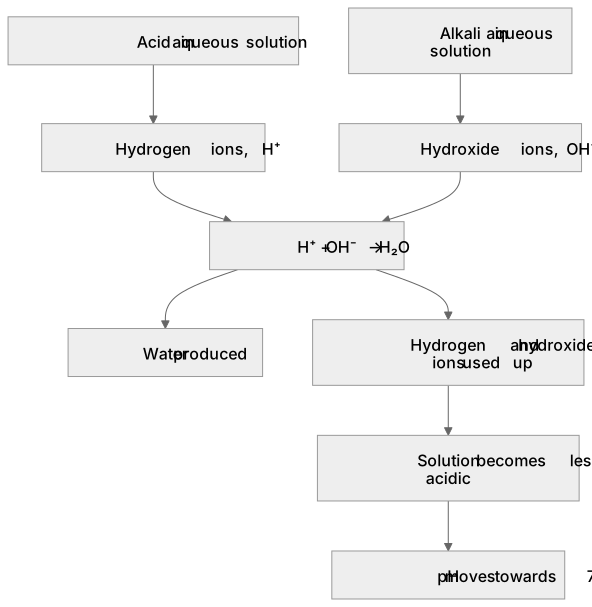
Label the diagram
Some boxes have lost their names. Pick the right name for each number.
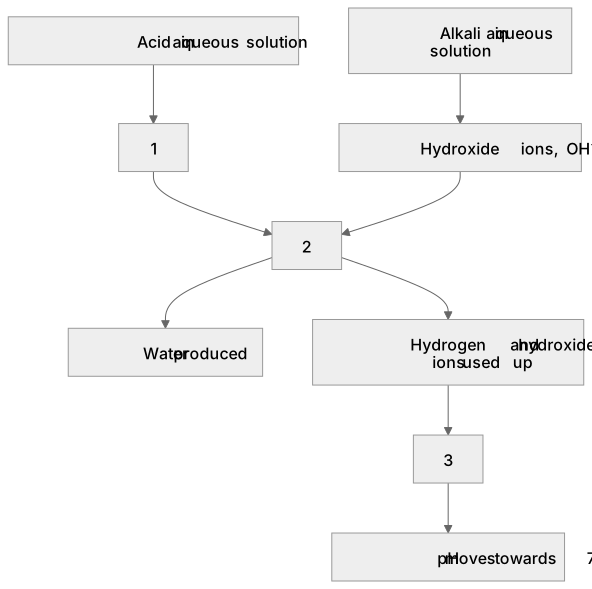
1Box 1
2Box 2
3Box 3
There is more to this lesson
The full lesson goes on to check your understanding and help you earn the marks. Create a free account to carry on, with your progress saved.
A week of Premium from your first lesson · Then the free plan continues · No card, no charge
Test your understanding of The pH scale and neutralisation: In neutralisation reactions between an acid and an alkali, hydrogen ions react with hydroxide ions to produce water.
Active recall beats re-reading. Take an instant quiz now to test what you’ve learned and lock it into long-term memory.
A week of Premium from your first lesson · Then the free plan continues · No card, no charge