AQA · GCSE · Combined Science
Course version: 8464 · Version from Sept 2018
The reactivity series: deduce an order of reactivity of metals based on experimental results.
To deduce an order of reactivity from experimental results, compare how vigorously different metals react with water or dilute acid, or compare displacement reactions.
- 4 key terms
Study notes
From the checked teaching notes for this specification point.
The idea
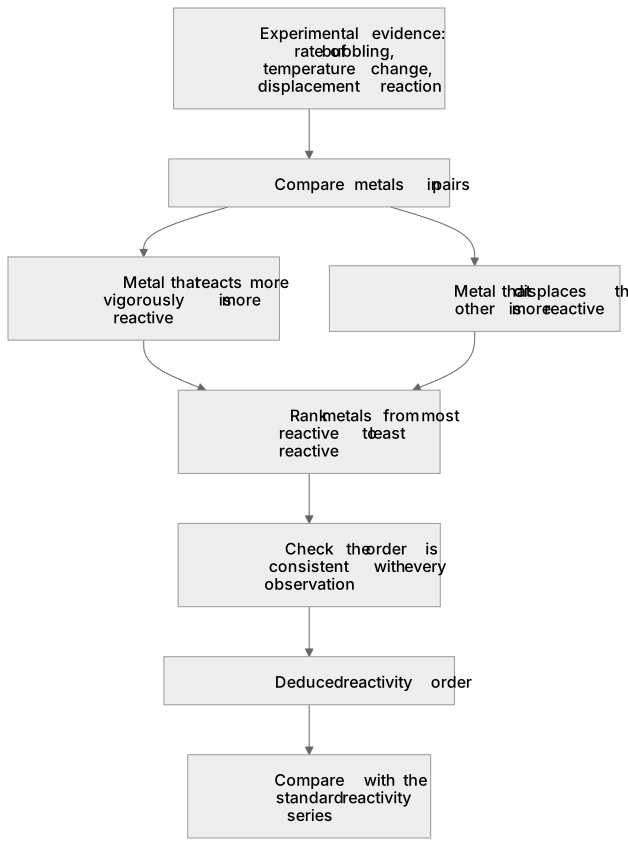
To deduce an order of reactivity from experimental results, compare how vigorously different metals react with water or dilute acid, or compare displacement reactions. For example, if metal A displaces metal B from a solution of a B salt, then A is more reactive than B. If metal C reacts more vigorously with dilute hydrochloric acid than metal D, producing bubbles faster and a greater temperature rise, then C is more reactive than D. By ranking several metals from most to least vigorous, you build a reactivity order. The order must be consistent with all the evidence: a metal that displaces another is placed above it, and a metal that reacts more vigorously is placed above a less vigorous one. This deduced order can then be compared with the standard reactivity series.
What earns the marks
- Identify the experimental evidence available, such as rate of bubbling, temperature change, or whether a displacement reaction occurs.
- Compare the metals in pairs: the metal that reacts more vigorously or displaces the other is the more reactive.
- Rank the metals from most reactive to least reactive using all the comparisons, ensuring the final order is consistent with every observation.
- Use displacement results to place a metal above another in the reactivity series, for example if zinc displaces copper from copper sulfate solution then zinc is more reactive than copper.
- Explain that the deduced order matches the tendency of each metal to form a positive ion, with more reactive metals forming ions more readily.
Common mistakes and how to put them right
Assuming that the metal that produces the most gas is always the most reactive without considering the time taken or the amount of metal used.
Put it right: Compare the rate of reaction under the same conditions, or use displacement evidence, to make a fair comparison.
Placing a metal above another just because it is higher in a remembered list, without using the experimental results.
Put it right: The deduced order must be based on the results provided, not on memory alone.
Ignoring a displacement result that contradicts the rest of the order.
Put it right: Check all pairs of metals and adjust the order so that every observation is consistent.
Exam tips
- Present your deduced order as a clear list from most reactive to least reactive, and briefly state the evidence for each adjacent pair.
- If the question gives a table of results, look for the metal with the fastest reaction or the greatest temperature rise and place it at the top of your order.
- When using displacement reactions, remember that the more reactive metal displaces the less reactive metal from its compound, so the displacing metal goes above the displaced metal.
Try the lesson
The start of the The reactivity series: deduce an order of reactivity of metals based on experimental results. lesson, made from checked teaching notes for this specification point.
Have a go first
A student adds a piece of metal X to dilute hydrochloric acid and sees bubbles of gas. The student adds a piece of metal Y to dilute hydrochloric acid and sees no bubbles. Which metal is more reactive?
Listen
To deduce an order of reactivity from experimental results, compare how vigorously different metals react with water or dilute acid, or compare displacement reactions. For example, if metal A displaces metal B from a solution of a B salt, then A is more reactive than B. If metal C reacts more vigorously with dilute hydrochloric acid than metal D, producing bubbles faster and a greater temperature rise, then C is more reactive than D. By ranking several metals from most to least vigorous, you build a reactivity order. The order must be consistent with all the evidence: a metal that displaces another is placed above it, and a metal that reacts more vigorously is placed above a less vigorous one. This deduced order can then be compared with the standard reactivity series. A strong answer earns marks for these points. Identify the experimental evidence available, such as rate of bubbling, temperature change, or whether a displacement reaction occurs. Compare the metals in pairs: the metal that reacts more vigorously or displaces the other is the more reactive. Rank the metals from most reactive to least reactive using all the comparisons, ensuring the final order is consistent with every observation. Use displacement results to place a metal above another in the reactivity series, for example if zinc displaces copper from copper sulfate solution then zinc is more reactive than copper. A common slip: assuming that the metal that produces the most gas is always the most reactive without considering the time taken or the amount of metal used. Instead, compare the rate of reaction under the same conditions, or use displacement evidence, to make a fair comparison. Exam tip: Present your deduced order as a clear list from most reactive to least reactive, and briefly state the evidence for each adjacent pair.
See it
Key words
Say what each word means before you turn the card.
Reactivity series
Try answering aloud or in your head before turning the card.
Displacement reactions
Try answering aloud or in your head before turning the card.
Experimental comparison
Try answering aloud or in your head before turning the card.
Ranking and ordering
Try answering aloud or in your head before turning the card.
See every definition
- Reactivity series
- An order of metals from most to least reactive, deduced from experimental results and consistent with all the evidence.
- Displacement reactions
- Reactions in which a more reactive metal displaces a less reactive metal from a solution of its salt.
- Experimental comparison
- Comparing how vigorously different metals react with water or dilute acid, or comparing displacement reactions, to deduce reactivity.
- Ranking and ordering
- Placing several metals from most to least vigorous using all the comparisons, ensuring the final order is consistent with every observation.
Label the diagram
Some boxes have lost their names. Pick the right name for each number.
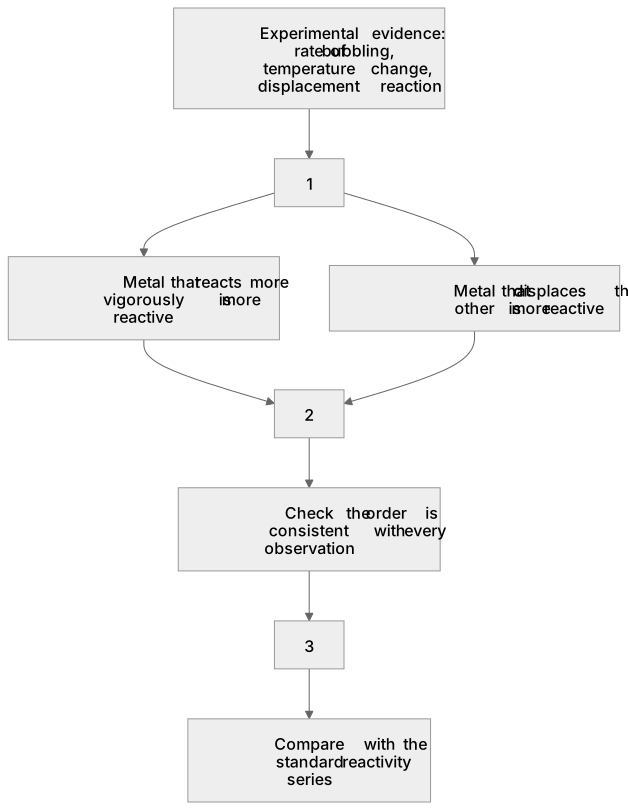
1Box 1
2Box 2
3Box 3
There is more to this lesson
The full lesson goes on to check your understanding and help you earn the marks. Create a free account to carry on, with your progress saved.
A week of Premium from your first lesson · Then the free plan continues · No card, no charge
Test your understanding of The reactivity series: deduce an order of reactivity of metals based on experimental results.
Active recall beats re-reading. Take an instant quiz now to test what you’ve learned and lock it into long-term memory.
A week of Premium from your first lesson · Then the free plan continues · No card, no charge