AQA · GCSE · Combined Science
Course version: 8464 · Version from Sept 2018
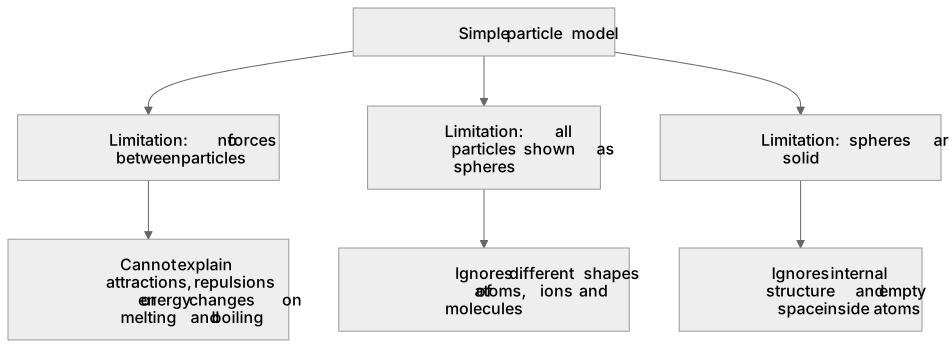
The three states of matter: (HT only) Limitations of the simple model above include that in the model there are no forces, that all particles are represented as spheres and that the spheres are solid.
The particle model pictures matter as tiny spheres arranged in solids, liquids and gases.
Study notes
From the checked teaching notes for this specification point.
The idea
The particle model pictures matter as tiny spheres arranged in solids, liquids and gases. It explains melting, boiling, diffusion and gas pressure, but it is a simplification.
For example: Drawing water molecules as identical solid balls cannot show hydrogen bonding or the bent shape of H₂O.
What earns the marks
- States that the simple model has no forces between particles, so it cannot explain attractions, repulsions or the energy changes on melting and boiling.
- Explains that representing all particles as spheres ignores the different shapes of atoms, ions and molecules, such as the bent H₂O molecule.
- Explains that treating spheres as solid ignores internal structure and the empty space within atoms.
- Links each limitation to a property the model cannot explain, for example diffusion rates, gas pressure or changes of state.
- Uses the model's success in explaining the three states alongside its limitations, showing awareness that models are provisional.
- Applies the limitations to a named substance rather than describing them only in the abstract.
Common mistakes and how to put them right
Saying the model has no particles.
Put it right: Particles are present but forces between them are omitted.
Claiming the spheres are solid because particles are hard.
Put it right: Real particles have internal structure and empty space.
Stating that the model is wrong.
Put it right: It is limited, not useless, and still explains many observations.
Exam tips
- Read the command word: 'describe' needs the limitations stated, while 'explain' needs each limitation linked to an observation it cannot account for.
- Use the phrase 'the model assumes' to signal that you are discussing a simplification rather than a fact.
- Give one concrete substance, such as water or carbon dioxide, to make each limitation specific and creditworthy.
- Remember that evaluating the limitations of the simple particle model is assessed at Higher Tier only.
Try the lesson
The start of the The three states of matter: (HT only) Limitations of the simple model above include that in the model there are no forces, that all particles are represented as spheres and that the spheres are solid. lesson, made from checked teaching notes for this specification point.
Have a go first
The simple particle model of matter has several limitations. Which limitation explains why the model cannot show how strongly particles attract each other?
Listen
The particle model pictures matter as tiny spheres arranged in solids, liquids and gases. It explains melting, boiling, diffusion and gas pressure, but it is a simplification. For example, drawing water molecules as identical solid balls cannot show hydrogen bonding or the bent shape of H₂O. A strong answer earns marks for these points. States that the simple model has no forces between particles, so it cannot explain attractions, repulsions or the energy changes on melting and boiling. Explains that representing all particles as spheres ignores the different shapes of atoms, ions and molecules, such as the bent H₂O molecule. Explains that treating spheres as solid ignores internal structure and the empty space within atoms. Links each limitation to a property the model cannot explain, for example diffusion rates, gas pressure or changes of state. A common slip: Saying the model has no particles: the error is confusing 'no forces' with 'no particles'. Instead, particles are present but forces between them are omitted. Exam tip: Read the command word: 'describe' needs the limitations stated, while 'explain' needs each limitation linked to an observation it cannot account for.
See it
Label the diagram
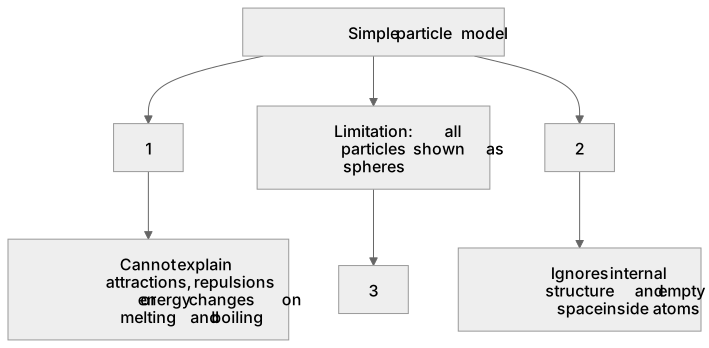
Some boxes have lost their names. Pick the right name for each number.
1Box 1
2Box 2
3Box 3
There is more to this lesson
The full lesson goes on to check your understanding and help you earn the marks. Create a free account to carry on, with your progress saved.
A week of Premium from your first lesson · Then the free plan continues · No card, no charge
Test your understanding of The three states of matter: (HT only) Limitations of the simple model above include that in the model there are no forces, that all particles are represented as spheres and that the spheres are solid.
Active recall beats re-reading. Take an instant quiz now to test what you’ve learned and lock it into long-term memory.
A week of Premium from your first lesson · Then the free plan continues · No card, no charge