AQA · GCSE · Combined Science
Course version: 8464 · Version from Sept 2018
The three states of matter: recognise that atoms themselves do not have the bulk properties of materials
Bulk properties are the large-scale behaviours we observe, such as melting point, boiling point, density, conductivity and solubility.
Study notes
From the checked teaching notes for this specification point.
The idea
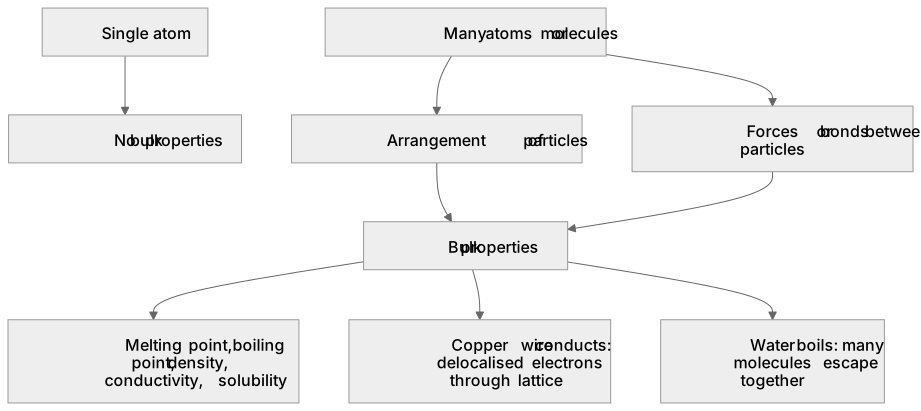
Bulk properties are the large-scale behaviours we observe, such as melting point, boiling point, density, conductivity and solubility. They emerge from how enormous numbers of atoms or molecules are arranged and how they interact, not from a single atom. One isolated atom has no melting point, no boiling point and no fixed density because these ideas only make sense for a collection of particles. For example, a single copper atom cannot conduct electricity through a wire, yet a copper wire does because delocalised electrons move through the whole lattice. Similarly, one water molecule does not boil at 100 °C; boiling describes molecules escaping from a bulk liquid. When you explain a material's properties, refer to the particles, their arrangement, and the forces or bonds between them, rather than saying the atoms themselves are hard, shiny or dense.
What earns the marks
- State that bulk properties belong to a material made of many atoms, not to one atom on its own.
- Give a named bulk property such as melting point, boiling point, density, conductivity or solubility.
- Explain that the property depends on the arrangement of particles and the forces or bonds between them.
- Use a specific example, such as copper conducting because of delocalised electrons throughout the lattice, or water boiling because many molecules escape together.
- Avoid describing an individual atom as having a property such as shiny, hard, dense or a fixed melting point.
Common mistakes and how to put them right
Saying a single atom is hard or shiny.
Put it right by explaining that hardness and shininess are bulk properties arising from many atoms and their bonding.
Claiming one atom has a melting point.
Put it right by stating that melting point describes a bulk sample changing state, not an isolated particle.
Confusing the properties of an element with the properties of one atom.
Put it right by linking the material's behaviour to the particle arrangement and intermolecular or metallic bonding.
Exam tips
- Read the question carefully: if it asks about a material or a sample, answer in terms of many particles, not one atom.
- When asked to explain a property, name the property, then link it to particle arrangement and the forces or bonds present.
- Use a quick contrast in your answer, such as 'one copper atom cannot conduct, but a copper wire can because delocalised electrons move through the lattice'.
Try the lesson
The start of the The three states of matter: recognise that atoms themselves do not have the bulk properties of materials lesson, made from checked teaching notes for this specification point.
Have a go first
A single atom of copper is compared with a block of copper metal. Which statement is correct?
Listen
Bulk properties are the large-scale behaviours we observe, such as melting point, boiling point, density, conductivity and solubility. They emerge from how enormous numbers of atoms or molecules are arranged and how they interact, not from a single atom. One isolated atom has no melting point, no boiling point and no fixed density because these ideas only make sense for a collection of particles. For example, a single copper atom cannot conduct electricity through a wire, yet a copper wire does because delocalised electrons move through the whole lattice. Similarly, one water molecule does not boil at 100 °C; boiling describes molecules escaping from a bulk liquid. When you explain a material's properties, refer to the particles, their arrangement, and the forces or bonds between them, rather than saying the atoms themselves are hard, shiny or dense. A strong answer earns marks for these points. State that bulk properties belong to a material made of many atoms, not to one atom on its own. Give a named bulk property such as melting point, boiling point, density, conductivity or solubility. Explain that the property depends on the arrangement of particles and the forces or bonds between them. Use a specific example, such as copper conducting because of delocalised electrons throughout the lattice, or water boiling because many molecules escape together. A common slip: Saying a single atom is hard or shiny. Instead, explaining that hardness and shininess are bulk properties arising from many atoms and their bonding. Exam tip: Read the question carefully: if it asks about a material or a sample, answer in terms of many particles, not one atom.
See it
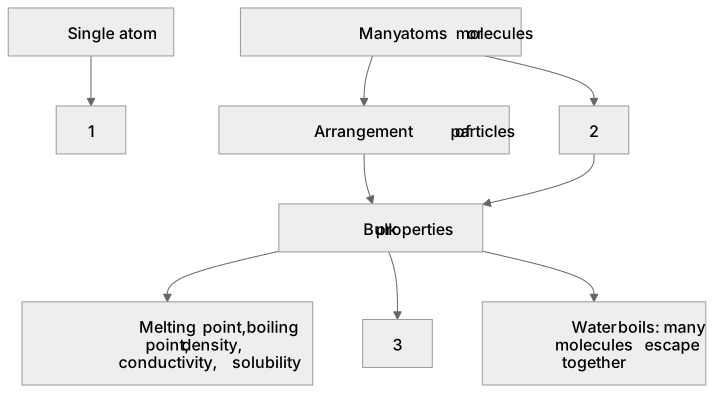
Label the diagram
Some boxes have lost their names. Pick the right name for each number.
1Box 1
2Box 2
3Box 3
There is more to this lesson
The full lesson goes on to check your understanding and help you earn the marks. Create a free account to carry on, with your progress saved.
A week of Premium from your first lesson · Then the free plan continues · No card, no charge
Test your understanding of The three states of matter: recognise that atoms themselves do not have the bulk properties of materials
Active recall beats re-reading. Take an instant quiz now to test what you’ve learned and lock it into long-term memory.
A week of Premium from your first lesson · Then the free plan continues · No card, no charge