AQA · GCSE · Combined Science
Course version: 8464 · Version from Sept 2018
The use of hormones to treat infertility (HT only): At the stage when they are tiny balls of cells, one or two embryos are inserted into the mother's uterus (womb).
Assessed at Higher Tier only, this step links laboratory fertilisation to pregnancy.
- 3 key terms
Study notes
From the checked teaching notes for this specification point.
The idea
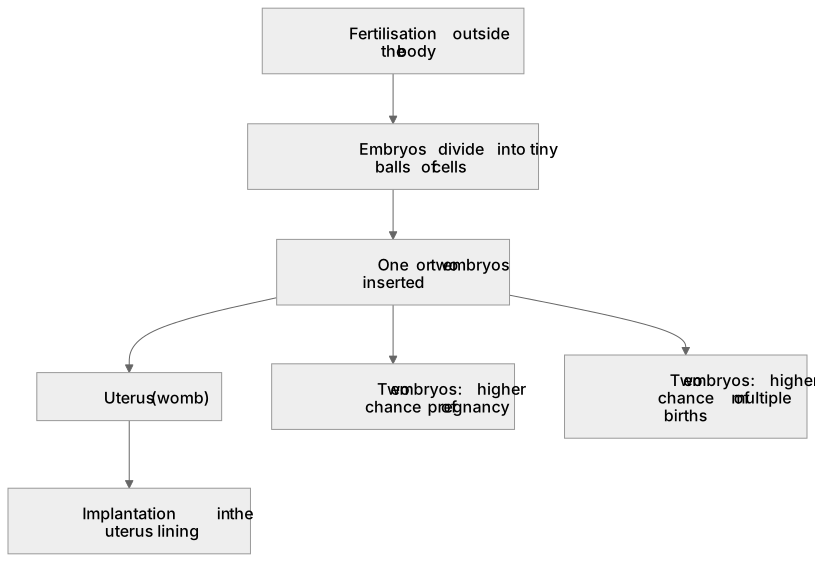
Assessed at Higher Tier only, this step links laboratory fertilisation to pregnancy. After fertilisation outside the body, embryos divide into tiny balls of cells. At this early stage, one or two embryos are transferred into the mother's uterus (womb). Inserting them at the ball-of-cells stage improves the chance of implantation in the uterus lining. Transferring two embryos increases pregnancy chances but raises the risk of multiple births (twins). The uterus is the correct site because its lining is prepared by hormones to receive an embryo.
For example: Progesterone maintains this lining.
What earns the marks
- Embryos are transferred when they are tiny balls of cells, not at a later fetal stage.
- One or two embryos are inserted into the mother's uterus, also called the womb.
- The uterus lining is where an embryo can implant and continue developing.
- Transferring two embryos increases the chance of pregnancy but also the chance of multiple births.
- The transfer happens after fertilisation and early cell division outside the body.
- Hormones prepare the uterus lining so it can receive the embryo.
Common mistakes and how to put them right
Saying the embryo is inserted into the ovary or fallopian tube.
Put it right by naming the uterus (womb) as the site of insertion.
Thinking many embryos are always inserted at once.
Put it right by stating that one or two embryos are inserted to balance success rates with multiple birth risks.
Confusing insertion with fertilisation.
Put it right by stating that fertilisation already happened outside the body before transfer.
Exam tips
- Note that the use of hormones to treat infertility, including IVF, is a Higher Tier only topic.
- Name the uterus and add '(womb)' to show you know both terms.
- When discussing risks, link the transfer of multiple embryos to a higher chance of multiple births.
Try the lesson
The start of the The use of hormones to treat infertility (HT only): At the stage when they are tiny balls of cells, one or two embryos are inserted into the mother's uterus (womb). lesson, made from checked teaching notes for this specification point.
Have a go first
At which stage are embryos inserted into the mother's uterus during fertility treatment?
Listen
Assessed at Higher Tier only, this step links laboratory fertilisation to pregnancy. After fertilisation outside the body, embryos divide into tiny balls of cells. At this early stage, one or two embryos are transferred into the mother's uterus (womb). Inserting them at the ball-of-cells stage improves the chance of implantation in the uterus lining. Transferring two embryos increases pregnancy chances but raises the risk of multiple births (twins). The uterus is the correct site because its lining is prepared by hormones to receive an embryo. For example, progesterone maintains this lining. A strong answer earns marks for these points. Embryos are transferred when they are tiny balls of cells, not at a later fetal stage. One or two embryos are inserted into the mother's uterus, also called the womb. The uterus lining is where an embryo can implant and continue developing. Transferring two embryos increases the chance of pregnancy but also the chance of multiple births. A common slip: Saying the embryo is inserted into the ovary or fallopian tube. Instead, naming the uterus (womb) as the site of insertion. Exam tip: Note that the use of hormones to treat infertility, including IVF, is a Higher Tier only topic.
See it
Key words
Say what each word means before you turn the card.
Embryo transfer in IVF
Try answering aloud or in your head before turning the card.
Uterus lining and implantation
Try answering aloud or in your head before turning the card.
Multiple pregnancy risk
Try answering aloud or in your head before turning the card.
See every definition
- Embryo transfer in IVF
- One or two embryos are inserted into the mother's uterus (womb) when they are tiny balls of cells.
- Uterus lining and implantation
- The uterus lining is where an embryo can implant and continue developing, and hormones prepare it to receive the embryo.
- Multiple pregnancy risk
- Transferring two embryos increases the chance of pregnancy but also the chance of multiple births.
Label the diagram
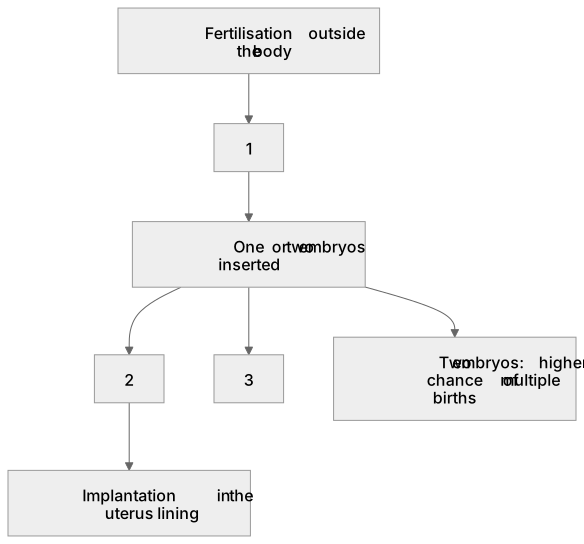
Some boxes have lost their names. Pick the right name for each number.
1Box 1
2Box 2
3Box 3
There is more to this lesson
The full lesson goes on to check your understanding and help you earn the marks. Create a free account to carry on, with your progress saved.
A week of Premium from your first lesson · Then the free plan continues · No card, no charge
Test your understanding of The use of hormones to treat infertility (HT only): At the stage when they are tiny balls of cells, one or two embryos are inserted into the mother's uterus (womb).
Active recall beats re-reading. Take an instant quiz now to test what you’ve learned and lock it into long-term memory.
A week of Premium from your first lesson · Then the free plan continues · No card, no charge