AQA · GCSE · Combined Science
Course version: 8464 · Version from Sept 2018
Using electrolysis to extract metals: Aluminium is manufactured by the electrolysis of a molten mixture of aluminium oxide and cryolite using carbon as the positive electrode (anode).
Aluminium is extracted from a molten mixture of aluminium oxide and cryolite.
- 3 key terms
Study notes
From the checked teaching notes for this specification point.
The idea
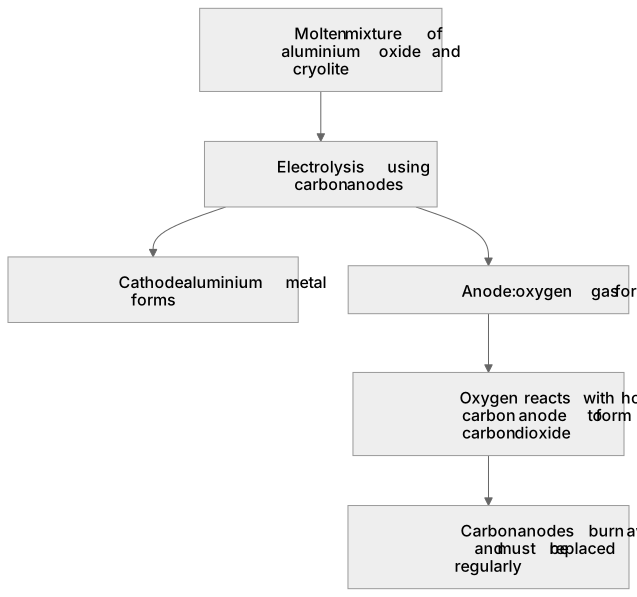
Aluminium is extracted from a molten mixture of aluminium oxide and cryolite. Aluminium oxide has a very high melting point, so cryolite is added to lower the melting point and reduce the energy needed to melt the electrolyte. The mixture is electrolysed using carbon anodes, which are chosen because carbon conducts electricity and has a high melting point. At the cathode, aluminium metal forms. At the carbon anode, oxygen gas forms. (HT only: Al³⁺ ions gain electrons at the cathode, and oxide ions lose electrons at the anode). The oxygen produced reacts with the hot carbon anodes to form carbon dioxide gas. This explains why the anodes gradually burn away and must be replaced regularly, making the process continuous and energy-intensive.
What earns the marks
- Aluminium is manufactured by electrolysis of a molten mixture of aluminium oxide and cryolite.
- Cryolite is added to lower the melting point of the electrolyte, reducing the energy required and making the process more economical.
- Carbon is used as the positive electrode (the anode) because it conducts electricity and has a high melting point.
- At the cathode, aluminium ions form aluminium metal, and at the anode, oxide ions form oxygen gas.
- The oxygen produced reacts with the hot carbon anode to form carbon dioxide.
- Because the carbon anodes react and burn away, they are gradually used up and need regular replacement.
- (HT only) Explain that Al³⁺ ions gain electrons at the cathode and oxide ions lose electrons at the anode.
Common mistakes and how to put them right
Saying cryolite is added to increase the melting point.
Put it right by linking cryolite to reduced energy cost.
Confusing the electrodes: aluminium forms at the cathode, not the anode.
Put it right by stating that positive aluminium ions move to the negative electrode.
Forgetting that the carbon anode is consumed.
Put it right by including this reaction in explanations of the process.
Exam tips
- Name both substances in the electrolyte and state the role of cryolite when explaining the extraction.
- Link the reaction at the anode to the need for regular replacement of carbon electrodes, showing understanding of the industrial process.
- (HT only) Be prepared to describe the electron transfer at each electrode, ensuring atoms and charges balance.
Try the lesson
The start of the Using electrolysis to extract metals: Aluminium is manufactured by the electrolysis of a molten mixture of aluminium oxide and cryolite using carbon as the positive electrode (anode). lesson, made from checked teaching notes for this specification point.
Have a go first
In the industrial manufacture of aluminium by electrolysis, what is the composition of the electrolyte and the positive electrode (anode)?
Listen
Aluminium is extracted from a molten mixture of aluminium oxide and cryolite. Aluminium oxide has a very high melting point, so cryolite is added to lower the melting point and reduce the energy needed to melt the electrolyte. The mixture is electrolysed using carbon anodes, which are chosen because carbon conducts electricity and has a high melting point. At the cathode, aluminium metal forms. At the carbon anode, oxygen gas forms. HT only: Al³⁺ ions gain electrons at the cathode, and oxide ions lose electrons at the anode). The oxygen produced reacts with the hot carbon anodes to form carbon dioxide gas. This explains why the anodes gradually burn away and must be replaced regularly, making the process continuous and energy-intensive. A strong answer earns marks for these points. Aluminium is manufactured by electrolysis of a molten mixture of aluminium oxide and cryolite. Cryolite is added to lower the melting point of the electrolyte, reducing the energy required and making the process more economical. Carbon is used as the positive electrode (the anode) because it conducts electricity and has a high melting point. At the cathode, aluminium ions form aluminium metal, and at the anode, oxide ions form oxygen gas. A common slip: Saying cryolite is added to increase the melting point: it lowers the melting point, so less energy is needed. Instead, linking cryolite to reduced energy cost. Exam tip: Name both substances in the electrolyte and state the role of cryolite when explaining the extraction.
See it
Key words
Say what each word means before you turn the card.
Industrial extraction of aluminium
Try answering aloud or in your head before turning the card.
Electrolysis of molten mixtures
Try answering aloud or in your head before turning the card.
Role of cryolite in reducing energy costs
Try answering aloud or in your head before turning the card.
See every definition
- Industrial extraction of aluminium
- Aluminium is manufactured by the electrolysis of a molten mixture of aluminium oxide and cryolite using carbon as the positive electrode.
- Electrolysis of molten mixtures
- The molten mixture of aluminium oxide and cryolite is electrolysed, with aluminium metal forming at the cathode and oxygen gas forming at the carbon anode.
- Role of cryolite in reducing energy costs
- Cryolite is added to lower the melting point of the electrolyte, reducing the energy required and making the process more economical.
Label the diagram
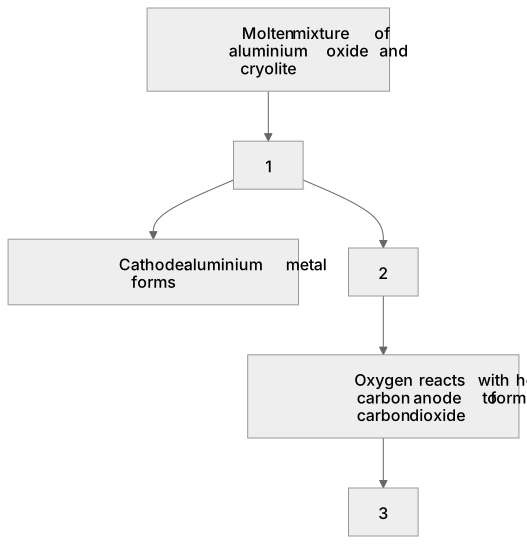
Some boxes have lost their names. Pick the right name for each number.
1Box 1
2Box 2
3Box 3
There is more to this lesson
The full lesson goes on to check your understanding and help you earn the marks. Create a free account to carry on, with your progress saved.
A week of Premium from your first lesson · Then the free plan continues · No card, no charge
Test your understanding of Using electrolysis to extract metals: Aluminium is manufactured by the electrolysis of a molten mixture of aluminium oxide and cryolite using carbon as the positive electrode (anode).
Active recall beats re-reading. Take an instant quiz now to test what you’ve learned and lock it into long-term memory.
A week of Premium from your first lesson · Then the free plan continues · No card, no charge