AQA · GCSE · Combined Science
Course version: 8464 · Version from Sept 2018
Using moles to balance equations (HT only): Students should be able to change the subject of a mathematical equation.
Changing the subject of an equation means rearranging it so a different variable stands alone on one side.
Study notes
From the checked teaching notes for this specification point.
The idea
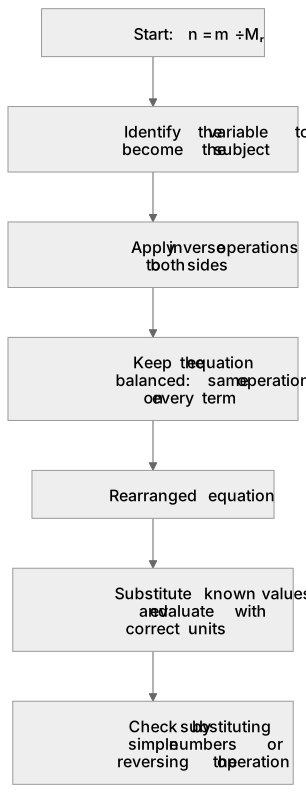
Changing the subject of an equation means rearranging it so a different variable stands alone on one side. In chemistry, this is essential when using the mole equation n = m ÷ Mᵣ. To make mass the subject, multiply both sides by Mᵣ: m = n × Mᵣ. To make relative formula mass the subject, divide both sides by n: Mᵣ = m ÷ n. The same inverse-operation method applies to any equation, such as concentration = amount ÷ volume, which rearranges to amount = concentration × volume. Always perform the same operation on both sides, keep the equation balanced, and check by substituting simple numbers. This skill supports quantitative chemistry calculations.
What earns the marks
- Identify the variable that must become the subject and the operations connecting it to the other variables.
- Apply inverse operations to both sides of the equation so that the required variable is isolated.
- Keep the equation balanced by performing the same operation on every term.
- Substitute known values into the rearranged equation and evaluate the result with correct units.
- Check the rearrangement by substituting simple numbers or by reversing the operation.
Common mistakes and how to put them right
Applying an operation to only one side of the equation.
Put it right: Perform the same operation on both sides to preserve equality.
Confusing multiplication and division when rearranging, for example writing m = n ÷ Mᵣ instead of m = n × Mᵣ.
Put it right: Use inverse operations and check with simple numbers.
Ignoring brackets when the subject appears in a term with more than one factor.
Put it right: Expand or factorise carefully before isolating the variable.
Exam tips
- Write the original equation clearly, then show each rearrangement step so that your method can be followed even if the final answer has an arithmetic slip.
- Substitute simple numbers into your rearranged equation to check it gives the same result as the original equation.
- Include units in your final answer and make sure the unit matches the variable you have made the subject.
Try the lesson
The start of the Using moles to balance equations (HT only): Students should be able to change the subject of a mathematical equation. lesson, made from checked teaching notes for this specification point.
Have a go first
The equation n = m ÷ M relates the number of moles n, the mass m and the molar mass M. Which rearrangement makes m the subject?
Listen
Changing the subject of an equation means rearranging it so a different variable stands alone on one side. In chemistry, this is essential when using the mole equation n = m ÷ Mᵣ. To make mass the subject, multiply both sides by Mᵣ: m = n × Mᵣ. To make relative formula mass the subject, divide both sides by n: Mᵣ = m ÷ n. The same inverse-operation method applies to any equation, such as concentration = amount ÷ volume, which rearranges to amount = concentration × volume. Always perform the same operation on both sides, keep the equation balanced, and check by substituting simple numbers. This skill supports quantitative chemistry calculations. A strong answer earns marks for these points. Identify the variable that must become the subject and the operations connecting it to the other variables. Apply inverse operations to both sides of the equation so that the required variable is isolated. Keep the equation balanced by performing the same operation on every term. Substitute known values into the rearranged equation and evaluate the result with correct units. A common slip: Applying an operation to only one side of the equation. Instead, perform the same operation on both sides to preserve equality. Exam tip: Write the original equation clearly, then show each rearrangement step so that your method can be followed even if the final answer has an arithmetic slip.
See it
Put it in order
Put these steps in the order they happen.
- 1. Identify the variable to become the subject
- 2. Apply inverse operations to both sides
- 3. Keep the equation balanced: same operation on every term
- 4. Rearranged equation
- 5. Substitute known values and evaluate with correct units
- 6. Check by substituting simple numbers or reversing the operation
- 7. Start: n = m ÷ Mᵣ
Label the diagram
Some boxes have lost their names. Pick the right name for each number.
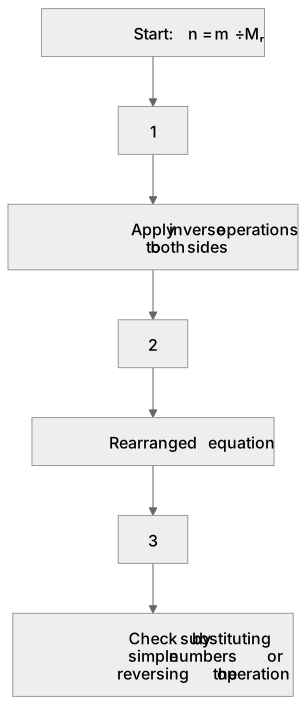
1Box 1
2Box 2
3Box 3
There is more to this lesson
The full lesson goes on to check your understanding and help you earn the marks. Create a free account to carry on, with your progress saved.
A week of Premium from your first lesson · Then the free plan continues · No card, no charge
Test your understanding of Using moles to balance equations (HT only): Students should be able to change the subject of a mathematical equation.
Active recall beats re-reading. Take an instant quiz now to test what you’ve learned and lock it into long-term memory.
A week of Premium from your first lesson · Then the free plan continues · No card, no charge