AQA · GCSE · Combined Science
Course version: 8464 · Version from Sept 2018
Using the Earth's resources and sustainable development: Finite resources from the Earth, oceans and atmosphere are processed to provide energy and materials.
Earth supplies a fixed stock of raw materials.
- 2 key terms
Study notes
From the checked teaching notes for this specification point.
The idea
Earth supplies a fixed stock of raw materials. Finite means the total amount cannot be replaced once used, so extraction rates matter. The crust yields metal ores such as haematite, as well as other resources like limestone and crude oil; the oceans supply water, sodium chloride and dissolved minerals; the atmosphere supplies nitrogen and oxygen. These natural resources are not useful directly in most cases, so they undergo processing. Crude oil is separated by fractional distillation and cracked to give fuels and feedstock for polymers. Iron ore is reduced in a blast furnace to make iron and then steel. Seawater is desalinated or electrolysed to give chlorine and sodium hydroxide. Each process needs energy, often from burning finite fossil fuels, and produces waste, so chemists must balance product yield against environmental cost.
What earns the marks
- State that finite resources cannot be replaced once they are used up, so their supply is limited.
- Identify examples from each sphere: metal ores and crude oil from the Earth, water and sodium chloride from the oceans, nitrogen and oxygen from the atmosphere.
- Explain that raw materials are processed, for example fractional distillation of crude oil or reduction of iron ore, before they provide useful energy or materials.
- Recognise that processing requires energy and can produce waste or emissions, so it has environmental and economic costs.
- Link the idea of finite supply to the need to conserve resources, recycle metals and develop renewable alternatives.
Common mistakes and how to put them right
Saying finite means 'will run out soon' rather than that the total quantity is limited and cannot be replenished.
Put it right by defining finite as a fixed stock that is used up permanently.
Treating air or seawater as infinite because they are abundant.
Put it right by noting that useful components such as helium or fresh water can still be limited or costly to obtain.
Assuming all resources are used directly.
Put it right by giving a processing step, such as cracking crude oil fractions to make alkenes for polymers.
Exam tips
- Name the sphere for each resource you quote, for example 'haematite from the Earth's crust', to show precise knowledge.
- When asked why a resource is finite, refer to the rate of formation being far slower than the rate of use.
- Use a named process and its product to show how a raw material becomes a useful energy source or material.
Try the lesson
The start of the Using the Earth's resources and sustainable development: Finite resources from the Earth, oceans and atmosphere are processed to provide energy and materials. lesson, made from checked teaching notes for this specification point.
Have a go first
Which of these resources is described as finite because it cannot be replaced once it has been used up?
Listen
Earth supplies a fixed stock of raw materials. Finite means the total amount cannot be replaced once used, so extraction rates matter. The crust yields metal ores such as haematite, as well as other resources like limestone and crude oil; the oceans supply water, sodium chloride and dissolved minerals; the atmosphere supplies nitrogen and oxygen. These natural resources are not useful directly in most cases, so they undergo processing. Crude oil is separated by fractional distillation and cracked to give fuels and feedstock for polymers. Iron ore is reduced in a blast furnace to make iron and then steel. Seawater is desalinated or electrolysed to give chlorine and sodium hydroxide. Each process needs energy, often from burning finite fossil fuels, and produces waste, so chemists must balance product yield against environmental cost. A strong answer earns marks for these points. State that finite resources cannot be replaced once they are used up, so their supply is limited. Identify examples from each sphere: metal ores and crude oil from the Earth, water and sodium chloride from the oceans, nitrogen and oxygen from the atmosphere. Explain that raw materials are processed, for example fractional distillation of crude oil or reduction of iron ore, before they provide useful energy or materials. Recognise that processing requires energy and can produce waste or emissions, so it has environmental and economic costs. A common slip: Saying finite means 'will run out soon' rather than that the total quantity is limited and cannot be replenished. Instead, defining finite as a fixed stock that is used up permanently. Exam tip: Name the sphere for each resource you quote, for example 'haematite from the Earth's crust', to show precise knowledge.
See it
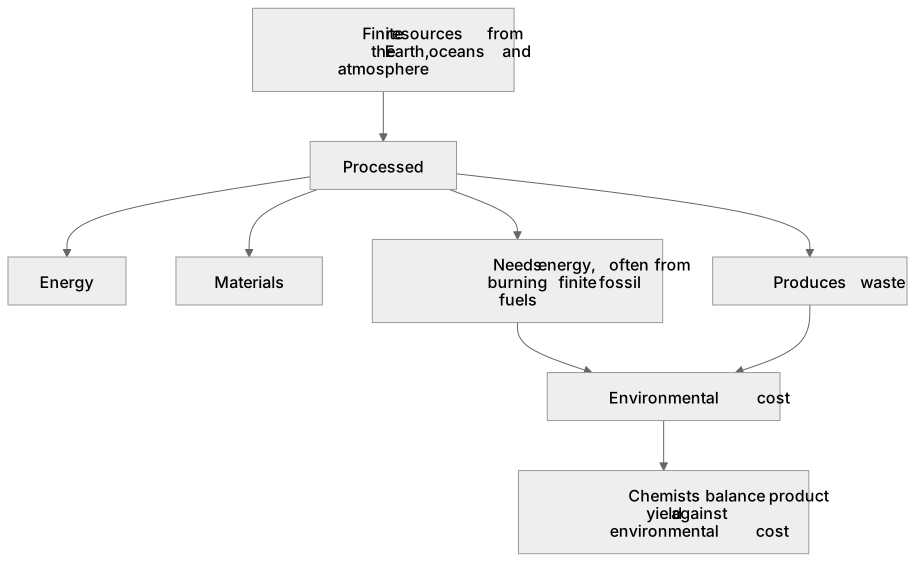
Key words
Say what each word means before you turn the card.
Finite resources
Try answering aloud or in your head before turning the card.
Processing
Try answering aloud or in your head before turning the card.
See every definition
- Finite resources
- Resources whose total amount cannot be replaced once used, so their supply is limited.
- Processing
- The treatment that natural resources undergo, because they are not useful directly in most cases, to provide energy and materials.
Label the diagram
Some boxes have lost their names. Pick the right name for each number.
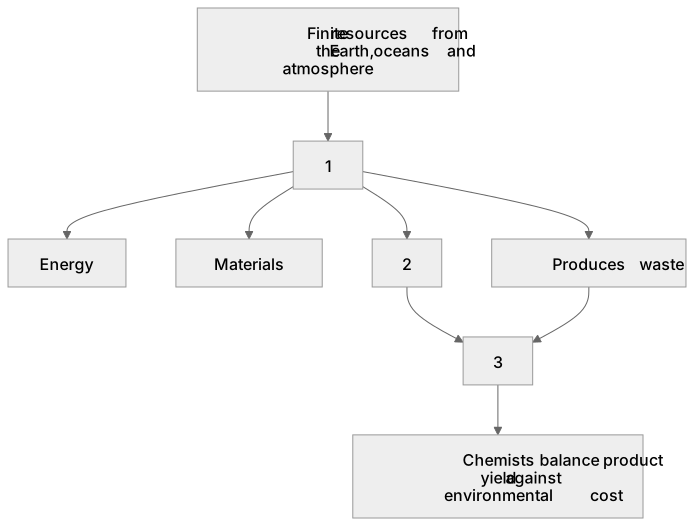
1Box 1
2Box 2
3Box 3
There is more to this lesson
The full lesson goes on to check your understanding and help you earn the marks. Create a free account to carry on, with your progress saved.
A week of Premium from your first lesson · Then the free plan continues · No card, no charge
Test your understanding of Using the Earth's resources and sustainable development: Finite resources from the Earth, oceans and atmosphere are processed to provide energy and materials.
Active recall beats re-reading. Take an instant quiz now to test what you’ve learned and lock it into long-term memory.
A week of Premium from your first lesson · Then the free plan continues · No card, no charge