AQA · GCSE · Combined Science
Course version: 8464 · Version from Sept 2018
Using the Earth's resources and sustainable development: Natural resources, supplemented by agriculture, provide food, timber, clothing and fuels.
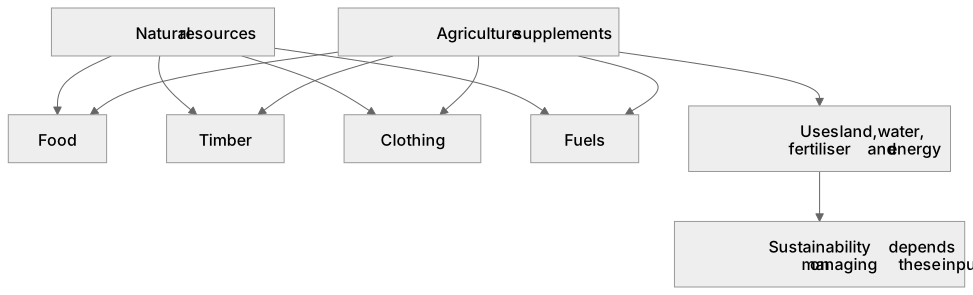
Natural resources come directly from the environment, while agriculture supplements them by farming plants and animals.
- 3 key terms
Study notes
From the checked teaching notes for this specification point.
The idea
Natural resources come directly from the environment, while agriculture supplements them by farming plants and animals. Food is obtained from wild fish, game and gathered plants, but mostly from farmed crops and livestock. Timber comes from managed forests, where trees are felled and replanted. Clothing uses natural fibres such as cotton, wool and silk, plus synthetic polymers made from crude oil. Fuels include wood, peat, coal, crude oil and natural gas, with biodiesel and bioethanol produced from crops. Agriculture therefore increases supply but also uses land, water, fertilisers and energy, so sustainability depends on managing these inputs carefully.
What earns the marks
- Define natural resources as materials obtained directly from the environment, such as wild plants, animals, timber, coal and crude oil.
- Explain that agriculture supplements natural supply by farming crops and livestock for food, fibres and biofuel crops.
- Identify timber as a natural resource from forests that can be managed sustainably by replanting felled trees.
- State that clothing uses natural fibres such as cotton, wool and silk, and synthetic fibres such as polyester made from crude oil.
- Describe fuels as including wood, coal, crude oil, natural gas, biodiesel and bioethanol, and classify each as renewable or non-renewable.
- Discuss how agriculture increases food and fuel supply but requires land, water, fertiliser and energy, affecting sustainability.
Common mistakes and how to put them right
Calling farmed crops natural resources without qualification.
Put it right by saying agriculture supplements natural resources rather than replacing them.
Believing all clothing fibres are natural.
Put it right by naming synthetic fibres such as polyester and nylon, which come from crude oil.
Classifying biodiesel as non-renewable.
Put it right by stating it is renewable because it is produced from crops that can be regrown.
Exam tips
- For each product named in the statement, give one natural source and one agricultural source where both exist.
- When comparing fibres or fuels, use a table of criteria such as renewability, land use and energy cost to structure your answer.
- Check that every fuel you name is correctly labelled renewable or non-renewable before finishing the answer.
Try the lesson
The start of the Using the Earth's resources and sustainable development: Natural resources, supplemented by agriculture, provide food, timber, clothing and fuels. lesson, made from checked teaching notes for this specification point.
Have a go first
Which of these materials is obtained directly from a natural resource rather than being produced by agriculture?
Listen
Natural resources come directly from the environment, while agriculture supplements them by farming plants and animals. Food is obtained from wild fish, game and gathered plants, but mostly from farmed crops and livestock. Timber comes from managed forests, where trees are felled and replanted. Clothing uses natural fibres such as cotton, wool and silk, plus synthetic polymers made from crude oil. Fuels include wood, peat, coal, crude oil and natural gas, with biodiesel and bioethanol produced from crops. Agriculture therefore increases supply but also uses land, water, fertilisers and energy, so sustainability depends on managing these inputs carefully. A strong answer earns marks for these points. Define natural resources as materials obtained directly from the environment, such as wild plants, animals, timber, coal and crude oil. Explain that agriculture supplements natural supply by farming crops and livestock for food, fibres and biofuel crops. Identify timber as a natural resource from forests that can be managed sustainably by replanting felled trees. State that clothing uses natural fibres such as cotton, wool and silk, and synthetic fibres such as polyester made from crude oil. A common slip: Calling farmed crops natural resources without qualification. Instead, saying agriculture supplements natural resources rather than replacing them. Exam tip: For each product named in the statement, give one natural source and one agricultural source where both exist.
See it
Key words
Say what each word means before you turn the card.
Natural resources
Try answering aloud or in your head before turning the card.
Agriculture
Try answering aloud or in your head before turning the card.
Renewable fuels
Try answering aloud or in your head before turning the card.
See every definition
- Natural resources
- Materials obtained directly from the environment, such as wild plants, animals, timber, coal and crude oil.
- Agriculture
- Farming crops and livestock, which supplements natural supply for food, fibres and biofuel crops.
- Renewable fuels
- Fuels such as biodiesel and bioethanol produced from crops that can be regrown.
Label the diagram
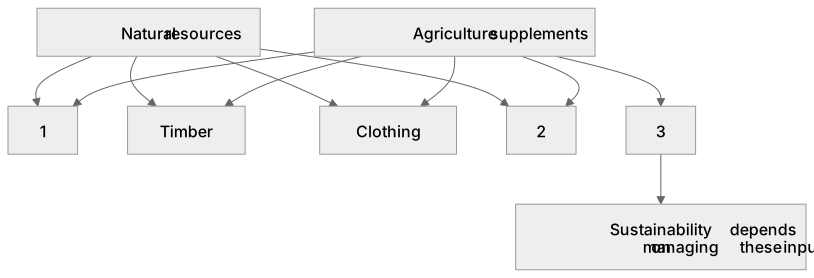
Some boxes have lost their names. Pick the right name for each number.
1Box 1
2Box 2
3Box 3
There is more to this lesson
The full lesson goes on to check your understanding and help you earn the marks. Create a free account to carry on, with your progress saved.
A week of Premium from your first lesson · Then the free plan continues · No card, no charge
Test your understanding of Using the Earth's resources and sustainable development: Natural resources, supplemented by agriculture, provide food, timber, clothing and fuels.
Active recall beats re-reading. Take an instant quiz now to test what you’ve learned and lock it into long-term memory.
A week of Premium from your first lesson · Then the free plan continues · No card, no charge