AQA · GCSE · Combined Science
Course version: 8464 · Version from Sept 2018
Using the Earth's resources and sustainable development: use orders of magnitude to evaluate the significance of data. MS 2h
Orders of magnitude compare quantities by powers of ten, so a value ten times another differs by one order of magnitude.
- 3 key terms
Study notes
From the checked teaching notes for this specification point.
The idea
Orders of magnitude compare quantities by powers of ten, so a value ten times another differs by one order of magnitude. To use them, write both values in standard form, divide the larger by the smaller, then round the result to the nearest power of ten. For example, if one process uses 2.0 × 10⁶ dm³ of water and another uses 4.0 × 10⁴ dm³, the ratio is 50, so the first is about 10² times greater, roughly two orders of magnitude. This helps evaluate significance: a difference of one order of magnitude or more usually matters when judging resource use or sustainability, whereas a small difference may not. Always state the comparison being made and link the size of the difference to the context, such as water demand or waste produced.
What earns the marks
- Convert each data value into standard form before comparing, for example 4.0 × 10⁴ dm³ rather than 40 000 dm³.
- Divide the larger value by the smaller value to find the ratio, then round that ratio to the nearest power of ten.
- State the comparison as a multiple or as a number of orders of magnitude, for example 'about 10² times greater' or 'roughly two orders of magnitude larger'.
- Link the size of the difference to the resource or sustainability context, explaining whether the difference is significant for the decision being made.
- Use the calculated order of magnitude to support a conclusion, such as identifying which process uses a much greater share of a limited resource.
Common mistakes and how to put them right
Subtracting the exponents instead of dividing the values.
Put it right: Divide the actual values, then express the ratio as a power of ten.
Treating any numerical difference as significant.
Put it right: Compare the ratio with powers of ten and judge whether the difference is large enough to matter in context.
Leaving values in ordinary form and misplacing zeros.
Put it right: Convert to standard form first so the exponent shows the order of magnitude clearly.
Exam tips
- Show the division you perform, not just the final order of magnitude, so your reasoning is visible.
- Use the phrase 'orders of magnitude' correctly, linking it to powers of ten rather than to a simple subtraction.
- Finish with a contextual judgement, for example whether the difference is large enough to affect sustainable use of the resource.
Try the lesson
The start of the Using the Earth's resources and sustainable development: use orders of magnitude to evaluate the significance of data. MS 2h lesson, made from checked teaching notes for this specification point.
Have a go first
A factory releases 4 × 10² tonnes of carbon dioxide into the atmosphere each year. A second factory releases 4 × 10³ tonnes each year. Roughly how many times greater is the mass released by the second factory than by the first?
Listen
Orders of magnitude compare quantities by powers of ten, so a value ten times another differs by one order of magnitude. To use them, write both values in standard form, divide the larger by the smaller, then round the result to the nearest power of ten. For example, if one process uses 2.0 × 10⁶ dm³ of water and another uses 4.0 × 10⁴ dm³, the ratio is 50, so the first is about 10² times greater, roughly two orders of magnitude. This helps evaluate significance: a difference of one order of magnitude or more usually matters when judging resource use or sustainability, whereas a small difference may not. Always state the comparison being made and link the size of the difference to the context, such as water demand or waste produced. A strong answer earns marks for these points. Convert each data value into standard form before comparing, for example 4.0 × 10⁴ dm³ rather than 40 000 dm³. Divide the larger value by the smaller value to find the ratio, then round that ratio to the nearest power of ten. State the comparison as a multiple or as a number of orders of magnitude, for example 'about 10² times greater' or 'roughly two orders of magnitude larger'. Link the size of the difference to the resource or sustainability context, explaining whether the difference is significant for the decision being made. A common slip: Subtracting the exponents instead of dividing the values. Instead, divide the actual values, then express the ratio as a power of ten. Exam tip: Show the division you perform, not just the final order of magnitude, so your reasoning is visible.
See it
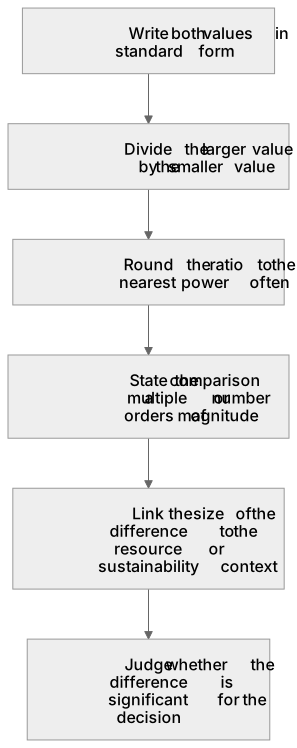
Put it in order
Put these steps in the order they happen.
- 1. Divide the larger value by the smaller value
- 2. Round the ratio to the nearest power of ten
- 3. State the comparison as a multiple or number of orders of magnitude
- 4. Link the size of the difference to the resource or sustainability context
- 5. Judge whether the difference is significant for the decision
- 6. Write both values in standard form
Key words
Say what each word means before you turn the card.
Orders of magnitude
Try answering aloud or in your head before turning the card.
Standard form
Try answering aloud or in your head before turning the card.
Evaluating significance
Try answering aloud or in your head before turning the card.
See every definition
- Orders of magnitude
- A way of comparing quantities by powers of ten, so a value ten times another differs by one order of magnitude.
- Standard form
- A way of writing each data value so that the exponent shows the order of magnitude clearly.
- Evaluating significance
- Judging whether a difference of one order of magnitude or more matters when considering resource use or sustainability, whereas a small difference may not.
Label the diagram
Some boxes have lost their names. Pick the right name for each number.
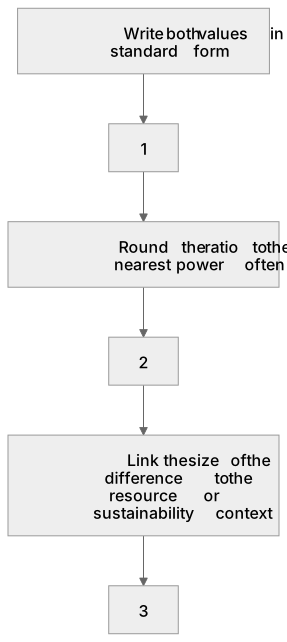
1Box 1
2Box 2
3Box 3
There is more to this lesson
The full lesson goes on to check your understanding and help you earn the marks. Create a free account to carry on, with your progress saved.
A week of Premium from your first lesson · Then the free plan continues · No card, no charge
Test your understanding of Using the Earth's resources and sustainable development: use orders of magnitude to evaluate the significance of data. MS 2h
Active recall beats re-reading. Take an instant quiz now to test what you’ve learned and lock it into long-term memory.
A week of Premium from your first lesson · Then the free plan continues · No card, no charge