AQA · GCSE · Combined Science
Course version: 8464 · Version from Sept 2018
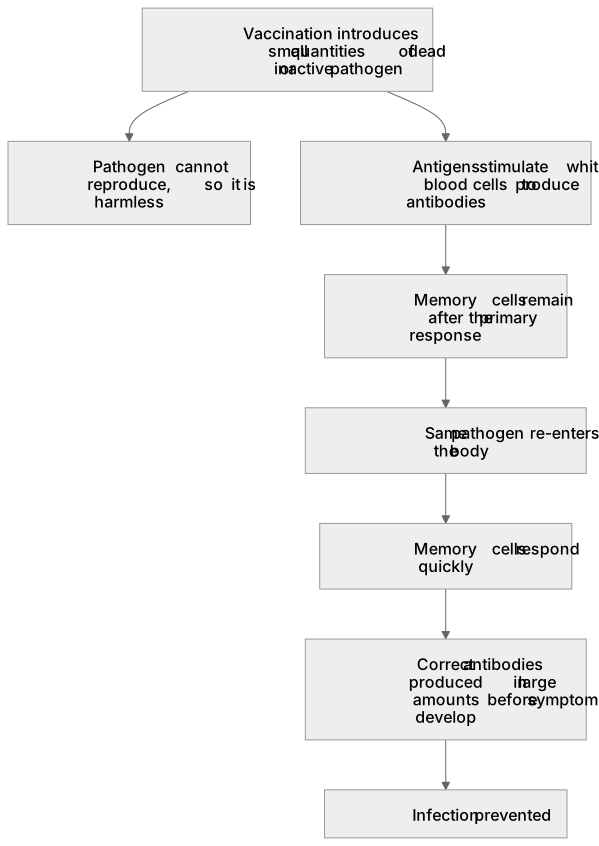
Vaccination: Vaccination involves introducing small quantities of dead or inactive forms of a pathogen into the body to stimulate the white blood cells to produce antibodies. If the same pathogen re-enters the body the white blood cells respond quickly to produce the correct antibodies, preventing infection.
Vaccination introduces small quantities of dead or inactive pathogen into the body.
- 4 key terms
Study notes
From the checked teaching notes for this specification point.
The idea
Vaccination introduces small quantities of dead or inactive pathogen into the body. These antigens are harmless because the pathogen cannot reproduce, yet white blood cells still recognise them as foreign. Lymphocytes produce specific antibodies that bind to the antigens, and memory cells remain after the primary response. If the same live pathogen later re-enters the body, these memory cells respond quickly, so the correct antibodies are produced in large amounts before symptoms develop, preventing infection. For example, the MMR vaccine contains weakened measles, mumps and rubella pathogens; later exposure to live measles virus triggers a rapid secondary response. This explains both the initial stimulation and the faster protective response.
What earns the marks
- Vaccination introduces small quantities of dead or inactive forms of a pathogen into the body.
- The antigens on these dead or inactive pathogens stimulate white blood cells to produce antibodies.
- Because the pathogen is dead or inactive, it cannot reproduce and cause disease during vaccination.
- Memory cells produced after vaccination allow a rapid secondary antibody response on re-exposure.
- The antibodies produced are specific to the pathogen's antigens, so they bind and prevent infection.
- Preventing infection occurs because the correct antibodies are produced quickly before the pathogen can multiply and cause symptoms.
Common mistakes and how to put them right
Stating that vaccination injects live pathogenic organisms that cause the disease.
Put it right: The pathogen is dead or inactive, so it cannot reproduce and cause illness.
Saying white blood cells 'remember' the pathogen without mentioning antibodies or memory cells.
Put it right: Describe specific antibody production and memory cells that enable a faster secondary response.
Claiming antibodies directly kill all pathogens.
Put it right: Antibodies bind to antigens and help destroy pathogens, often by agglutination or marking them for phagocytosis.
Exam tips
- Use the phrase 'dead or inactive pathogen' rather than 'weak germ' to match scientific terminology.
- When explaining the second exposure, explicitly compare the speed and amount of antibody production with the first response.
- Link specificity to the pathogen's antigens, for example 'antibodies complementary to the measles antigen'.
Try the lesson
The start of the Vaccination: Vaccination involves introducing small quantities of dead or inactive forms of a pathogen into the body to stimulate the white blood cells to produce antibodies. If the same pathogen re-enters the body the white blood cells respond quickly to produce the correct antibodies, preventing infection. lesson, made from checked teaching notes for this specification point.
Have a go first
What is introduced into the body during a vaccination?
Listen
Vaccination introduces small quantities of dead or inactive pathogen into the body. These antigens are harmless because the pathogen cannot reproduce, yet white blood cells still recognise them as foreign. Lymphocytes produce specific antibodies that bind to the antigens, and memory cells remain after the primary response. If the same live pathogen later re-enters the body, these memory cells respond quickly, so the correct antibodies are produced in large amounts before symptoms develop, preventing infection. For example, the MMR vaccine contains weakened measles, mumps and rubella pathogens; later exposure to live measles virus triggers a rapid secondary response. This explains both the initial stimulation and the faster protective response. A strong answer earns marks for these points. Vaccination introduces small quantities of dead or inactive forms of a pathogen into the body. The antigens on these dead or inactive pathogens stimulate white blood cells to produce antibodies. Because the pathogen is dead or inactive, it cannot reproduce and cause disease during vaccination. Memory cells produced after vaccination allow a rapid secondary antibody response on re-exposure. A common slip: stating that vaccination injects live pathogenic organisms that cause the disease. Instead, the pathogen is dead or inactive, so it cannot reproduce and cause illness. Exam tip: Use the phrase 'dead or inactive pathogen' rather than 'weak germ' to match scientific terminology.
See it
Key words
Say what each word means before you turn the card.
Vaccination
Try answering aloud or in your head before turning the card.
Memory cells
Try answering aloud or in your head before turning the card.
Secondary response
Try answering aloud or in your head before turning the card.
Antibody specificity
Try answering aloud or in your head before turning the card.
See every definition
- Vaccination
- Introducing small quantities of dead or inactive forms of a pathogen into the body to stimulate the white blood cells to produce antibodies.
- Memory cells
- Cells that remain after the primary response and respond quickly if the same live pathogen later re-enters the body.
- Secondary response
- A rapid response on re-exposure in which the correct antibodies are produced in large amounts before symptoms develop, preventing infection.
- Antibody specificity
- Antibodies produced are specific to the pathogen's antigens, so they bind and prevent infection.
Label the diagram
Some boxes have lost their names. Pick the right name for each number.
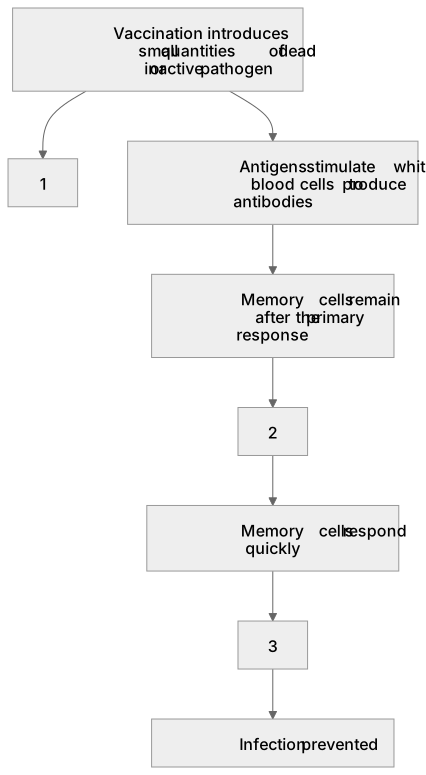
1Box 1
2Box 2
3Box 3
There is more to this lesson
The full lesson goes on to check your understanding and help you earn the marks. Create a free account to carry on, with your progress saved.
A week of Premium from your first lesson · Then the free plan continues · No card, no charge
Test your understanding of Vaccination: Vaccination involves introducing small quantities of dead or inactive forms of a pathogen into the body to stimulate the white blood cells to produce antibodies. If the same pathogen re-enters the body the white blood cells respond quickly to produce the correct antibodies, preventing infection.
Active recall beats re-reading. Take an instant quiz now to test what you’ve learned and lock it into long-term memory.
A week of Premium from your first lesson · Then the free plan continues · No card, no charge