AQA · GCSE · Combined Science
Course version: 8464 · Version from Sept 2018
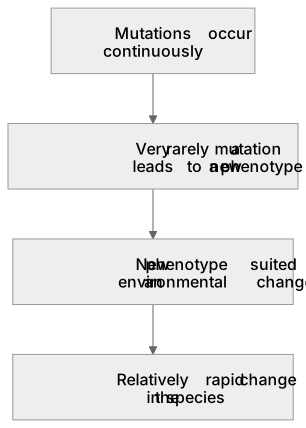
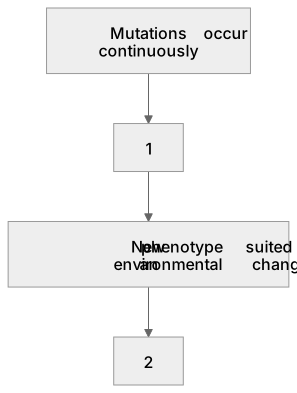
Variation: Mutations occur continuously. Very rarely a mutation will lead to a new phenotype. If the new phenotype is suited to an environmental change it can lead to a relatively rapid change in the species.
Mutations are random changes in the base sequence of DNA and they happen continuously, for example when DNA is copied before cell division or when radiation or chemicals damage DNA.
- 4 key terms
Study notes
From the checked teaching notes for this specification point.
The idea
Mutations are random changes in the base sequence of DNA and they happen continuously, for example when DNA is copied before cell division or when radiation or chemicals damage DNA. Most mutations have no effect on the phenotype, some affect it, and very rarely a mutation produces a new phenotype. Usually a new phenotype is neutral or harmful, but if the environment changes, the new phenotype may give an advantage. Individuals with that phenotype are more likely to survive and reproduce, so the allele becomes more common in the population. Over many generations this natural selection can change the species relatively rapidly, especially when the environmental change is strong, such as a new predator or a change in climate.
What earns the marks
- Mutations are random changes in DNA that occur continuously, including during DNA replication and after exposure to mutagenic agents such as ultraviolet radiation.
- Most mutations do not change the phenotype because the genetic code is degenerate or the change occurs in non-coding DNA; only very rarely does a mutation produce a new phenotype.
- A new phenotype may be advantageous, neutral or harmful; whether it is advantageous depends on the environment.
- If the new phenotype is suited to an environmental change, individuals with it are more likely to survive, reproduce and pass on the allele, so its frequency in the population increases.
- Explanations should link mutation, phenotype, selection pressure, survival, reproduction and change in allele frequency over generations.
Common mistakes and how to put them right
Thinking that mutations are always harmful.
Put it right by stating that most mutations have no effect and a rare few may be beneficial in a particular environment.
Believing that organisms mutate because they need to adapt.
Put it right by stressing that mutations occur randomly and continuously, and selection acts on the variation already present.
Saying that an individual evolves during its lifetime.
Put it right by explaining that evolution is a change in the inherited characteristics of a population over generations, not a change in one organism.
Exam tips
- Use the phrase 'random change in DNA' when defining mutation, then link it to a possible new phenotype.
- When explaining rapid change, refer to a changed environment, a selection pressure, survival and reproduction of individuals with the advantageous phenotype, and an increase in allele frequency.
- Avoid saying that the organism 'chooses' to mutate or 'tries' to adapt; describe mutation as random and selection as non-random.
Try the lesson
The start of the Variation: Mutations occur continuously. Very rarely a mutation will lead to a new phenotype. If the new phenotype is suited to an environmental change it can lead to a relatively rapid change in the species. lesson, made from checked teaching notes for this specification point.
Have a go first
Which statement describes when mutations happen in an organism?
Listen
Mutations are random changes in the base sequence of DNA and they happen continuously, for example when DNA is copied before cell division or when radiation or chemicals damage DNA. Most mutations have no effect on the phenotype, some affect it, and very rarely a mutation produces a new phenotype. Usually a new phenotype is neutral or harmful, but if the environment changes, the new phenotype may give an advantage. Individuals with that phenotype are more likely to survive and reproduce, so the allele becomes more common in the population. Over many generations this natural selection can change the species relatively rapidly, especially when the environmental change is strong, such as a new predator or a change in climate. A strong answer earns marks for these points. Mutations are random changes in DNA that occur continuously, including during DNA replication and after exposure to mutagenic agents such as ultraviolet radiation. Most mutations do not change the phenotype because the genetic code is degenerate or the change occurs in non-coding DNA; only very rarely does a mutation produce a new phenotype. A new phenotype may be advantageous, neutral or harmful; whether it is advantageous depends on the environment. If the new phenotype is suited to an environmental change, individuals with it are more likely to survive, reproduce and pass on the allele, so its frequency in the population increases. A common slip: Thinking that mutations are always harmful. Instead, stating that most mutations have no effect and a rare few may be beneficial in a particular environment. Exam tip: Use the phrase 'random change in DNA' when defining mutation, then link it to a possible new phenotype.
See it
Put it in order
Put these steps in the order they happen.
- 1. Very rarely a mutation leads to a new phenotype
- 2. New phenotype suited to an environmental change
- 3. Relatively rapid change in the species
- 4. Mutations occur continuously
Key words
Say what each word means before you turn the card.
DNA and mutation
Try answering aloud or in your head before turning the card.
Phenotype and variation
Try answering aloud or in your head before turning the card.
Natural selection
Try answering aloud or in your head before turning the card.
Environmental change and allele frequency
Try answering aloud or in your head before turning the card.
See every definition
- DNA and mutation
- Random changes in the base sequence of DNA that occur continuously, for example when DNA is copied before cell division or when radiation or chemicals damage DNA.
- Phenotype and variation
- Most mutations have no effect on the phenotype, some affect it, and very rarely a mutation produces a new phenotype.
- Natural selection
- Individuals with a phenotype that gives an advantage are more likely to survive and reproduce, so the allele becomes more common in the population over many generations.
- Environmental change and allele frequency
- If the new phenotype is suited to an environmental change, the allele becomes more common in the population, and this can change the species relatively rapidly.
Label the diagram
Some boxes have lost their names. Pick the right name for each number.
1Box 1
2Box 2
There is more to this lesson
The full lesson goes on to check your understanding and help you earn the marks. Create a free account to carry on, with your progress saved.
A week of Premium from your first lesson · Then the free plan continues · No card, no charge
Test your understanding of Variation: Mutations occur continuously. Very rarely a mutation will lead to a new phenotype. If the new phenotype is suited to an environmental change it can lead to a relatively rapid change in the species.
Active recall beats re-reading. Take an instant quiz now to test what you’ve learned and lock it into long-term memory.
A week of Premium from your first lesson · Then the free plan continues · No card, no charge