AQA · GCSE · Combined Science
Course version: 8464 · Version from Sept 2018
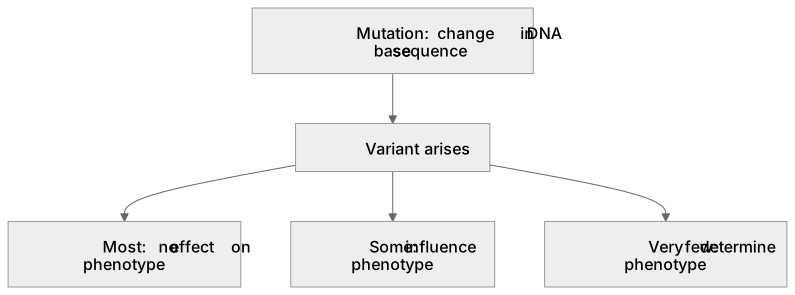
Variation: recall that all variants arise from mutations and that: most have no effect on the phenotype; some influence phenotype; very few determine phenotype.
A mutation is a change in the base sequence of DNA.
- 4 key terms
Study notes
From the checked teaching notes for this specification point.
The idea
A mutation is a change in the base sequence of DNA. New alleles, called variants, appear only when mutation alters a gene, so every variant has a mutational origin. Most mutations are neutral because they occur in non-coding DNA or do not change the amino acid sequence, so the phenotype is unaffected. Some mutations alter the protein produced, perhaps changing an enzyme's shape or a structural protein, and so influence the phenotype; the effect may be slight or depend on the environment. Very few mutations determine the phenotype on their own, for example a mutation that causes a genetic disorder or a decisive change such as antibiotic resistance. This explains why most mutations are not harmful and why variation accumulates gradually in populations.
What earns the marks
- Defines mutation as a change in the DNA base sequence that can produce a new allele or variant.
- States that all variants ultimately arise from mutations, not from use or need.
- Explains that most mutations have no effect on the phenotype because they are in non-coding DNA or do not change the protein.
- Explains that some mutations influence the phenotype by altering the protein or how it works.
- States that very few mutations determine the phenotype, meaning the mutation alone decides the characteristic.
- Uses a suitable example, such as a mutation giving antibiotic resistance or causing a genetic disorder.
Common mistakes and how to put them right
Saying organisms mutate because they need to adapt.
Put it right: Mutations occur at random, and selection then acts on the variants produced.
Claiming most mutations are harmful.
Put it right: Most have no effect on the phenotype, some influence it, and very few determine it.
Treating influence and determine as identical.
Put it right: Influence means the mutation contributes to the phenotype, while determine means it alone decides the phenotype.
Exam tips
- Learn the three-part pattern: most have no effect, some influence, very few determine. Use those exact contrasts in your answer.
- When explaining a mutation's effect, refer to the protein made and whether its shape or function changes.
- Use one clear example, such as a mutation in a gene for a cell-surface receptor, to show how a variant can determine a phenotype.
Try the lesson
The start of the Variation: recall that all variants arise from mutations and that: most have no effect on the phenotype; some influence phenotype; very few determine phenotype. lesson, made from checked teaching notes for this specification point.
Have a go first
What is the original source of all genetic variants within a population?
Listen
A mutation is a change in the base sequence of DNA. New alleles, called variants, appear only when mutation alters a gene, so every variant has a mutational origin. Most mutations are neutral because they occur in non-coding DNA or do not change the amino acid sequence, so the phenotype is unaffected. Some mutations alter the protein produced, perhaps changing an enzyme's shape or a structural protein, and so influence the phenotype; the effect may be slight or depend on the environment. Very few mutations determine the phenotype on their own, for example a mutation that causes a genetic disorder or a decisive change such as antibiotic resistance. This explains why most mutations are not harmful and why variation accumulates gradually in populations. A strong answer earns marks for these points. Defines mutation as a change in the DNA base sequence that can produce a new allele or variant. States that all variants ultimately arise from mutations, not from use or need. Explains that most mutations have no effect on the phenotype because they are in non-coding DNA or do not change the protein. Explains that some mutations influence the phenotype by altering the protein or how it works. A common slip: Saying organisms mutate because they need to adapt. Instead, mutations occur at random, and selection then acts on the variants produced. Exam tip: Learn the three-part pattern: most have no effect, some influence, very few determine. Use those exact contrasts in your answer.
See it
Key words
Say what each word means before you turn the card.
Mutation
Try answering aloud or in your head before turning the card.
Variant
Try answering aloud or in your head before turning the card.
Influence phenotype
Try answering aloud or in your head before turning the card.
Determine phenotype
Try answering aloud or in your head before turning the card.
See every definition
- Mutation
- A change in the base sequence of DNA that can produce a new allele or variant.
- Variant
- A new allele that appears only when mutation alters a gene, so every variant has a mutational origin.
- Influence phenotype
- The mutation contributes to the phenotype by altering the protein produced, and the effect may be slight or depend on the environment.
- Determine phenotype
- The mutation alone decides the characteristic, as in a genetic disorder or a decisive change such as antibiotic resistance.
Label the diagram
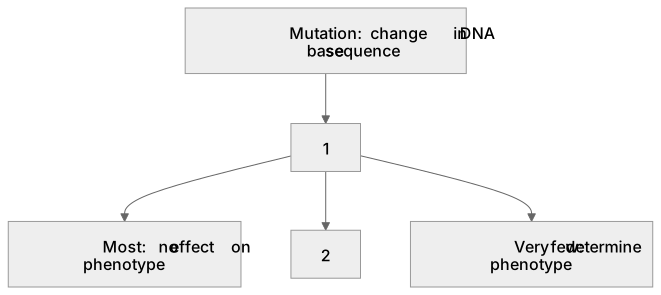
Some boxes have lost their names. Pick the right name for each number.
1Box 1
2Box 2
There is more to this lesson
The full lesson goes on to check your understanding and help you earn the marks. Create a free account to carry on, with your progress saved.
A week of Premium from your first lesson · Then the free plan continues · No card, no charge
Test your understanding of Variation: recall that all variants arise from mutations and that: most have no effect on the phenotype; some influence phenotype; very few determine phenotype.
Active recall beats re-reading. Take an instant quiz now to test what you’ve learned and lock it into long-term memory.
A week of Premium from your first lesson · Then the free plan continues · No card, no charge