AQA · GCSE · Combined Science
Course version: 8464 · Version from Sept 2018
Variation: state that there is usually extensive genetic variation within a population of a species
A population is the group of individuals of one species living in a particular area.
- 2 key terms
Study notes
From the checked teaching notes for this specification point.
The idea
A population is the group of individuals of one species living in a particular area. Within that group, individuals differ in many inherited features because they carry different combinations of alleles. This is genetic variation. For example, in a population of banded snails, shell colour and banding pattern vary because different alleles for shell-pattern genes are present. Variation arises through mutation and is reshuffled by sexual reproduction, so populations usually contain a wide range of genotypes and phenotypes rather than being uniform. The word extensive signals that the variation is normally large, not slight or occasional. Recognising this matters because natural selection acts on the variation already present: if a population lacks variation, it cannot adapt so easily when the environment changes.
What earns the marks
- Defines a population as the individuals of one species living together in the same area at the same time.
- States that members of a population usually differ genetically from one another.
- Uses the term genetic variation to describe differences in alleles or genotypes within the population.
- Explains that the variation is extensive, meaning many individuals differ and differences are common.
- Links genetic variation to differences in phenotype, such as shell colour or banding pattern in snails.
- Recognises that sexual reproduction and mutation are sources that maintain variation in a population.
Common mistakes and how to put them right
Confusing a population with a species.
Put it right: Define population as one species in one area.
Assuming all members of a population are genetically identical apart from a few mutants.
Put it right: State that extensive variation is usual because many alleles and allele combinations exist.
Treating variation as only environmental, such as a plant growing taller because of more light.
Put it right: Genetic variation means inherited differences in alleles, although phenotype can also be affected by environment.
Exam tips
- Use the exact phrase genetic variation within a population when answering, rather than writing that animals are simply different.
- Give a named example, such as banded snails or human blood groups, to show the variation is inherited and not just due to age or diet.
- If asked why variation matters, link it to natural selection: a population with extensive variation is more likely to contain individuals suited to a changed environment.
Try the lesson
The start of the Variation: state that there is usually extensive genetic variation within a population of a species lesson, made from checked teaching notes for this specification point.
Have a go first
Which statement best describes the amount of genetic variation typically found within a population of a species?
Listen
A population is the group of individuals of one species living in a particular area. Within that group, individuals differ in many inherited features because they carry different combinations of alleles. This is genetic variation. For example, in a population of banded snails, shell colour and banding pattern vary because different alleles for shell-pattern genes are present. Variation arises through mutation and is reshuffled by sexual reproduction, so populations usually contain a wide range of genotypes and phenotypes rather than being uniform. The word extensive signals that the variation is normally large, not slight or occasional. Recognising this matters because natural selection acts on the variation already present: if a population lacks variation, it cannot adapt so easily when the environment changes. A strong answer earns marks for these points. Defines a population as the individuals of one species living together in the same area at the same time. States that members of a population usually differ genetically from one another. Uses the term genetic variation to describe differences in alleles or genotypes within the population. Explains that the variation is extensive, meaning many individuals differ and differences are common. A common slip: Confusing a population with a species: a species may contain many separate populations, so the statement applies to one local group, not the whole species. Instead, define population as one species in one area. Exam tip: Use the exact phrase genetic variation within a population when answering, rather than writing that animals are simply different.
See it
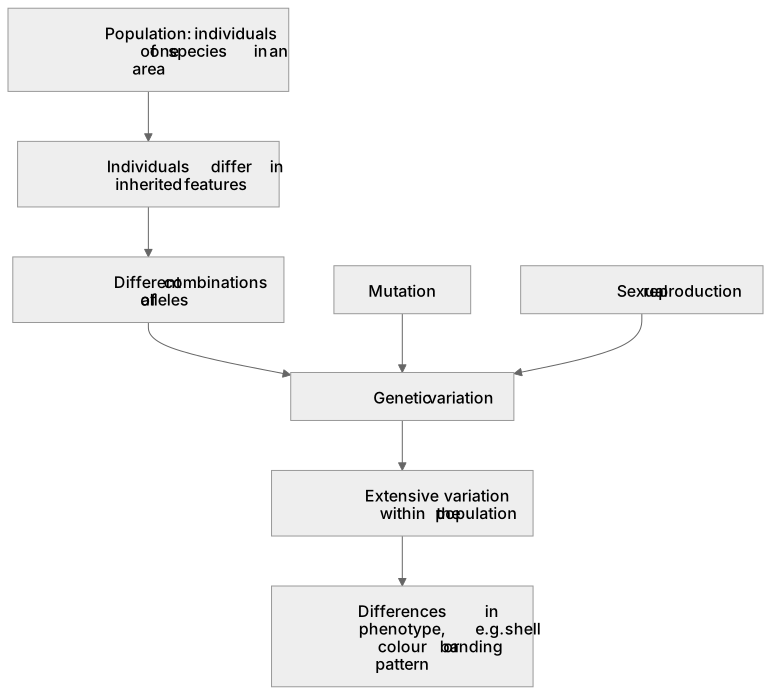
Key words
Say what each word means before you turn the card.
Genetic variation
Try answering aloud or in your head before turning the card.
Population
Try answering aloud or in your head before turning the card.
See every definition
- Genetic variation
- Differences in inherited features among individuals because they carry different combinations of alleles.
- Population
- The group of individuals of one species living in a particular area.
Label the diagram
Some boxes have lost their names. Pick the right name for each number.
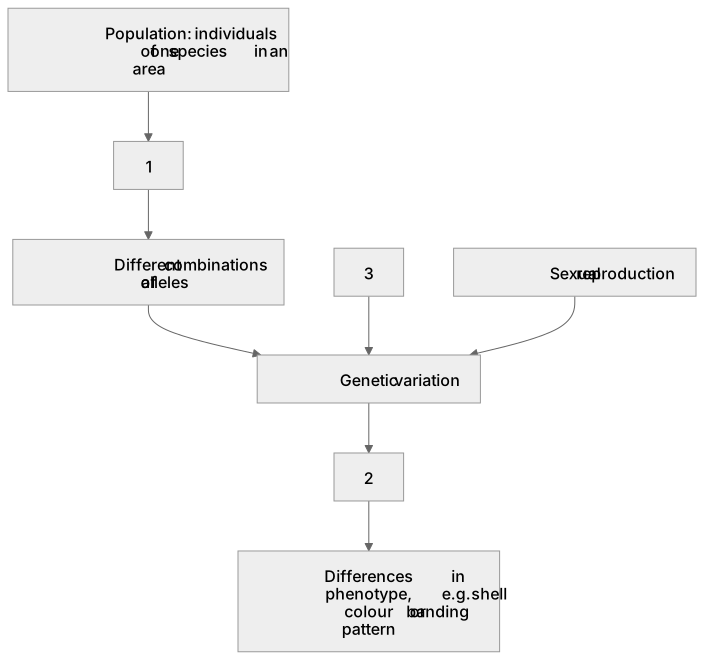
1Box 1
2Box 2
3Box 3
There is more to this lesson
The full lesson goes on to check your understanding and help you earn the marks. Create a free account to carry on, with your progress saved.
A week of Premium from your first lesson · Then the free plan continues · No card, no charge
Test your understanding of Variation: state that there is usually extensive genetic variation within a population of a species
Active recall beats re-reading. Take an instant quiz now to test what you’ve learned and lock it into long-term memory.
A week of Premium from your first lesson · Then the free plan continues · No card, no charge