AQA · GCSE · Combined Science
Course version: 8464 · Version from Sept 2018
Variation: the genes they have inherited (genetic causes)
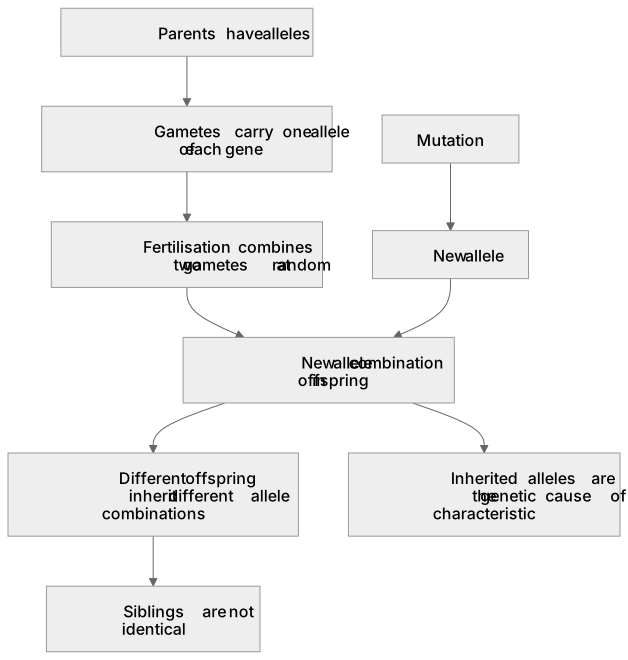
Genetic variation arises because offspring inherit different combinations of alleles from their parents.
- 4 key terms
Study notes
From the checked teaching notes for this specification point.
The idea
Genetic variation arises because offspring inherit different combinations of alleles from their parents. Each gamete carries one allele of each gene, and fertilisation combines two gametes at random, so siblings differ even though they share parents. Some characteristics, such as blood group or natural eye colour, are determined mainly by genes. Others, such as height, are affected by many genes and by the environment. A mutation can create a new allele, adding further genetic variation. For example, a child may inherit an allele for brown eyes from one parent and an allele for blue eyes from the other, giving brown eyes because brown is dominant. The inherited alleles are the genetic cause of that characteristic.
What earns the marks
- Genetic variation is caused by the alleles inherited from both parents.
- Gametes contain one allele of each gene, so fertilisation produces a new allele combination.
- Different offspring inherit different allele combinations, which is why siblings are not identical.
- Some characteristics are determined mainly by genes, for example blood group or natural eye colour.
- A mutation can produce a new allele and so increase genetic variation.
- The genetic cause of a characteristic is the set of alleles an organism has inherited.
Common mistakes and how to put them right
Writing that genes are learned or acquired during life.
Put it right: Genes are inherited from parents and are present from fertilisation.
Confusing genes with chromosomes.
Put it right: A gene is a short section of DNA that codes for a characteristic, while a chromosome is a structure that carries many genes.
Stating that all genetic characteristics are controlled by a single gene.
Put it right: Many, such as height, are controlled by several genes and are also affected by the environment.
Exam tips
- Use the terms allele, gamete and fertilisation when explaining how genetic variation arises.
- Link each inherited allele to the characteristic it affects, for example an allele for brown eyes.
- If a question asks for a genetic cause, name the inherited alleles rather than describing the environment.
Try the lesson
The start of the Variation: the genes they have inherited (genetic causes) lesson, made from checked teaching notes for this specification point.
Have a go first
Which cause of variation in a person is described as genetic?
Listen
Genetic variation arises because offspring inherit different combinations of alleles from their parents. Each gamete carries one allele of each gene, and fertilisation combines two gametes at random, so siblings differ even though they share parents. Some characteristics, such as blood group or natural eye colour, are determined mainly by genes. Others, such as height, are affected by many genes and by the environment. A mutation can create a new allele, adding further genetic variation. For example, a child may inherit an allele for brown eyes from one parent and an allele for blue eyes from the other, giving brown eyes because brown is dominant. The inherited alleles are the genetic cause of that characteristic. A strong answer earns marks for these points. Genetic variation is caused by the alleles inherited from both parents. Gametes contain one allele of each gene, so fertilisation produces a new allele combination. Different offspring inherit different allele combinations, which is why siblings are not identical. Some characteristics are determined mainly by genes, for example blood group or natural eye colour. Exam tip: Use the terms allele, gamete and fertilisation when explaining how genetic variation arises.
See it
Key words
Say what each word means before you turn the card.
Genetic variation
Try answering aloud or in your head before turning the card.
Gametes
Try answering aloud or in your head before turning the card.
Mutation
Try answering aloud or in your head before turning the card.
Genetic cause
Try answering aloud or in your head before turning the card.
See every definition
- Genetic variation
- Arises because offspring inherit different combinations of alleles from their parents.
- Gametes
- Each carries one allele of each gene, and fertilisation combines two gametes at random.
- Mutation
- Can create a new allele, adding further genetic variation.
- Genetic cause
- The inherited alleles are the genetic cause of a characteristic.
Label the diagram
Some boxes have lost their names. Pick the right name for each number.
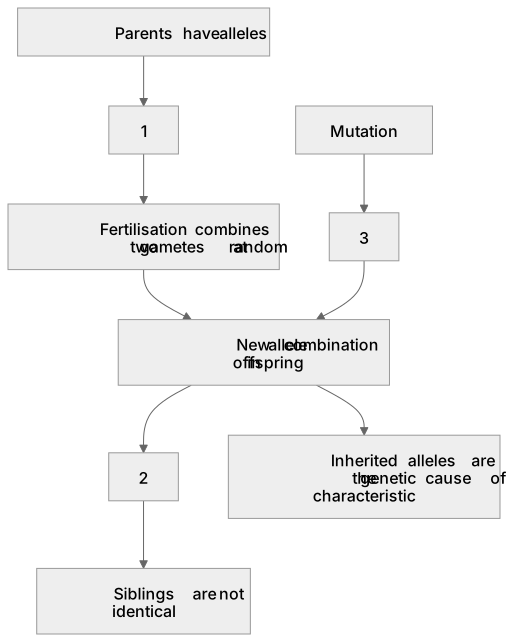
1Box 1
2Box 2
3Box 3
There is more to this lesson
The full lesson goes on to check your understanding and help you earn the marks. Create a free account to carry on, with your progress saved.
A week of Premium from your first lesson · Then the free plan continues · No card, no charge
Test your understanding of Variation: the genes they have inherited (genetic causes)
Active recall beats re-reading. Take an instant quiz now to test what you’ve learned and lock it into long-term memory.
A week of Premium from your first lesson · Then the free plan continues · No card, no charge