AQA · GCSE · Combined Science
Course version: 8464 · Version from Sept 2018
(HT only) Students should be able to explain qualitatively, with examples,…
Full specification wording
Velocity: (HT only) Students should be able to explain qualitatively, with examples, that motion in a circle involves constant speed but changing velocity.
Speed is a scalar quantity indicating how fast an object moves, whereas velocity is a vector quantity representing speed in a stated direction.
Checked against the AQA 8464 specification (opens in a new tab) on .
- Point 3 of 3
- 3 key terms
Study notes
From the checked teaching notes for this specification point.
The idea
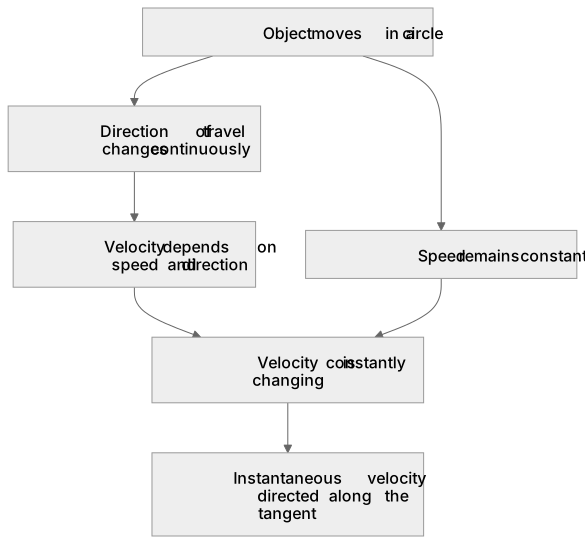
Speed is a scalar quantity indicating how fast an object moves, whereas velocity is a vector quantity representing speed in a stated direction. For an object moving in a circle, such as a car on a roundabout or a satellite in orbit, its direction of travel changes continuously. Because velocity depends on direction, the velocity is constantly changing even if the object's speed remains perfectly constant. The instantaneous velocity is always directed along the tangent to the circular path. Understanding that a change in direction constitutes a change in velocity is crucial for explaining circular motion.
What earns the marks
- States that speed is a scalar quantity (magnitude only) while velocity is a vector quantity (magnitude and direction).
- Explains that an object moving in a circular path continuously changes its direction of motion.
- Concludes that because the direction changes, the velocity must be changing even if the speed remains constant.
- Provides a valid example of circular motion, such as a satellite in orbit, a car on a circular track, or a whirling bung.
Common mistakes and how to put them right
Stating that velocity is constant because the speed is constant.
Put it right by emphasising that velocity is a vector and changes if the direction changes.
Confusing the terms speed and velocity in explanations.
Put it right: Strictly defining speed as a scalar and velocity as a vector in a given direction.
Failing to provide a concrete example when asked to explain the concept.
Put it right by memorising and citing a specific example like a fairground carousel or an orbiting moon.
Exam tips
- As this is a Higher Tier concept, always explicitly state that velocity includes direction, which continuously changes during circular motion.
- Use a specific example, such as a car on a roundabout, and consider drawing a quick sketch with tangent arrows to illustrate the changing direction.
Try the lesson
The start of the Velocity: (HT only) Students should be able to explain qualitatively, with examples, that motion in a circle involves constant speed but changing velocity. lesson, made from checked teaching notes for this specification point.
Have a go first
A car travels around a circular roundabout at a constant speed of 15 m/s. Which statement correctly describes the velocity of the car?
Listen
Speed is a scalar quantity indicating how fast an object moves, whereas velocity is a vector quantity representing speed in a stated direction. For an object moving in a circle, such as a car on a roundabout or a satellite in orbit, its direction of travel changes continuously. Because velocity depends on direction, the velocity is constantly changing even if the object's speed remains perfectly constant. The instantaneous velocity is always directed along the tangent to the circular path. Understanding that a change in direction constitutes a change in velocity is crucial for explaining circular motion. A strong answer earns marks for these points. States that speed is a scalar quantity (magnitude only) while velocity is a vector quantity (magnitude and direction). Explains that an object moving in a circular path continuously changes its direction of motion. Concludes that because the direction changes, the velocity must be changing even if the speed remains constant. Provides a valid example of circular motion, such as a satellite in orbit, a car on a circular track, or a whirling bung. A common slip: Stating that velocity is constant because the speed is constant. Instead, emphasising that velocity is a vector and changes if the direction changes. Exam tip: As this is a Higher Tier concept, always explicitly state that velocity includes direction, which continuously changes during circular motion.
See it
Key words
Say what each word means before you turn the card.
Velocity
Try answering aloud or in your head before turning the card.
Speed
Try answering aloud or in your head before turning the card.
Circular motion
Try answering aloud or in your head before turning the card.
See every definition
- Velocity
- A vector quantity representing speed in a stated direction.
- Speed
- A scalar quantity indicating how fast an object moves.
- Circular motion
- Motion in a circle in which the direction of travel changes continuously, so the velocity is constantly changing even if the speed remains constant.
Label the diagram
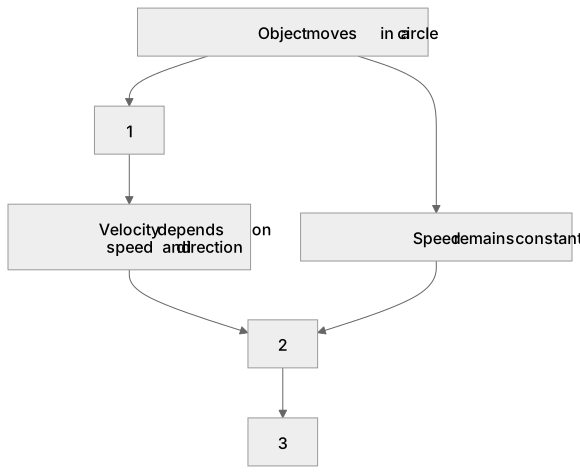
Some boxes have lost their names. Pick the right name for each number.
1Box 1
2Box 2
3Box 3
There is more to this lesson
The full lesson goes on to check your understanding and help you earn the marks. Create a free account to carry on, with your progress saved.
A week of Premium from your first lesson · Then the free plan continues · No card, no charge
Test your understanding of Velocity: (HT only) Students should be able to explain qualitatively, with examples, that motion in a circle involves constant speed but changing velocity.
Active recall beats re-reading. Take an instant quiz now to test what you’ve learned and lock it into long-term memory.
A week of Premium from your first lesson · Then the free plan continues · No card, no charge