AQA · GCSE · Combined Science
Course version: 8464 · Version from Sept 2018
Waste management: in water, from sewage, fertiliser or toxic chemicals
Water pollution arises when harmful substances enter rivers, lakes or groundwater.
- 4 key terms
Study notes
From the checked teaching notes for this specification point.
The idea
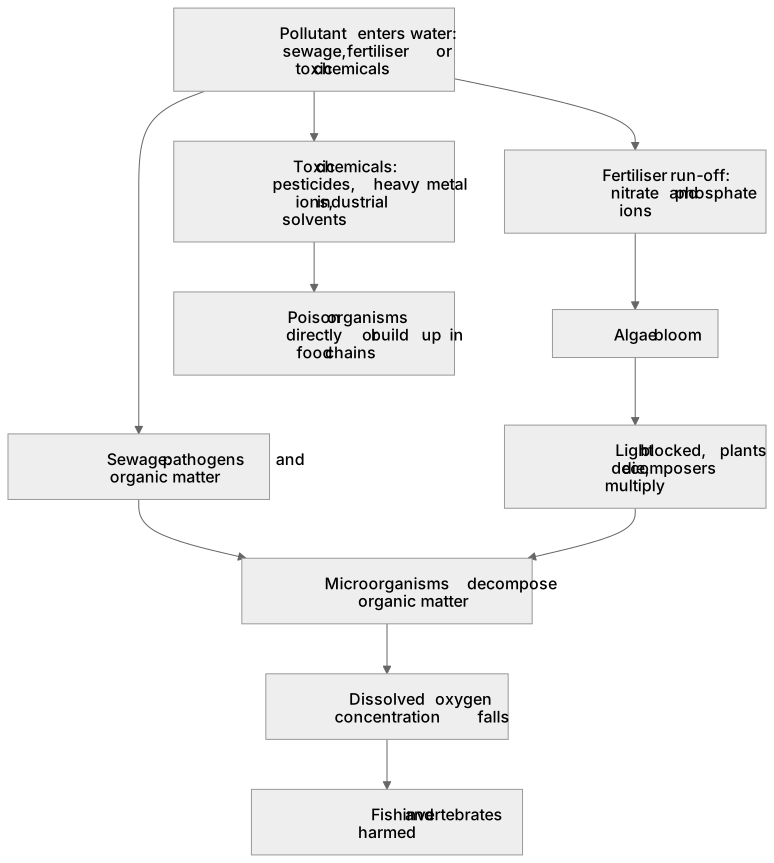
Water pollution arises when harmful substances enter rivers, lakes or groundwater. Sewage carries pathogens and organic matter; bacteria decomposing it use dissolved oxygen, so fish may suffocate. Fertiliser run-off supplies nitrate and phosphate ions, causing eutrophication: algae bloom, block light, die, and decomposition again removes oxygen. Toxic chemicals such as pesticides, heavy metal ions and industrial solvents may poison organisms directly or accumulate along food chains. For example, excess nitrate from farmland leaches into a stream, algae grow rapidly, oxygen concentration falls, and invertebrates disappear. Reducing pollution involves treating sewage, limiting fertiliser use and safely disposing of toxic chemicals.
What earns the marks
- Identify sewage as a source of pathogens and organic matter that increases biochemical oxygen demand as microorganisms decompose it.
- Explain that fertiliser run-off adds nitrate and phosphate ions, which promote algal growth and can lead to eutrophication.
- Describe how decomposers reduce dissolved oxygen concentration, harming aquatic animals such as fish and invertebrates.
- State that toxic chemicals include pesticides, heavy metal ions and industrial solvents that can poison organisms or build up in food chains.
- Link each pollutant to a specific consequence for water quality, biodiversity or human health rather than listing sources alone.
- Suggest a control measure, such as sewage treatment, reduced fertiliser application or safe disposal of toxic chemicals.
Common mistakes and how to put them right
Confusing eutrophication with direct poisoning.
Put it right: Separate nutrient pollution from toxic pollution in explanations.
Claiming that fertiliser is toxic to plants.
Put it right: Describe the sequence of eutrophication.
Stating that sewage only causes disease.
Put it right: Include both pathogen and oxygen-demand effects.
Exam tips
- Name the pollutant and its source before explaining the consequence, so each point is clearly linked.
- Use the sequence algae bloom, light blocked, plants die, decomposers multiply, oxygen falls when explaining eutrophication.
- Refer to dissolved oxygen concentration rather than simply saying the water has no oxygen, and link it to named aquatic organisms.
Try the lesson
The start of the Waste management: in water, from sewage, fertiliser or toxic chemicals lesson, made from checked teaching notes for this specification point.
Have a go first
Which of these is a source of water pollution?
Listen
Water pollution arises when harmful substances enter rivers, lakes or groundwater. Sewage carries pathogens and organic matter; bacteria decomposing it use dissolved oxygen, so fish may suffocate. Fertiliser run-off supplies nitrate and phosphate ions, causing eutrophication: algae bloom, block light, die, and decomposition again removes oxygen. Toxic chemicals such as pesticides, heavy metal ions and industrial solvents may poison organisms directly or accumulate along food chains. For example, excess nitrate from farmland leaches into a stream, algae grow rapidly, oxygen concentration falls, and invertebrates disappear. Reducing pollution involves treating sewage, limiting fertiliser use and safely disposing of toxic chemicals. A strong answer earns marks for these points. Identify sewage as a source of pathogens and organic matter that increases biochemical oxygen demand as microorganisms decompose it. Explain that fertiliser run-off adds nitrate and phosphate ions, which promote algal growth and can lead to eutrophication. Describe how decomposers reduce dissolved oxygen concentration, harming aquatic animals such as fish and invertebrates. State that toxic chemicals include pesticides, heavy metal ions and industrial solvents that can poison organisms or build up in food chains. A common slip: Confusing eutrophication with direct poisoning: algae blooms are caused by nutrient enrichment, whereas toxic chemicals poison organisms directly. Instead, separate nutrient pollution from toxic pollution in explanations. Exam tip: Name the pollutant and its source before explaining the consequence, so each point is clearly linked.
See it
Key words
Say what each word means before you turn the card.
Water pollution sources
Try answering aloud or in your head before turning the card.
Eutrophication
Try answering aloud or in your head before turning the card.
Dissolved oxygen and decomposition
Try answering aloud or in your head before turning the card.
Toxic chemicals and bioaccumulation
Try answering aloud or in your head before turning the card.
See every definition
- Water pollution sources
- Harmful substances enter rivers, lakes or groundwater from sewage, fertiliser or toxic chemicals.
- Eutrophication
- Fertiliser run-off supplies nitrate and phosphate ions, causing algae to bloom, block light, die, and decomposition removes oxygen.
- Dissolved oxygen and decomposition
- Bacteria decomposing organic matter use dissolved oxygen, so fish may suffocate.
- Toxic chemicals and bioaccumulation
- Pesticides, heavy metal ions and industrial solvents may poison organisms directly or accumulate along food chains.
Label the diagram
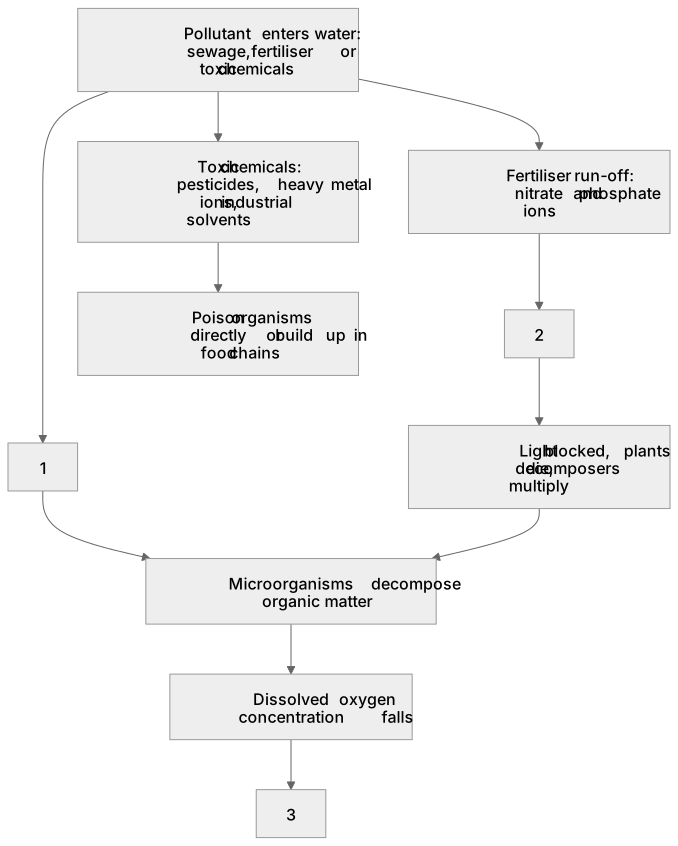
Some boxes have lost their names. Pick the right name for each number.
1Box 1
2Box 2
3Box 3
There is more to this lesson
The full lesson goes on to check your understanding and help you earn the marks. Create a free account to carry on, with your progress saved.
A week of Premium from your first lesson · Then the free plan continues · No card, no charge
Test your understanding of Waste management: in water, from sewage, fertiliser or toxic chemicals
Active recall beats re-reading. Take an instant quiz now to test what you’ve learned and lock it into long-term memory.
A week of Premium from your first lesson · Then the free plan continues · No card, no charge