AQA · GCSE · Combined Science
Course version: 8464 · Version from Sept 2018
Waste management: on land, from landfill and from toxic chemicals.
Waste management reduces pollution by choosing suitable disposal routes.
- 4 key terms
Study notes
From the checked teaching notes for this specification point.
The idea
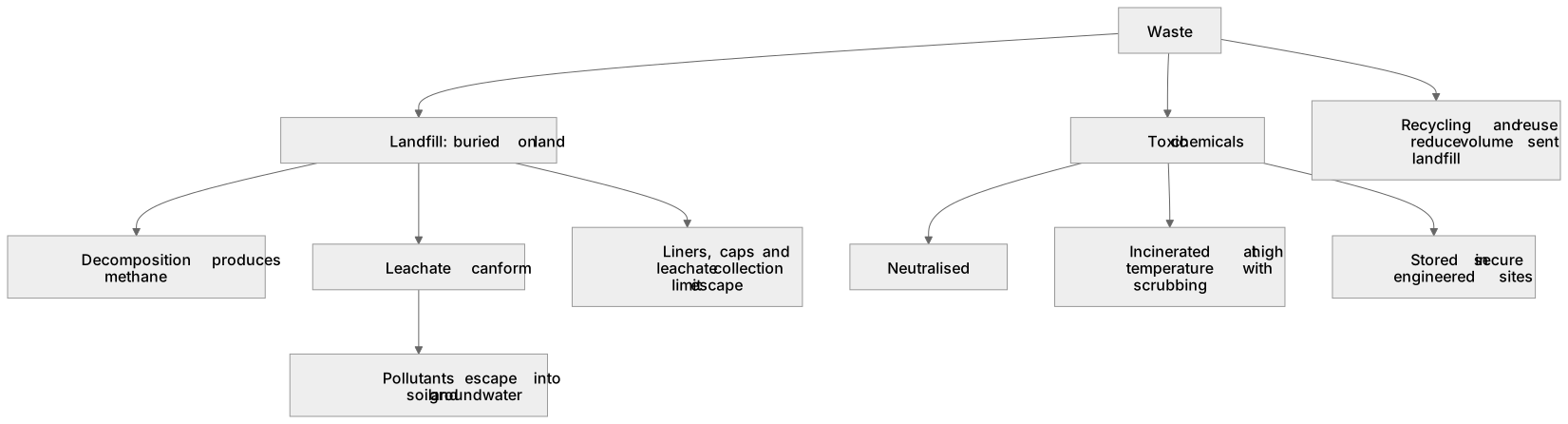
Waste management reduces pollution by choosing suitable disposal routes. Waste sent to landfill is buried on land; it may release methane as it decomposes and can leach toxic chemicals into soil and groundwater. Toxic chemicals need careful handling: they can be neutralised, treated, incinerated at high temperature with scrubbing, or stored in secure engineered sites rather than tipped on land. Recycling and reuse reduce the volume sent to landfill. For example, waste engine oil is collected and reprocessed, while laboratory heavy-metal solutions are stored separately and treated, never poured down a sink. Landfill sites are lined and capped, and leachate is collected, to limit escape of pollutants into the environment.
What earns the marks
- Landfill is the burial of waste on land; decomposition produces methane, a greenhouse gas, and can produce leachate.
- Toxic chemicals must not be released into soil, water or air; they are treated, neutralised, incinerated under controlled conditions or stored securely.
- Recycling, reuse and composting reduce the mass of waste going to landfill and lower pollution risk.
- Pollutants can move from landfill into groundwater and rivers, so liners, caps and leachate collection are used.
- Correct use of terms such as landfill, leachate, toxic chemical and waste management shows understanding of disposal routes.
Common mistakes and how to put them right
Thinking all waste in landfill simply disappears.
Put it right: It decomposes slowly and can release methane and leachate for many years.
Assuming toxic chemicals can be poured down the sink because water dilutes them.
Put it right: Dilution does not remove toxicity; they must be treated or stored safely.
Confusing landfill with incineration.
Put it right: Landfill buries waste on land, whereas incineration burns it, producing ash and gases that need cleaning.
Exam tips
- Name the disposal route and then state the pollution risk it controls, for example landfill plus leachate collection.
- Use comparative language such as reduces, limits or prevents to show how a method lowers pollution.
- Link each method to a named pollutant or effect, such as methane from decomposition or toxic metal ions in groundwater.
Try the lesson
The start of the Waste management: on land, from landfill and from toxic chemicals. lesson, made from checked teaching notes for this specification point.
Have a go first
Which of these is a way that waste can pollute land?
Listen
Waste management reduces pollution by choosing suitable disposal routes. Waste sent to landfill is buried on land; it may release methane as it decomposes and can leach toxic chemicals into soil and groundwater. Toxic chemicals need careful handling: they can be neutralised, treated, incinerated at high temperature with scrubbing, or stored in secure engineered sites rather than tipped on land. Recycling and reuse reduce the volume sent to landfill. For example, waste engine oil is collected and reprocessed, while laboratory heavy-metal solutions are stored separately and treated, never poured down a sink. Landfill sites are lined and capped, and leachate is collected, to limit escape of pollutants into the environment. A strong answer earns marks for these points. Landfill is the burial of waste on land; decomposition produces methane, a greenhouse gas, and can produce leachate. Toxic chemicals must not be released into soil, water or air; they are treated, neutralised, incinerated under controlled conditions or stored securely. Recycling, reuse and composting reduce the mass of waste going to landfill and lower pollution risk. Pollutants can move from landfill into groundwater and rivers, so liners, caps and leachate collection are used. A common slip: Thinking all waste in landfill simply disappears. Instead, it decomposes slowly and can release methane and leachate for many years. Exam tip: Name the disposal route and then state the pollution risk it controls, for example landfill plus leachate collection.
See it
Key words
Say what each word means before you turn the card.
Waste management
Try answering aloud or in your head before turning the card.
Landfill
Try answering aloud or in your head before turning the card.
Toxic chemicals
Try answering aloud or in your head before turning the card.
Recycling and reuse
Try answering aloud or in your head before turning the card.
See every definition
- Waste management
- Reduces pollution by choosing suitable disposal routes for waste.
- Landfill
- The burial of waste on land, where decomposition produces methane and can produce leachate.
- Toxic chemicals
- Must not be released into soil, water or air; they are treated, neutralised, incinerated under controlled conditions or stored securely.
- Recycling and reuse
- Reduce the volume sent to landfill and lower pollution risk.
Label the diagram
Some boxes have lost their names. Pick the right name for each number.
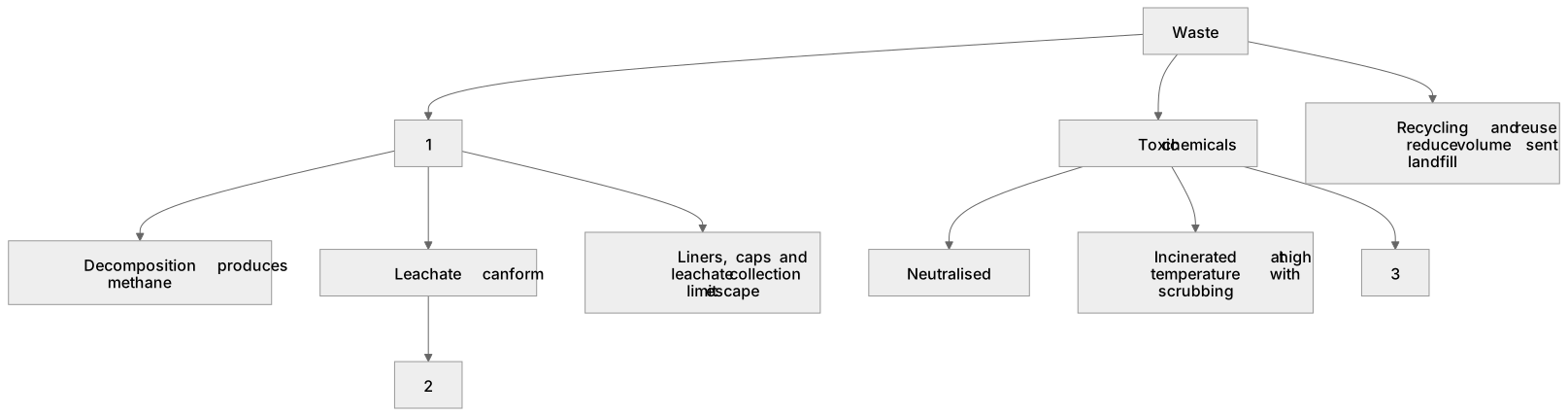
1Box 1
2Box 2
3Box 3
There is more to this lesson
The full lesson goes on to check your understanding and help you earn the marks. Create a free account to carry on, with your progress saved.
A week of Premium from your first lesson · Then the free plan continues · No card, no charge
Test your understanding of Waste management: on land, from landfill and from toxic chemicals.
Active recall beats re-reading. Take an instant quiz now to test what you’ve learned and lock it into long-term memory.
A week of Premium from your first lesson · Then the free plan continues · No card, no charge