AQA · GCSE · Combined Science
Course version: 8464 · Version from Sept 2018
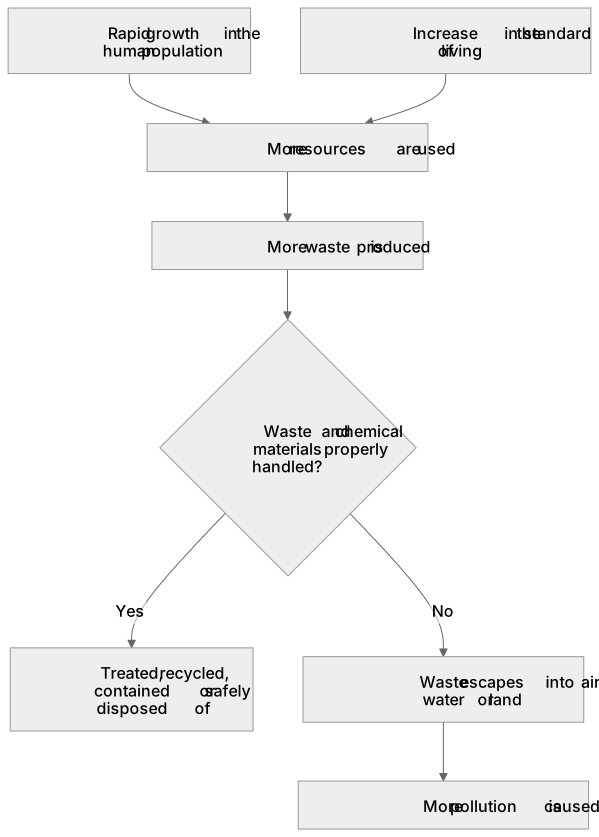
Waste management: Rapid growth in the human population and an increase in the standard of living mean that increasingly more resources are used and more waste is produced. Unless waste and chemical materials are properly handled, more pollution will be caused.
Human numbers are rising quickly, and on average each person expects a higher standard of living, with more food, goods, energy and travel.
- 4 key terms
Study notes
From the checked teaching notes for this specification point.
The idea
Human numbers are rising quickly, and on average each person expects a higher standard of living, with more food, goods, energy and travel. Both trends multiply demand for finite resources such as metal ores, fossil fuels and fresh water. Extracting, processing and using these resources generates waste: domestic rubbish, sewage, industrial scrap, waste gases and surplus chemicals. If waste is tipped, burned or discharged without proper handling, it escapes into air, water and land, causing pollution that harms organisms and ecosystems. For example, untreated sewage released into a river raises nutrient levels, microbes decompose it and dissolve oxygen falls, so fish suffocate. Proper handling means treating sewage, recycling materials, containing and neutralising chemical waste, and using landfill or incineration with controls.
What earns the marks
- Links rapid human population growth to increased demand for resources such as food, water, metals and fossil fuels.
- Links a rising standard of living to greater per-person consumption of goods, energy and travel, so demand rises further.
- Explains that extracting, processing and using resources produces waste, including domestic, agricultural, industrial and chemical waste.
- States that waste and chemical materials must be properly handled, for example treated, recycled, contained or safely disposed of.
- Explains that improper handling lets waste escape into air, water or land, causing pollution that damages organisms and ecosystems.
- Uses a named example, such as untreated sewage lowering dissolved oxygen in a river, to show the pollution consequence.
Common mistakes and how to put them right
Saying population growth alone causes pollution.
Put it right: Also credit rising living standards, because each person consumes and wastes more.
Treating all waste as harmless once buried.
Put it right: Chemical waste can leach into groundwater, so containment and treatment are needed.
Confusing waste production with pollution.
Put it right: Waste becomes pollution only when it is released into the environment without proper handling.
Exam tips
- Use the command word: if asked to explain, give a causal chain such as more people → more resources used → more waste → pollution if mishandled.
- Include one specific example of a resource and one specific waste or pollutant to make the link concrete.
- When asked to suggest a method, name the handling step, such as sewage treatment or recycling, and state how it reduces pollution.
Try the lesson
The start of the Waste management: Rapid growth in the human population and an increase in the standard of living mean that increasingly more resources are used and more waste is produced. Unless waste and chemical materials are properly handled, more pollution will be caused. lesson, made from checked teaching notes for this specification point.
Have a go first
What is the main environmental consequence of rapid human population growth and an increasing standard of living?
Listen
Human numbers are rising quickly, and on average each person expects a higher standard of living, with more food, goods, energy and travel. Both trends multiply demand for finite resources such as metal ores, fossil fuels and fresh water. Extracting, processing and using these resources generates waste: domestic rubbish, sewage, industrial scrap, waste gases and surplus chemicals. If waste is tipped, burned or discharged without proper handling, it escapes into air, water and land, causing pollution that harms organisms and ecosystems. For example, untreated sewage released into a river raises nutrient levels, microbes decompose it and dissolve oxygen falls, so fish suffocate. Proper handling means treating sewage, recycling materials, containing and neutralising chemical waste, and using landfill or incineration with controls. A strong answer earns marks for these points. Links rapid human population growth to increased demand for resources such as food, water, metals and fossil fuels. Links a rising standard of living to greater per-person consumption of goods, energy and travel, so demand rises further. Explains that extracting, processing and using resources produces waste, including domestic, agricultural, industrial and chemical waste. States that waste and chemical materials must be properly handled, for example treated, recycled, contained or safely disposed of. A common slip: Saying population growth alone causes pollution. Instead, also credit rising living standards, because each person consumes and wastes more. Exam tip: Use the command word: if asked to explain, give a causal chain such as more people → more resources used → more waste → pollution if mishandled.
See it
Key words
Say what each word means before you turn the card.
Human population growth
Try answering aloud or in your head before turning the card.
Standard of living and consumption
Try answering aloud or in your head before turning the card.
Finite resources
Try answering aloud or in your head before turning the card.
Waste management and pollution
Try answering aloud or in your head before turning the card.
See every definition
- Human population growth
- Rapid growth in the human population means that increasingly more resources are used and more waste is produced.
- Standard of living and consumption
- An increase in the standard of living means that increasingly more resources are used and more waste is produced.
- Finite resources
- Resources such as metal ores, fossil fuels and fresh water are finite, and demand for them multiplies as population and living standards rise.
- Waste management and pollution
- Unless waste and chemical materials are properly handled, more pollution will be caused as waste escapes into air, water and land.
There is more to this lesson
The full lesson goes on to check your understanding and help you earn the marks. Create a free account to carry on, with your progress saved.
A week of Premium from your first lesson · Then the free plan continues · No card, no charge
Test your understanding of Waste management: Rapid growth in the human population and an increase in the standard of living mean that increasingly more resources are used and more waste is produced. Unless waste and chemical materials are properly handled, more pollution will be caused.
Active recall beats re-reading. Take an instant quiz now to test what you’ve learned and lock it into long-term memory.
A week of Premium from your first lesson · Then the free plan continues · No card, no charge