AQA · GCSE · Combined Science
Course version: 8464 · Version from Sept 2018
Work done and energy transfer: 1 joule = 1 newton-metre
The joule is the SI unit of energy and work.
Checked against the AQA 8464 specification (opens in a new tab) on .
- Point 10 of 13
Study notes
From the checked teaching notes for this specification point.
The idea
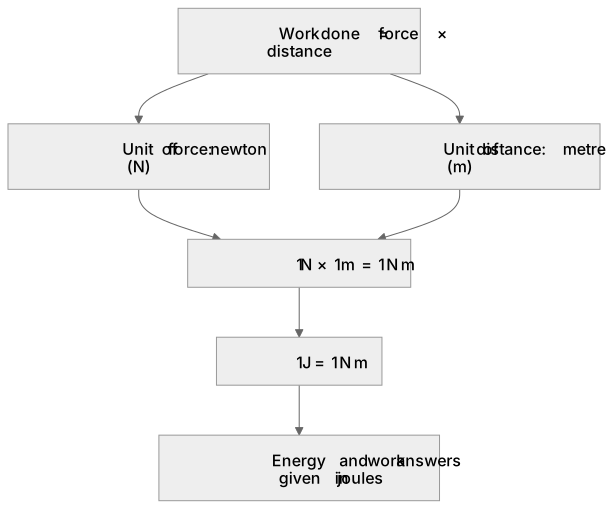
The joule is the SI unit of energy and work. Because work done = force × distance moved along the line of action of the force, the unit of work is the unit of force multiplied by the unit of distance: 1 N × 1 m = 1 N m. So 1 J = 1 N m. This is a unit identity, not a new equation: it tells you that a force of 1 N acting through 1 m transfers 1 J. For example, lifting a 2 N weight by 3 m does 2 N × 3 m = 6 N m = 6 J. The newton-metre is written N m. Note that the moment of a force is also measured in N m, but work done and energy transferred should be expressed in joules to distinguish them from moments.
What earns the marks
- State that the joule is the unit of work and energy.
- Derive the unit identity from W = F s: 1 N × 1 m = 1 N m.
- Convert a value in newton-metres to joules using 1 J = 1 N m.
- Use the identity in calculations, for example 2 N × 3 m = 6 N m = 6 J.
- Give energy and work answers in joules to distinguish them from moments.
Common mistakes and how to put them right
Leaving an energy answer in N m when the question asks for energy.
Put it right by converting to joules, since 1 N m = 1 J.
Treating 1 J = 1 N m as a separate formula to memorise.
Put it right by deriving it from W = F s.
Confusing the unit of work with the unit of power.
Put it right by remembering work is in joules (J) and power is in watts (W).
Exam tips
- Derive the unit identity in one line: J = N × m, so 1 J = 1 N m.
- Carry units through the calculation so the final unit is clearly J.
- If a value is given in N m for work done, state that it is numerically equal to the same value in J.
Try the lesson
The start of the Work done and energy transfer: 1 joule = 1 newton-metre lesson, made from checked teaching notes for this specification point.
Have a go first
A force of 1 newton moves an object 1 metre in the direction of the force. How much work is done on the object?
Listen
The joule is the SI unit of energy and work. Because work done = force × distance moved along the line of action of the force, the unit of work is the unit of force multiplied by the unit of distance: 1 N × 1 m = 1 N m. So 1 J = 1 N m. This is a unit identity, not a new equation: it tells you that a force of 1 N acting through 1 m transfers 1 J. For example, lifting a 2 N weight by 3 m does 2 N × 3 m = 6 N m = 6 J. The newton-metre is written N m. Note that the moment of a force is also measured in N m, but work done and energy transferred should be expressed in joules to distinguish them from moments. A strong answer earns marks for these points. State that the joule is the unit of work and energy. Derive the unit identity from W = F s: 1 N × 1 m = 1 N m. Convert a value in newton-metres to joules using 1 J = 1 N m. Use the identity in calculations, for example 2 N × 3 m = 6 N m = 6 J. A common slip: Leaving an energy answer in N m when the question asks for energy. Instead, converting to joules, since 1 N m = 1 J. Exam tip: Derive the unit identity in one line: J = N × m, so 1 J = 1 N m.
See it
Label the diagram
Some boxes have lost their names. Pick the right name for each number.
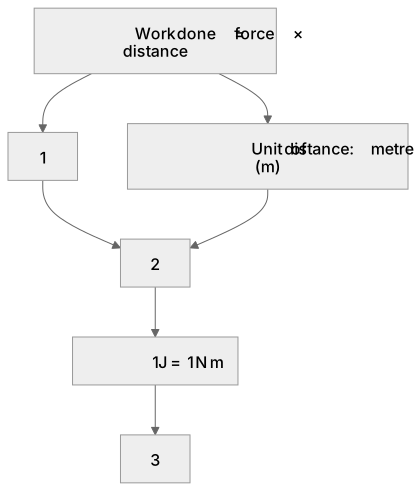
1Box 1
2Box 2
3Box 3
There is more to this lesson
The full lesson goes on to check your understanding and help you earn the marks. Create a free account to carry on, with your progress saved.
A week of Premium from your first lesson · Then the free plan continues · No card, no charge
Test your understanding of Work done and energy transfer: 1 joule = 1 newton-metre
Active recall beats re-reading. Take an instant quiz now to test what you’ve learned and lock it into long-term memory.
A week of Premium from your first lesson · Then the free plan continues · No card, no charge