AQA · GCSE · Combined Science
Course version: 8464 · Version from Sept 2018
Work done and energy transfer: distance, s, in metres
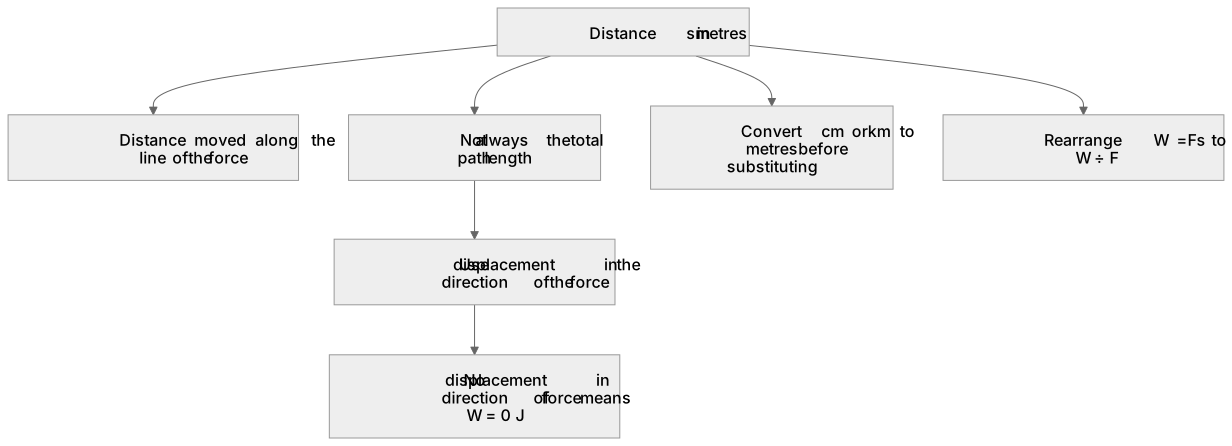
Distance s in the work done equation W = Fs is the distance moved along the line of the force, measured in metres (m).
Checked against the AQA 8464 specification (opens in a new tab) on .
- Point 8 of 13
- 4 key terms
Study notes
From the checked teaching notes for this specification point.
The idea
Distance s in the work done equation W = Fs is the distance moved along the line of the force, measured in metres (m). It is not always the total path length: if a force changes direction or the object moves back and forth, you must use the displacement in the direction of the force. For example, lifting a 5 N weight 2 m vertically does W = 5 × 2 = 10 J, but carrying it horizontally does no work against gravity because the vertical displacement is zero. Convert centimetres or kilometres to metres before substituting. In calculations, s can be found by rearranging to s = W ÷ F when work done and force are known.
What earns the marks
- State that distance s is measured in metres (m) and must be the distance moved along the direction of the force.
- Convert units such as cm, km or mm into metres before using W = Fs.
- Distinguish between total distance travelled and displacement in the direction of the force when they differ.
- Rearrange W = Fs to s = W ÷ F and substitute correctly to find distance.
- Recognise that if there is no displacement in the direction of the force, no work is done, so W = 0 J.
Common mistakes and how to put them right
Using the total journey distance when the force acts in a different direction.
Put it right by using the displacement parallel to the force.
Failing to convert centimetres to metres.
Put it right by dividing by 100 before substitution.
Confusing distance with displacement in direction.
Put it right by stating the direction of movement relative to the force.
Exam tips
- Underline the distance value and its unit, then convert to metres before starting the calculation.
- Sketch the force and displacement directions to check whether they are parallel.
- Show the rearranged equation s = W ÷ F when asked to find distance, and include the unit m in the answer.
Try the lesson
The start of the Work done and energy transfer: distance, s, in metres lesson, made from checked teaching notes for this specification point.
Have a go first
A student pushes a box with a constant force of 15 N. The work done on the box is 60 J. Calculate the distance moved by the box in the direction of the force.
Listen
Distance s in the work done equation W = Fs is the distance moved along the line of the force, measured in metres (m). It is not always the total path length: if a force changes direction or the object moves back and forth, you must use the displacement in the direction of the force. For example, lifting a 5 N weight 2 m vertically does W = 5 × 2 = 10 J, but carrying it horizontally does no work against gravity because the vertical displacement is zero. Convert centimetres or kilometres to metres before substituting. In calculations, s can be found by rearranging to s = W ÷ F when work done and force are known. A strong answer earns marks for these points. State that distance s is measured in metres (m) and must be the distance moved along the direction of the force. Convert units such as cm, km or mm into metres before using W = Fs. Distinguish between total distance travelled and displacement in the direction of the force when they differ. Rearrange W = Fs to s = W ÷ F and substitute correctly to find distance. A common slip: Using the total journey distance when the force acts in a different direction. Instead, using the displacement parallel to the force. Exam tip: Underline the distance value and its unit, then convert to metres before starting the calculation.
See it
Key words
Say what each word means before you turn the card.
Distance s
Try answering aloud or in your head before turning the card.
Displacement in the direction of the force
Try answering aloud or in your head before turning the card.
Unit conversion
Try answering aloud or in your head before turning the card.
Rearranging to s = W ÷ F
Try answering aloud or in your head before turning the card.
See every definition
- Distance s
- Measured in metres (m), it must be the distance moved along the direction of the force.
- Displacement in the direction of the force
- Used when a force changes direction or the object moves back and forth, rather than the total path length.
- Unit conversion
- Centimetres or kilometres are converted to metres before substituting into the equation.
- Rearranging to s = W ÷ F
- Used in calculations to find s when work done and force are known.
Label the diagram
Some boxes have lost their names. Pick the right name for each number.
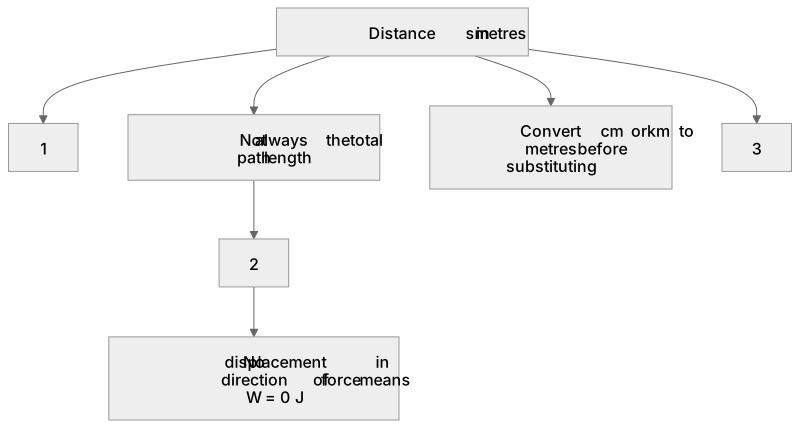
1Box 1
2Box 2
3Box 3
There is more to this lesson
The full lesson goes on to check your understanding and help you earn the marks. Create a free account to carry on, with your progress saved.
A week of Premium from your first lesson · Then the free plan continues · No card, no charge
Test your understanding of Work done and energy transfer: distance, s, in metres
Active recall beats re-reading. Take an instant quiz now to test what you’ve learned and lock it into long-term memory.
A week of Premium from your first lesson · Then the free plan continues · No card, no charge