
Study Notes
Overview
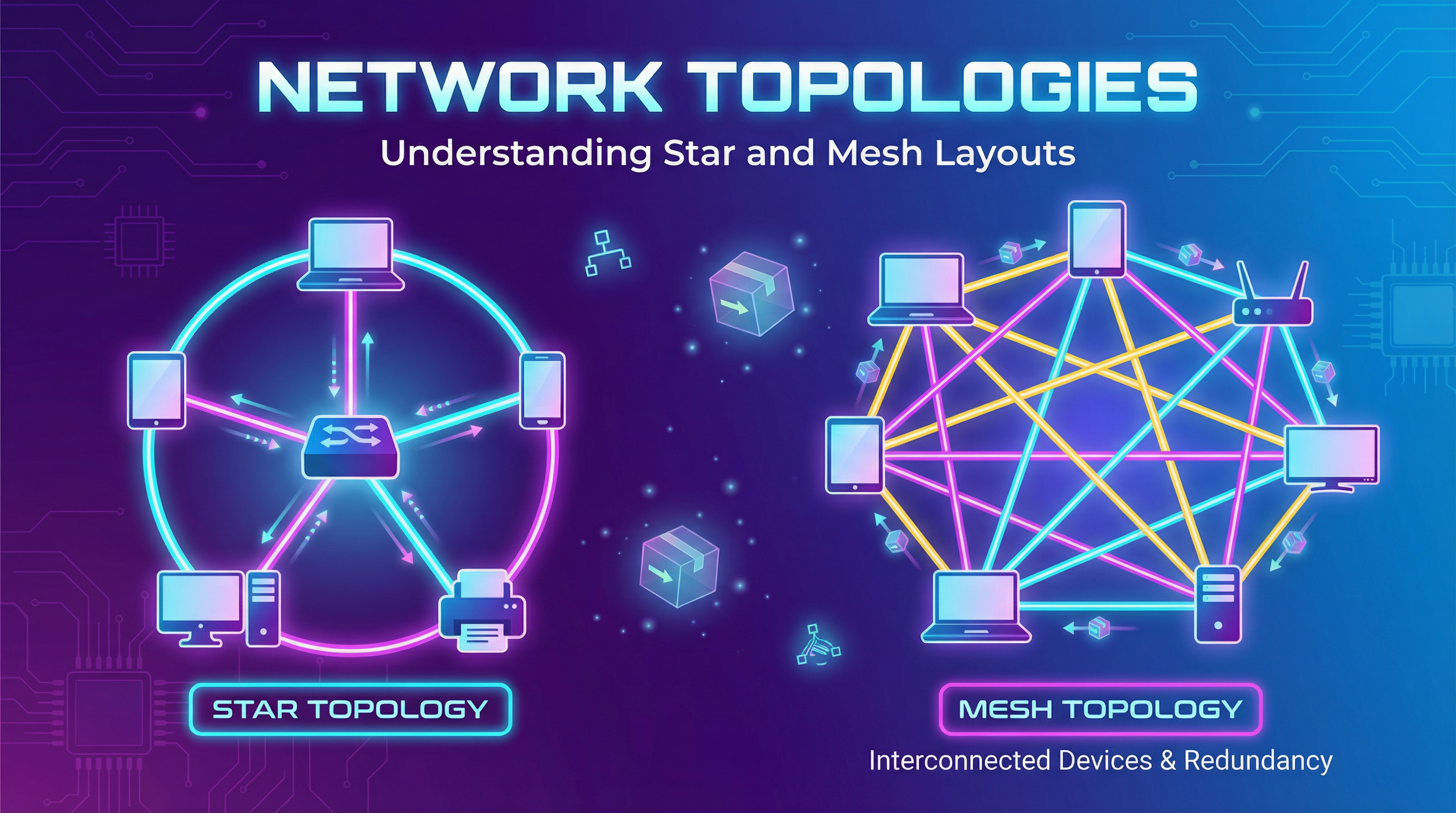
Welcome to the essential guide for Network Topologies, a core component of the AQA GCSE Computer Science specification (4.1). This topic explores how the physical layout of a network—its topology—fundamentally impacts its performance, cost, and reliability. In the exam, you'll be expected to compare and contrast the two key topologies: Star and Mesh. Understanding these isn't just about memorising diagrams; it's about evaluating their trade-offs to justify which is better for a given scenario, like a small office versus a critical hospital system. This guide will equip you with the precise terminology, exam techniques, and conceptual understanding to tackle any question an examiner throws at you, linking directly to network security and performance concepts you'll cover elsewhere.
Key Concepts
Concept 1: Star Topology
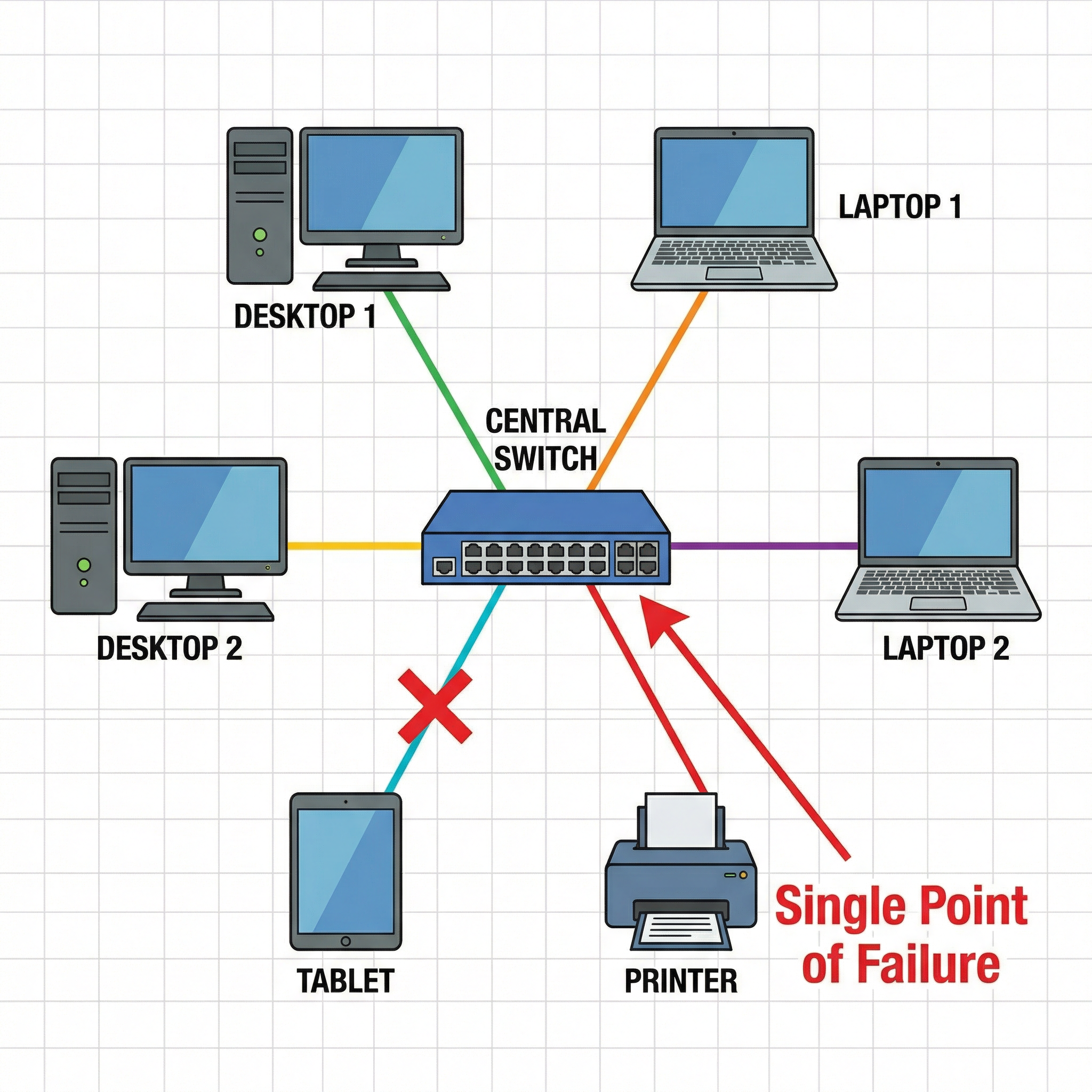
A Star topology is the most common layout for Local Area Networks (LANs) found in homes, schools, and small businesses. In this setup, every device (or 'node') on the network is connected to a central device. For your exam, it is crucial to identify this central device as a switch or a hub, not just a 'server'. The switch acts as a central point of communication; when one device wants to send data to another, it sends the data to the switch, which then forwards it to the correct destination device.
Advantages:
- Reliability (Device Failure): If one cable or device fails, it does not affect the rest of the network. Only the failed device is isolated.
- Performance: The switch directs traffic only to the intended recipient, reducing unnecessary data traffic on the network and minimising data collisions.
- Easy to Manage: Adding or removing devices is simple—you just plug them into or unplug them from the switch. Faults are easy to isolate.
Disadvantages:
- Single Point of Failure: This is a high-tariff phrase. The central switch is a single point of failure. If it fails, the entire network goes down.
- Cost: It requires more cabling than a bus topology, which can increase installation costs.
Concept 2: Mesh Topology
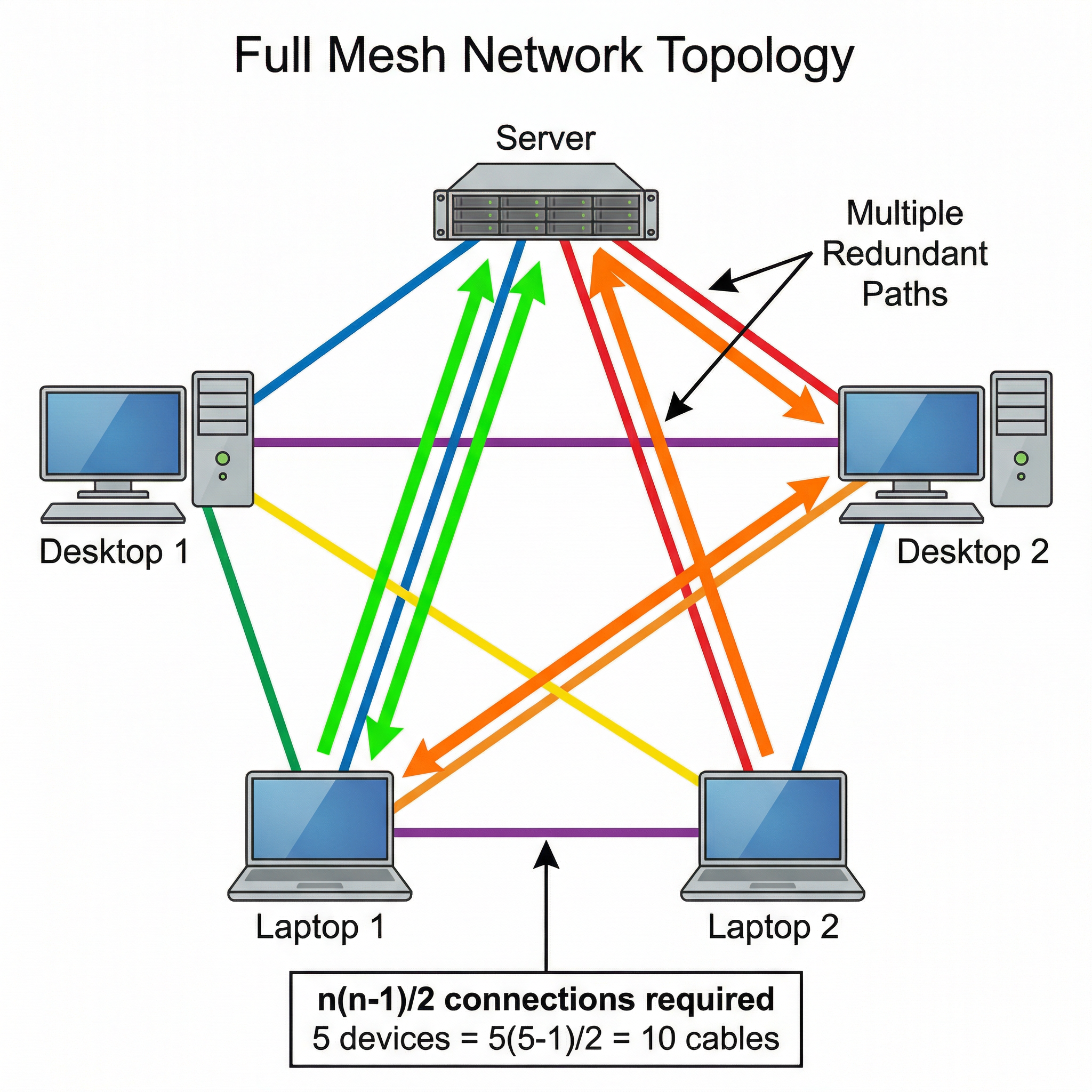
A Mesh topology is a more complex setup where devices are interconnected. There are two types: Full Mesh and Partial Mesh. In a Full Mesh network, every single device is connected to every other device. In a Partial Mesh network, only some devices are fully interconnected, typically the most critical ones.
Advantages:
- High Reliability & Redundancy: This is the primary benefit. If one connection or device fails, data can be rerouted through one of the many other available paths. This makes Mesh networks extremely fault-tolerant.
- No Single Point of Failure: Unlike a Star network, the failure of a single device or connection will not bring down the entire network.
Disadvantages:
- Cost & Complexity: The amount of cabling required is very high, making it expensive and complex to install, especially for a Full Mesh.
- Difficult to Manage: Adding a new device to a Full Mesh network is disruptive as it requires connecting it to every other existing device.
Mathematical/Scientific Relationships
For a Full Mesh network, the number of connections (cables) required for 'n' devices can be calculated with a specific formula. You must memorise this.
Formula: c = n(n-1) / 2
- c: number of connections (cables)
- n: number of devices (nodes)
Example: For a network with 6 devices, the number of cables required would be:
c = 6 * (6-1) / 2
c = 6 * 5 / 2
c = 30 / 2
c = 15
So, 15 cables would be needed to create a Full Mesh network with 6 devices.
Practical Applications
- Star Topology: The default choice for most modern LANs. Your school or college network is almost certainly a Star topology. It provides a good balance of performance, cost, and manageability for a typical environment.
- Mesh Topology: Used in critical systems where reliability is paramount and cost is a secondary concern. Examples include:
- Hospitals: Patient monitoring systems cannot afford to go down.
- Military & Government: Secure and resilient communication is essential.
- The Internet Backbone: The core routers of the internet form a massive Mesh network to ensure data can always find a path.