Pearson Edexcel · A-Level · Economics B
Course version: 9EB0 · Version from Sept 2015
C) Factors influencing AD: components C + I + G + (X-M)
Full specification wording
Circular flow of income, expenditure and output: c) Factors influencing AD: components C + I + G + (X-M)
Aggregate Demand (AD) is the total planned expenditure on goods and services in an economy at a given price level.
Checked against the Pearson Edexcel 9EB0 specification (opens in a new tab) on .
- Point 3 of 4
- 4 key terms
Study notes
From the checked teaching notes for this specification point.
The idea
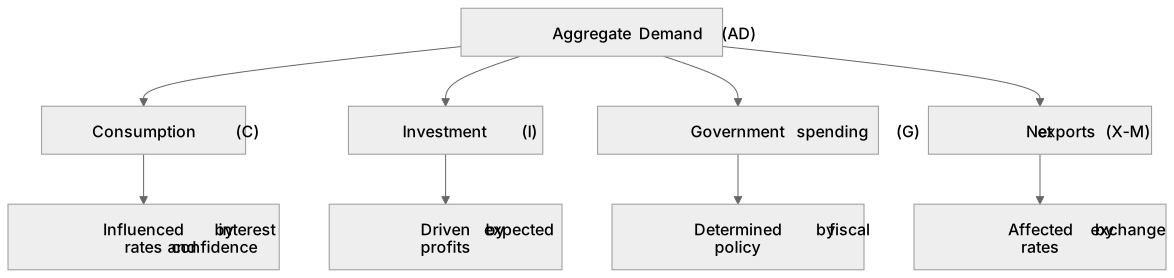
Aggregate Demand (AD) is the total planned expenditure on goods and services in an economy at a given price level. It is calculated as AD = C + I + G + (X-M). Consumption (C) is household spending, influenced by interest rates and confidence. Investment (I) is spending by firms on capital goods, driven by expected profits. Government spending (G) covers public services and infrastructure, determined by fiscal policy. Net exports (X-M) is the value of exports minus imports, affected by exchange rates.
For example: A depreciation in the exchange rate makes exports cheaper and imports dearer, increasing the (X-M) component and shifting the AD curve to the right, indicating higher total planned expenditure at any given price level.
What earns the marks
- Identify the components of the AD formula: Consumption, Investment, Government spending, Exports, and Imports.
- Explain how a change in interest rates affects both Consumption (C) and Investment (I).
- Analyse how government fiscal policy decisions directly alter Government spending (G).
- Evaluate the impact of exchange rate movements on the Net exports (X-M) component.
- Illustrate a shift in the AD curve resulting from a change in any of its underlying components.
Common mistakes and how to put them right
Confusing investment (I) with saving or financial investment like buying shares.
Put it right: Investment in economics refers specifically to firms spending on physical capital goods.
Assuming an increase in imports increases AD.
Put it right: Imports (M) are a leakage from the circular flow; an increase in imports reduces net exports (X-M) and therefore decreases AD.
Treating government spending on transfer payments like pensions as part of G in the AD equation.
Put it right: Transfer payments are not included in G as they do not represent current production; they affect AD indirectly through Consumption (C).
Exam tips
- Always state the full AD equation (AD = C + I + G + (X-M)) when defining Aggregate Demand in an exam answer.
- When analysing a factor like interest rates, explicitly link it to both consumption and investment to demonstrate comprehensive understanding.
- Remember that (X-M) can be negative if a country runs a trade deficit, which acts as a drag on total Aggregate Demand.
Try the lesson
The start of the Circular flow of income, expenditure and output: c) Factors influencing AD: components C + I + G + (X-M) lesson, made from checked teaching notes for this specification point.
Have a go first
Aggregate demand (AD) is calculated using the formula C + I + G + (X-M). What does the component 'I' represent in this equation?
Listen
Aggregate Demand (AD) is the total planned expenditure on goods and services in an economy at a given price level. It is calculated as AD = C + I + G + (X-M). Consumption (C) is household spending, influenced by interest rates and confidence. Investment (I) is spending by firms on capital goods, driven by expected profits. Government spending (G) covers public services and infrastructure, determined by fiscal policy. Net exports (X-M) is the value of exports minus imports, affected by exchange rates. For example, a depreciation in the exchange rate makes exports cheaper and imports dearer, increasing the (X-M) component and shifting the AD curve to the right, indicating higher total planned expenditure at any given price level. A strong answer earns marks for these points. Identify the components of the AD formula: Consumption, Investment, Government spending, Exports, and Imports. Explain how a change in interest rates affects both Consumption (C) and Investment (I). Analyse how government fiscal policy decisions directly alter Government spending (G). Evaluate the impact of exchange rate movements on the Net exports (X-M) component. A common slip: Confusing investment (I) with saving or financial investment like buying shares. Instead, Investment in economics refers specifically to firms spending on physical capital goods. Exam tip: Always state the full AD equation (AD = C + I + G + (X-M)) when defining Aggregate Demand in an exam answer.
See it
Key words
Say what each word means before you turn the card.
Aggregate Demand
Try answering aloud or in your head before turning the card.
Consumption
Try answering aloud or in your head before turning the card.
Investment
Try answering aloud or in your head before turning the card.
Net exports
Try answering aloud or in your head before turning the card.
See every definition
- Aggregate Demand
- The total planned expenditure on goods and services in an economy at a given price level, calculated as AD = C + I + G + (X-M).
- Consumption
- Household spending, influenced by interest rates and confidence.
- Investment
- Spending by firms on capital goods, driven by expected profits.
- Net exports
- The value of exports minus imports, affected by exchange rates.
Label the diagram
Some boxes have lost their names. Pick the right name for each number.
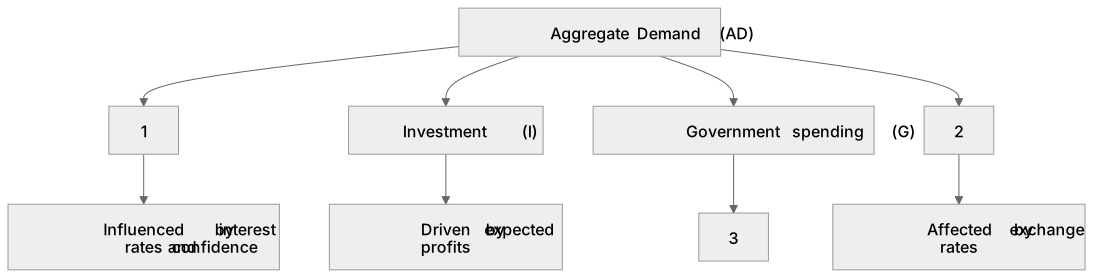
1Box 1
2Box 2
3Box 3
There is more to this lesson
The full lesson goes on to check your understanding and help you earn the marks. Create a free account to carry on, with your progress saved.
A week of Premium from your first lesson · Then the free plan continues · No card, no charge
Test your understanding of Circular flow of income, expenditure and output: c) Factors influencing AD: components C + I + G + (X-M)
Active recall beats re-reading. Take an instant quiz now to test what you’ve learned and lock it into long-term memory.
A week of Premium from your first lesson · Then the free plan continues · No card, no charge