Pearson Edexcel · A-Level · Economics B
Course version: 9EB0 · Version from Sept 2015
C) Changes in pricing to reflect social trends (online sales and price…
Full specification wording
Competing on price: c) Changes in pricing to reflect social trends (online sales and price comparison sites)
Social trends, particularly the shift towards online sales and the proliferation of price comparison sites, have fundamentally altered how businesses set prices.
Checked against the Pearson Edexcel 9EB0 specification (opens in a new tab) on .
- Point 3 of 3
Study notes
From the checked teaching notes for this specification point.
The idea
Social trends, particularly the shift towards online sales and the proliferation of price comparison sites, have fundamentally altered how businesses set prices. The internet has increased market transparency, reducing information asymmetry and making it easier for consumers to compare prices instantly. This heightened visibility often forces businesses into highly competitive pricing strategies to avoid losing market share. Furthermore, online sales allow for dynamic pricing, where algorithms adjust prices in real-time based on demand, competitor actions, and consumer browsing habits. Consequently, businesses must constantly monitor digital trends and adapt their pricing models to remain attractive to increasingly price-sensitive online shoppers.
What earns the marks
- Identify how the growth of online sales has increased price transparency for consumers.
- Explain how price comparison sites intensify competition, often driving prices down towards marginal cost.
- Analyse the use of dynamic pricing in online sales, where prices fluctuate based on real-time demand and competitor behaviour.
- Evaluate the impact of reduced information asymmetry on a firm's ability to maintain premium pricing.
- Assess how businesses might use non-price competition, such as free delivery, to offset the pressure of price comparison sites.
Common mistakes and how to put them right
Stating that online sales always lead to lower prices.
Put it right: While competition increases, online platforms also enable dynamic pricing, which can result in higher prices during peak demand.
Overlooking the cost of appearing on price comparison sites.
Put it right: Businesses often pay commission to these sites, which must be factored into their pricing and profit margins.
Assuming price comparison sites only affect homogeneous goods.
Put it right: They also impact differentiated goods, forcing brands to clearly justify any price premium over cheaper alternatives.
Exam tips
- When discussing online sales, mention dynamic pricing as a key strategy enabled by digital technology and real-time data.
- Use the concept of information asymmetry to explain why price comparison sites empower consumers and reduce the pricing power of businesses.
- Consider the broader impacts of online pricing, such as how high street retailers must adapt their pricing to compete with online-only rivals.
Try the lesson
The start of the Competing on price: c) Changes in pricing to reflect social trends (online sales and price comparison sites) lesson, made from checked teaching notes for this specification point.
Have a go first
How has the growth of price comparison sites generally affected the pricing strategies of businesses selling standardised products, such as car insurance?
Listen
Social trends, particularly the shift towards online sales and the proliferation of price comparison sites, have fundamentally altered how businesses set prices. The internet has increased market transparency, reducing information asymmetry and making it easier for consumers to compare prices instantly. This heightened visibility often forces businesses into highly competitive pricing strategies to avoid losing market share. Furthermore, online sales allow for dynamic pricing, where algorithms adjust prices in real-time based on demand, competitor actions, and consumer browsing habits. Consequently, businesses must constantly monitor digital trends and adapt their pricing models to remain attractive to increasingly price-sensitive online shoppers. A strong answer earns marks for these points. Identify how the growth of online sales has increased price transparency for consumers. Explain how price comparison sites intensify competition, often driving prices down towards marginal cost. Analyse the use of dynamic pricing in online sales, where prices fluctuate based on real-time demand and competitor behaviour. Evaluate the impact of reduced information asymmetry on a firm's ability to maintain premium pricing. A common slip: Stating that online sales always lead to lower prices. Instead, while competition increases, online platforms also enable dynamic pricing, which can result in higher prices during peak demand. Exam tip: When discussing online sales, mention dynamic pricing as a key strategy enabled by digital technology and real-time data.
See it
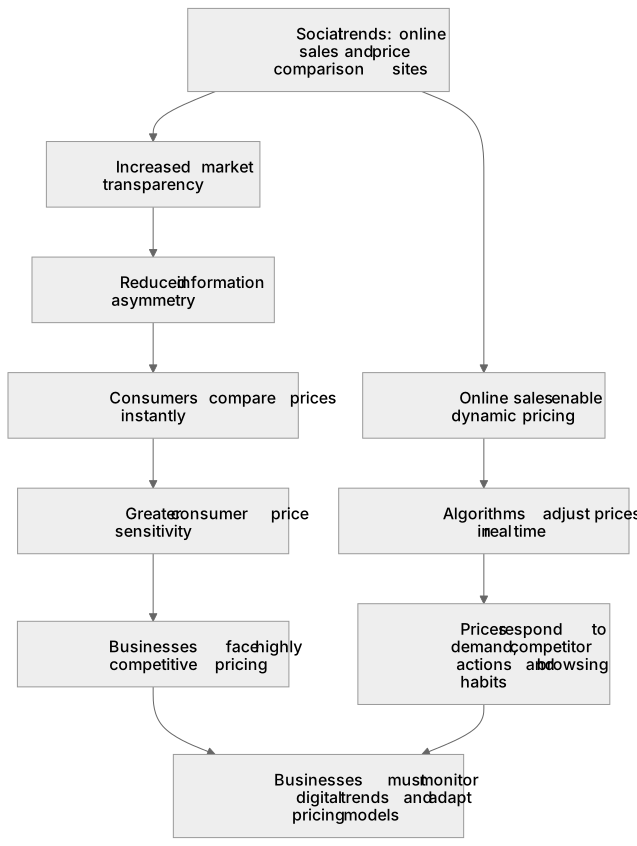
Label the diagram
Some boxes have lost their names. Pick the right name for each number.
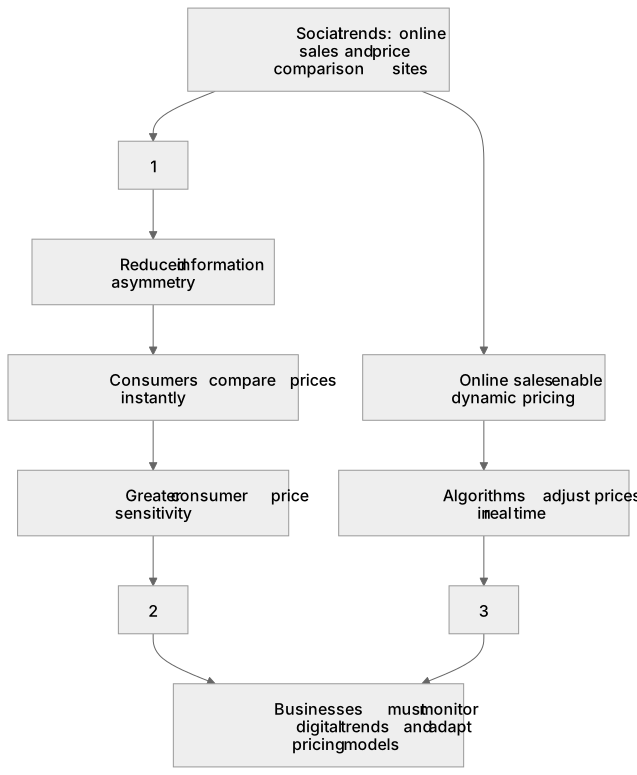
1Box 1
2Box 2
3Box 3
There is more to this lesson
The full lesson goes on to check your understanding and help you earn the marks. Create a free account to carry on, with your progress saved.
A week of Premium from your first lesson · Then the free plan continues · No card, no charge
Test your understanding of Competing on price: c) Changes in pricing to reflect social trends (online sales and price comparison sites)
Active recall beats re-reading. Take an instant quiz now to test what you’ve learned and lock it into long-term memory.
A week of Premium from your first lesson · Then the free plan continues · No card, no charge