Pearson Edexcel · A-Level · Economics B
Course version: 9EB0 · Version from Sept 2015
A) Distinction between monetary and fiscal policy o fiscal policy:…
Full specification wording
Demand-side policies: a) Distinction between monetary and fiscal policy o fiscal policy: government spending and taxation (direct and indirect) o monetary policy: the role of the Bank of England and the Bank of England's Monetary Policy Committee o interest rates o asset purchases to increase the money supply (quantitative easing)
Demand-side policies aim to influence aggregate demand.
Checked against the Pearson Edexcel 9EB0 specification (opens in a new tab) on .
- Point 1 of 6
- 3 key terms
Study notes
From the checked teaching notes for this specification point.
The idea
Demand-side policies aim to influence aggregate demand. Fiscal policy is controlled by the government and involves altering government spending and taxation. Direct taxes (like income tax) affect disposable income, while indirect taxes (like VAT) affect prices. Monetary policy is managed by the Bank of England's Monetary Policy Committee (MPC). The MPC uses interest rates to influence borrowing and saving behaviour. When interest rates cannot be lowered further, the MPC may use quantitative easing (QE), which involves asset purchases to increase the money supply and stimulate lending. Understanding the distinction between the government's fiscal tools and the central bank's monetary tools is crucial for analysing macroeconomic management.
What earns the marks
- Identify fiscal policy as changes in government spending and taxation, including both direct and indirect taxes.
- Identify monetary policy as changes in interest rates and the money supply.
- Recognise the Bank of England's Monetary Policy Committee (MPC) as the independent body responsible for setting interest rates and implementing quantitative easing.
- Explain that quantitative easing involves the central bank purchasing assets to increase the money supply and encourage lending.
Common mistakes and how to put them right
Confusing the agents responsible by stating the government sets interest rates.
Put it right: The Bank of England's Monetary Policy Committee sets interest rates independently of the government.
Misunderstanding quantitative easing by thinking it involves printing physical cash.
Put it right: Quantitative easing involves the central bank buying financial assets, usually government bonds, to increase liquidity in the banking system.
Mixing up direct and indirect taxes by classifying VAT as a direct tax.
Put it right: VAT is an indirect tax on expenditure, whereas income tax is a direct tax levied on earnings.
Exam tips
- Always specify whether a tax is direct or indirect when discussing how fiscal policy impacts aggregate demand.
- When evaluating monetary policy, explicitly mention the role of the Monetary Policy Committee (MPC) rather than just referring generally to the Bank of England.
- Use quantitative easing as an evaluative point when discussing the limitations of lowering interest rates to stimulate the economy.
Try the lesson
The start of the Demand-side policies: a) Distinction between monetary and fiscal policy o fiscal policy: government spending and taxation (direct and indirect) o monetary policy: the role of the Bank of England and the Bank of England's Monetary Policy Committee o interest rates o asset purchases to increase the money supply (quantitative easing) lesson, made from checked teaching notes for this specification point.
Have a go first
Which of the following actions is an example of fiscal policy being used to influence aggregate demand in the macroeconomy?
Listen
Demand-side policies aim to influence aggregate demand. Fiscal policy is controlled by the government and involves altering government spending and taxation. Direct taxes (like income tax) affect disposable income, while indirect taxes (like VAT) affect prices. Monetary policy is managed by the Bank of England's Monetary Policy Committee (MPC). The MPC uses interest rates to influence borrowing and saving behaviour. When interest rates cannot be lowered further, the MPC may use quantitative easing (QE), which involves asset purchases to increase the money supply and stimulate lending. Understanding the distinction between the government's fiscal tools and the central bank's monetary tools is crucial for analysing macroeconomic management. A strong answer earns marks for these points. Identify fiscal policy as changes in government spending and taxation, including both direct and indirect taxes. Identify monetary policy as changes in interest rates and the money supply. Recognise the Bank of England's Monetary Policy Committee (MPC) as the independent body responsible for setting interest rates and implementing quantitative easing. Explain that quantitative easing involves the central bank purchasing assets to increase the money supply and encourage lending. A common slip: Confusing the agents responsible by stating the government sets interest rates. Instead, The Bank of England's Monetary Policy Committee sets interest rates independently of the government. Exam tip: Always specify whether a tax is direct or indirect when discussing how fiscal policy impacts aggregate demand.
See it

Key words
Say what each word means before you turn the card.
Fiscal policy
Try answering aloud or in your head before turning the card.
Monetary policy
Try answering aloud or in your head before turning the card.
Quantitative easing
Try answering aloud or in your head before turning the card.
See every definition
- Fiscal policy
- Involves the government altering its spending and taxation, including both direct and indirect taxes, to influence aggregate demand.
- Monetary policy
- Managed by the Bank of England's Monetary Policy Committee, it uses interest rates and the money supply to influence borrowing and saving behaviour.
- Quantitative easing
- Involves asset purchases by the central bank to increase the money supply and stimulate lending when interest rates cannot be lowered further.
Label the diagram
Some boxes have lost their names. Pick the right name for each number.
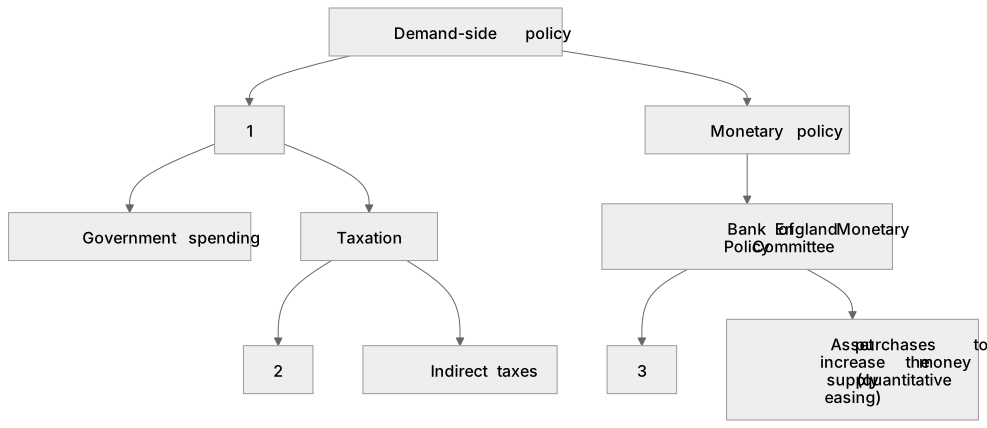
1Box 1
2Box 2
3Box 3
There is more to this lesson
The full lesson goes on to check your understanding and help you earn the marks. Create a free account to carry on, with your progress saved.
A week of Premium from your first lesson · Then the free plan continues · No card, no charge
Test your understanding of Demand-side policies: a) Distinction between monetary and fiscal policy o fiscal policy: government spending and taxation (direct and indirect) o monetary policy: the role of the Bank of England and the Bank of England's Monetary Policy Committee o interest rates o asset purchases to increase the money supply (quantitative easing)
Active recall beats re-reading. Take an instant quiz now to test what you’ve learned and lock it into long-term memory.
A week of Premium from your first lesson · Then the free plan continues · No card, no charge