Pearson Edexcel · A-Level · Economics B
Course version: 9EB0 · Version from Sept 2015
Demand-side policies: f) Time lags involved
Full specification wording
Demand-side policies: f) Time lags involved
Time lags are significant limitations of demand-side policies, delaying their intended effects on the economy.
Checked against the Pearson Edexcel 9EB0 specification (opens in a new tab) on .
- Point 6 of 6
- 4 key terms
Study notes
From the checked teaching notes for this specification point.
The idea
Time lags are significant limitations of demand-side policies, delaying their intended effects on the economy. They occur in several stages: recognition lags (time taken to identify an economic problem using data), decision lags (time required to formulate and pass policy, especially fiscal measures), and transmission lags (time taken for the policy to affect aggregate demand). For example, if a central bank lowers interest rates, it may take 18 to 24 months for the full effect to filter through to consumer spending and business investment. Consequently, by the time a policy takes effect, the economic context may have changed, potentially causing the intervention to destabilise the economy rather than correct the initial issue.
What earns the marks
- Define time lags as the delay between an economic shock occurring and a policy intervention taking full effect on aggregate demand.
- Identify recognition, decision, and transmission lags as the key components of policy time lags.
- Explain that fiscal policy typically suffers from longer decision lags due to the need for legislative approval.
- Explain that monetary policy often experiences long transmission lags, taking up to two years to fully impact the economy.
- Evaluate how time lags can render demand-side policies ineffective or even destabilising if the economic cycle shifts before the policy takes effect.
Common mistakes and how to put them right
Assuming monetary policy has an immediate effect on consumer spending.
Put it right: Monetary policy changes, such as interest rate adjustments, take considerable time (often 18 to 24 months) to fully transmit through the economy.
Confusing decision lags with transmission lags.
Put it right: Decision lags refer to the time taken by policymakers to agree on a measure, whereas transmission lags refer to the time it takes for the implemented measure to affect aggregate demand.
Believing fiscal policy is always faster to implement than monetary policy.
Put it right: Fiscal policy usually has a longer decision lag because it requires government budgets and legislative processes, unlike monetary policy which can be adjusted in regular central bank meetings.
Exam tips
- Use time lags as a key evaluative point when discussing the limitations of both monetary and fiscal policies.
- Differentiate between the types of lags (recognition, decision, transmission) to demonstrate a nuanced understanding of policy implementation.
- Provide a concrete example, such as the 18 to 24 month transmission mechanism of interest rate changes, to strengthen your evaluation.
Try the lesson
The start of the Demand-side policies: f) Time lags involved lesson, made from checked teaching notes for this specification point.
Have a go first
Which of the following best describes the 'transmission lag' associated with monetary policy?
Listen
Time lags are significant limitations of demand-side policies, delaying their intended effects on the economy. They occur in several stages: recognition lags (time taken to identify an economic problem using data), decision lags (time required to formulate and pass policy, especially fiscal measures), and transmission lags (time taken for the policy to affect aggregate demand). For example, if a central bank lowers interest rates, it may take 18 to 24 months for the full effect to filter through to consumer spending and business investment. Consequently, by the time a policy takes effect, the economic context may have changed, potentially causing the intervention to destabilise the economy rather than correct the initial issue. A strong answer earns marks for these points. Define time lags as the delay between an economic shock occurring and a policy intervention taking full effect on aggregate demand. Identify recognition, decision, and transmission lags as the key components of policy time lags. Explain that fiscal policy typically suffers from longer decision lags due to the need for legislative approval. Explain that monetary policy often experiences long transmission lags, taking up to two years to fully impact the economy. A common slip: Assuming monetary policy has an immediate effect on consumer spending. Instead, Monetary policy changes, such as interest rate adjustments, take considerable time (often 18 to 24 months) to fully transmit through the economy. Exam tip: Use time lags as a key evaluative point when discussing the limitations of both monetary and fiscal policies.
See it
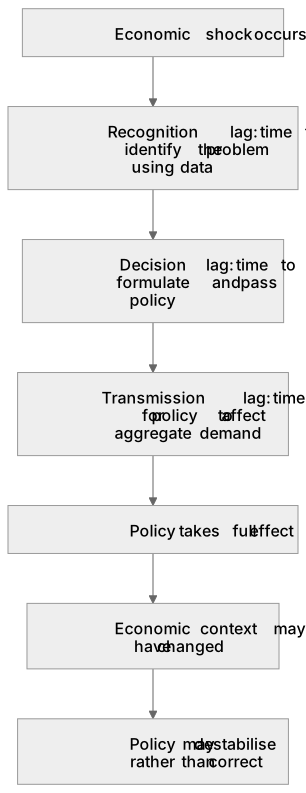
Put it in order
Put these steps in the order they happen.
- 1. Policy may destabilise rather than correct
- 2. Economic context may have changed
- 3. Decision lag: time to formulate and pass policy
- 4. Policy takes full effect
- 5. Economic shock occurs
- 6. Recognition lag: time to identify the problem using data
- 7. Transmission lag: time for policy to affect aggregate demand
Key words
Say what each word means before you turn the card.
Recognition lag
Try answering aloud or in your head before turning the card.
Decision lag
Try answering aloud or in your head before turning the card.
Transmission lag
Try answering aloud or in your head before turning the card.
Time lags
Try answering aloud or in your head before turning the card.
See every definition
- Recognition lag
- The time taken to identify an economic problem using data.
- Decision lag
- The time required to formulate and pass policy, especially fiscal measures.
- Transmission lag
- The time taken for the policy to affect aggregate demand.
- Time lags
- The delay between an economic shock occurring and a policy intervention taking full effect on aggregate demand.
Label the diagram
Some boxes have lost their names. Pick the right name for each number.

1Box 1
2Box 2
3Box 3
There is more to this lesson
The full lesson goes on to check your understanding and help you earn the marks. Create a free account to carry on, with your progress saved.
A week of Premium from your first lesson · Then the free plan continues · No card, no charge
Test your understanding of Demand-side policies: f) Time lags involved
Active recall beats re-reading. Take an instant quiz now to test what you’ve learned and lock it into long-term memory.
A week of Premium from your first lesson · Then the free plan continues · No card, no charge