Pearson Edexcel · A-Level · Economics B
Course version: 9EB0 · Version from Sept 2015
A) Quality: control, assurance, Total Quality Management (TQM)
Full specification wording
Efficiency and competitiveness using lean production: a) Quality: control, assurance, Total Quality Management (TQM)
Quality management is essential for efficiency and competitiveness.
Checked against the Pearson Edexcel 9EB0 specification (opens in a new tab) on .
- Point 1 of 4
- 3 key terms
Study notes
From the checked teaching notes for this specification point.
The idea
Quality management is essential for efficiency and competitiveness. Quality control involves inspecting products at the end of the production process to identify defects, often leading to high waste. Quality assurance shifts the focus to preventing errors by building quality checks into every stage of production, ensuring standards are met throughout. Total Quality Management (TQM) is a comprehensive approach where all employees, from the factory floor to senior management, are responsible for quality.
For example: In a car manufacturing plant using TQM, any worker can halt the assembly line if they spot a defect, fostering a culture of zero defects and continuous improvement, ultimately reducing costs and enhancing customer satisfaction.
What earns the marks
- Define quality control as the process of inspecting finished products to ensure they meet required standards, which can result in high wastage.
- Define quality assurance as a system of agreeing and meeting quality standards at each stage of production to prevent defects.
- Explain that Total Quality Management (TQM) requires a cultural shift where every employee is accountable for maintaining quality.
- Analyse how TQM and quality assurance contribute to lean production by minimising waste, reducing costs, and improving competitiveness.
Common mistakes and how to put them right
Confusing quality control with quality assurance.
Put it right: Control is reactive and checks at the end, while assurance is proactive and checks during the process.
Assuming TQM only applies to production staff.
Put it right: TQM involves all departments and employees within the organisation, including management and administration.
Believing quality control eliminates waste.
Put it right: Quality control often identifies waste after it has occurred; it is quality assurance and TQM that aim to prevent and eliminate waste.
Exam tips
- Use specific examples to illustrate the difference between quality control and quality assurance in a manufacturing context.
- When evaluating TQM, consider the costs and time required to train staff and change the corporate culture.
- Link quality management strategies directly to improvements in efficiency and international competitiveness.
Try the lesson
The start of the Efficiency and competitiveness using lean production: a) Quality: control, assurance, Total Quality Management (TQM) lesson, made from checked teaching notes for this specification point.
Have a go first
Which of the following best describes the process of quality assurance in a manufacturing business?
Listen
Quality management is essential for efficiency and competitiveness. Quality control involves inspecting products at the end of the production process to identify defects, often leading to high waste. Quality assurance shifts the focus to preventing errors by building quality checks into every stage of production, ensuring standards are met throughout. Total Quality Management (TQM) is a comprehensive approach where all employees, from the factory floor to senior management, are responsible for quality. For example, in a car manufacturing plant using TQM, any worker can halt the assembly line if they spot a defect, fostering a culture of zero defects and continuous improvement, ultimately reducing costs and enhancing customer satisfaction. A strong answer earns marks for these points. Define quality control as the process of inspecting finished products to ensure they meet required standards, which can result in high wastage. Define quality assurance as a system of agreeing and meeting quality standards at each stage of production to prevent defects. Explain that Total Quality Management (TQM) requires a cultural shift where every employee is accountable for maintaining quality. Analyse how TQM and quality assurance contribute to lean production by minimising waste, reducing costs, and improving competitiveness. A common slip: Confusing quality control with quality assurance. Instead, control is reactive and checks at the end, while assurance is proactive and checks during the process. Exam tip: Use specific examples to illustrate the difference between quality control and quality assurance in a manufacturing context.
See it
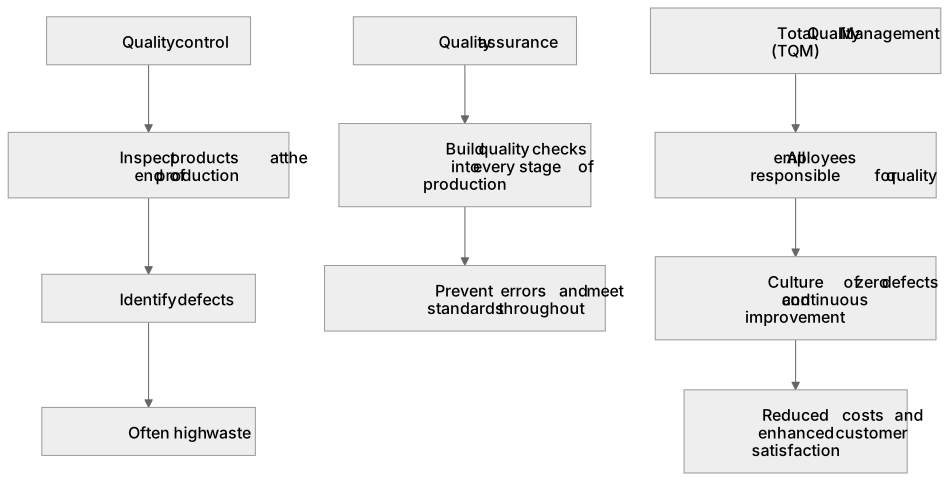
Key words
Say what each word means before you turn the card.
Quality control
Try answering aloud or in your head before turning the card.
Quality assurance
Try answering aloud or in your head before turning the card.
Total Quality Management (TQM)
Try answering aloud or in your head before turning the card.
See every definition
- Quality control
- The process of inspecting finished products to ensure they meet required standards, which can result in high wastage.
- Quality assurance
- A system of agreeing and meeting quality standards at each stage of production to prevent defects.
- Total Quality Management (TQM)
- A comprehensive approach where all employees, from the factory floor to senior management, are responsible for quality.
Label the diagram
Some boxes have lost their names. Pick the right name for each number.
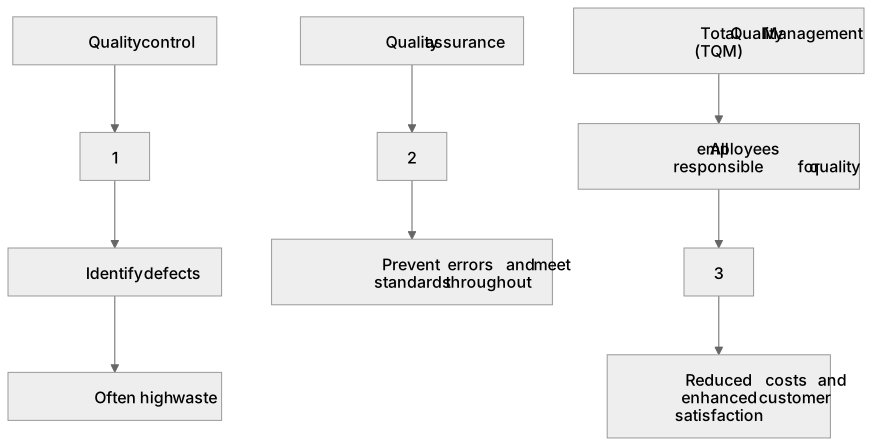
1Box 1
2Box 2
3Box 3
There is more to this lesson
The full lesson goes on to check your understanding and help you earn the marks. Create a free account to carry on, with your progress saved.
A week of Premium from your first lesson · Then the free plan continues · No card, no charge
Test your understanding of Efficiency and competitiveness using lean production: a) Quality: control, assurance, Total Quality Management (TQM)
Active recall beats re-reading. Take an instant quiz now to test what you’ve learned and lock it into long-term memory.
A week of Premium from your first lesson · Then the free plan continues · No card, no charge