Pearson Edexcel · A-Level · Economics B
Course version: 9EB0 · Version from Sept 2015
Ethical issues: a) Stakeholder conflicts
Stakeholder conflicts occur when the objectives of different groups associated with a business are incompatible, often driven by ethical issues.
Checked against the Pearson Edexcel 9EB0 specification (opens in a new tab) on .
- Point 1 of 5
- 4 key terms
Study notes
From the checked teaching notes for this specification point.
The idea
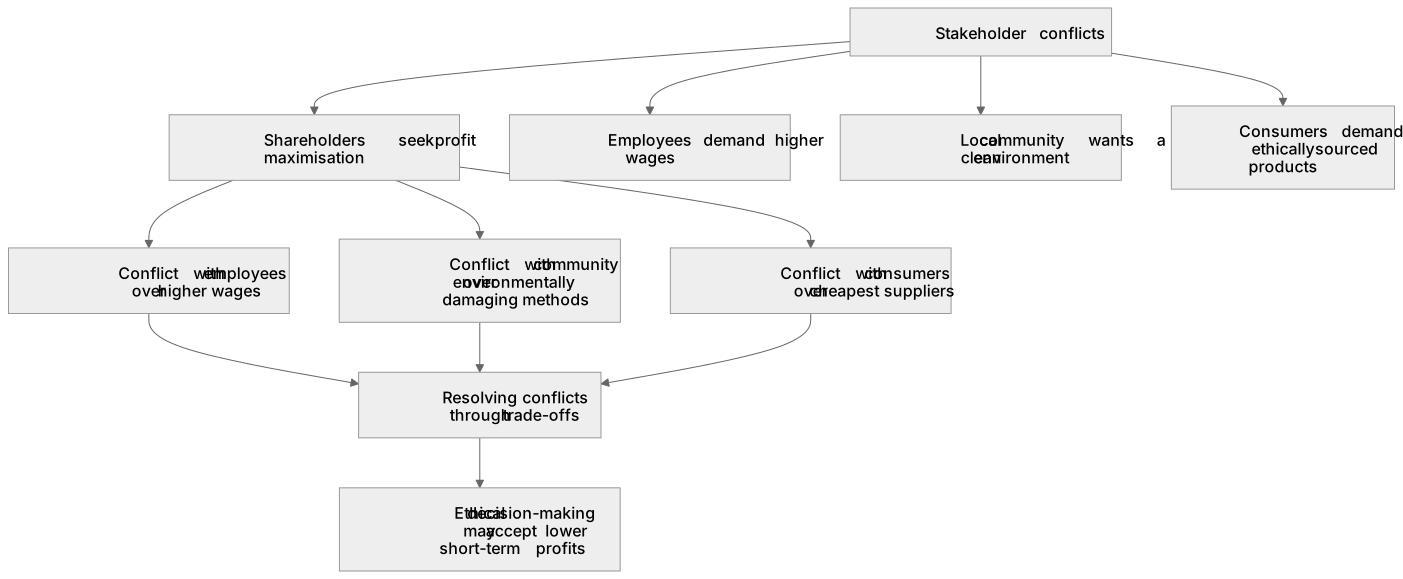
Stakeholder conflicts occur when the objectives of different groups associated with a business are incompatible, often driven by ethical issues. Shareholders typically seek profit maximisation, which can conflict with employees demanding higher wages. A firm's desire to minimise costs using environmentally damaging methods conflicts with the local community's interest in a clean environment. Resolving these conflicts requires balancing competing interests through trade-offs. Ethical decision-making might lead a firm to accept lower short-term profits to satisfy consumer demands for fair trade products or to ensure suppliers are treated ethically, thereby avoiding reputational damage and satisfying broader stakeholder needs.
What earns the marks
- Stakeholder conflicts arise because different groups have divergent objectives, such as shareholders wanting dividends versus employees wanting higher pay.
- Ethical business practices often increase short-term costs, conflicting with the shareholder objective of profit maximisation.
- Consumers increasingly demand ethically sourced products, which can conflict with a firm's desire to use the cheapest available suppliers.
- Local communities may conflict with businesses over negative externalities, such as pollution or noise, generated by production processes.
Common mistakes and how to put them right
Confusing stakeholders with shareholders.
Put it right: Shareholders are just one type of stakeholder who own the business, whereas stakeholders include anyone affected by the business.
Assuming ethical behaviour always reduces long-term profits.
Put it right: While short-term costs may rise, ethical behaviour can enhance brand loyalty and long-term profitability.
Believing all stakeholders have equal power.
Put it right: Stakeholder power varies significantly, and businesses often prioritise those with the most influence, such as major shareholders.
Exam tips
- Always identify the specific stakeholders involved in a conflict and clearly state their opposing objectives.
- Use examples of ethical issues, such as environmental damage or poor working conditions, to illustrate why stakeholder conflicts occur.
- Discuss how resolving stakeholder conflicts often involves trade-offs, where satisfying one group requires compromising the objectives of another.
Try the lesson
The start of the Ethical issues: a) Stakeholder conflicts lesson, made from checked teaching notes for this specification point.
Have a go first
A clothing retailer decides to increase its profit margins by sourcing garments from factories with poor working conditions and low wages. Which two stakeholder groups are most directly in conflict in this scenario?
Listen
Stakeholder conflicts occur when the objectives of different groups associated with a business are incompatible, often driven by ethical issues. Shareholders typically seek profit maximisation, which can conflict with employees demanding higher wages. A firm's desire to minimise costs using environmentally damaging methods conflicts with the local community's interest in a clean environment. Resolving these conflicts requires balancing competing interests through trade-offs. Ethical decision-making might lead a firm to accept lower short-term profits to satisfy consumer demands for fair trade products or to ensure suppliers are treated ethically, thereby avoiding reputational damage and satisfying broader stakeholder needs. A strong answer earns marks for these points. Stakeholder conflicts arise because different groups have divergent objectives, such as shareholders wanting dividends versus employees wanting higher pay. Ethical business practices often increase short-term costs, conflicting with the shareholder objective of profit maximisation. Consumers increasingly demand ethically sourced products, which can conflict with a firm's desire to use the cheapest available suppliers. Local communities may conflict with businesses over negative externalities, such as pollution or noise, generated by production processes. A common slip: Confusing stakeholders with shareholders. Instead, shareholders are just one type of stakeholder who own the business, whereas stakeholders include anyone affected by the business. Exam tip: Always identify the specific stakeholders involved in a conflict and clearly state their opposing objectives.
See it
Key words
Say what each word means before you turn the card.
Stakeholder conflicts
Try answering aloud or in your head before turning the card.
Profit maximisation
Try answering aloud or in your head before turning the card.
Trade-offs
Try answering aloud or in your head before turning the card.
Stakeholders
Try answering aloud or in your head before turning the card.
See every definition
- Stakeholder conflicts
- Occur when the objectives of different groups associated with a business are incompatible, often driven by ethical issues.
- Profit maximisation
- The objective typically sought by shareholders, which can conflict with employees demanding higher wages.
- Trade-offs
- Balancing competing interests, where satisfying one group requires compromising the objectives of another.
- Stakeholders
- Anyone affected by the business, of which shareholders are just one type who own the business.
Label the diagram
Some boxes have lost their names. Pick the right name for each number.
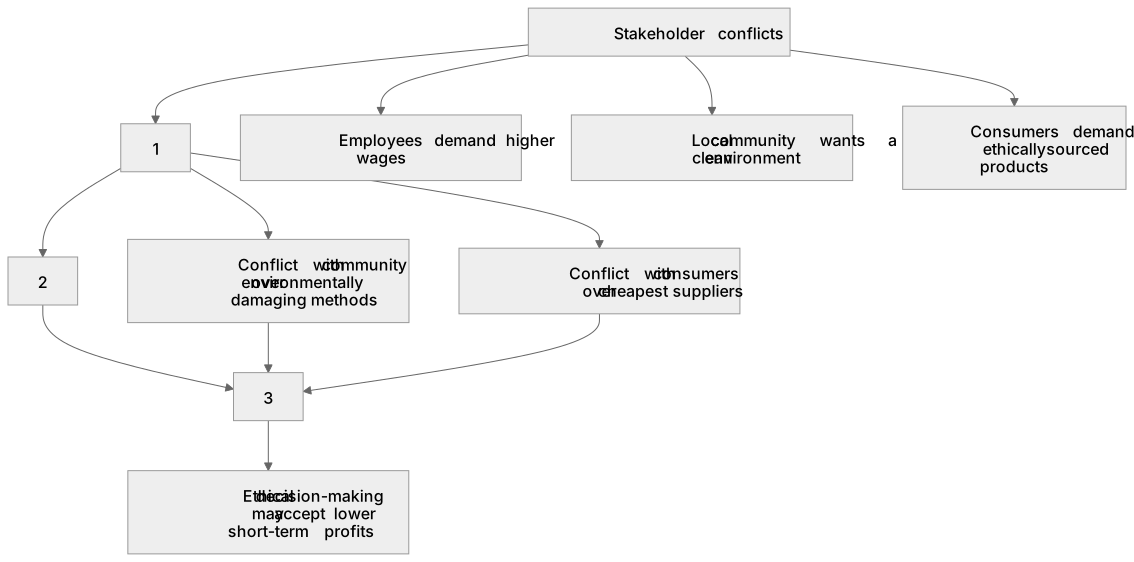
1Box 1
2Box 2
3Box 3
There is more to this lesson
The full lesson goes on to check your understanding and help you earn the marks. Create a free account to carry on, with your progress saved.
A week of Premium from your first lesson · Then the free plan continues · No card, no charge
Test your understanding of Ethical issues: a) Stakeholder conflicts
Active recall beats re-reading. Take an instant quiz now to test what you’ve learned and lock it into long-term memory.
A week of Premium from your first lesson · Then the free plan continues · No card, no charge