Pearson Edexcel · A-Level · Economics B
Course version: 9EB0 · Version from Sept 2015
Exchange rate changes: b) The Eurozone
Full specification wording
Exchange rate changes: b) The Eurozone
The Eurozone is a monetary union of EU member states that use the euro as their sole currency.
Checked against the Pearson Edexcel 9EB0 specification (opens in a new tab) on .
Study notes
From the checked teaching notes for this specification point.
The idea
The Eurozone is a monetary union of EU member states that use the euro as their sole currency. Regarding exchange rate changes, Eurozone membership means individual countries, like Italy, cannot independently devalue their currency to manage economic shocks or boost competitiveness. The European Central Bank sets a single monetary policy for the bloc. While this single currency eliminates exchange rate uncertainty and transaction costs between members, boosting intra-Eurozone trade, it removes a key macroeconomic adjustment tool. If a member faces a downturn, it cannot use exchange rate depreciation to stimulate export demand, relying instead on internal devaluation, such as lowering wages, to restore its international competitiveness.
What earns the marks
- Identify the Eurozone as a monetary union sharing a single currency and central bank.
- Explain that Eurozone members cannot independently alter their exchange rates to manage economic shocks.
- Recognise that a single currency eliminates exchange rate risk and transaction costs for trade between member states.
- Evaluate the inability to use currency depreciation to boost exports during a recession as a significant disadvantage.
Common mistakes and how to put them right
Confusing the Eurozone with the European Union.
Put it right: The EU is a political and economic union, whereas the Eurozone specifically refers to the subset of EU countries that use the euro.
Assuming individual Eurozone countries can set their own interest rates.
Put it right: The European Central Bank sets a single interest rate for the entire Eurozone.
Believing Eurozone countries can devalue their currency to boost exports.
Put it right: Member states share the euro and cannot independently devalue it; they must use internal devaluation instead.
Exam tips
- When evaluating the impact of exchange rates, contrast the policy options of a Eurozone member with those of a country with a floating national currency.
- Use the concept of internal devaluation (lowering domestic prices and wages) as the alternative to currency depreciation for Eurozone members.
- Remember that while intra-Eurozone trade has no exchange rate risk, the euro still fluctuates against other global currencies like the US dollar.
Try the lesson
The start of the Exchange rate changes: b) The Eurozone lesson, made from checked teaching notes for this specification point.
Have a go first
What is a key characteristic of the Eurozone regarding the exchange rates of its member countries?
Listen
The Eurozone is a monetary union of EU member states that use the euro as their sole currency. Regarding exchange rate changes, Eurozone membership means individual countries, like Italy, cannot independently devalue their currency to manage economic shocks or boost competitiveness. The European Central Bank sets a single monetary policy for the bloc. While this single currency eliminates exchange rate uncertainty and transaction costs between members, boosting intra-Eurozone trade, it removes a key macroeconomic adjustment tool. If a member faces a downturn, it cannot use exchange rate depreciation to stimulate export demand, relying instead on internal devaluation, such as lowering wages, to restore its international competitiveness. A strong answer earns marks for these points. Identify the Eurozone as a monetary union sharing a single currency and central bank. Explain that Eurozone members cannot independently alter their exchange rates to manage economic shocks. Recognise that a single currency eliminates exchange rate risk and transaction costs for trade between member states. Evaluate the inability to use currency depreciation to boost exports during a recession as a significant disadvantage. A common slip: Confusing the Eurozone with the European Union. Instead, The EU is a political and economic union, whereas the Eurozone specifically refers to the subset of EU countries that use the euro. Exam tip: When evaluating the impact of exchange rates, contrast the policy options of a Eurozone member with those of a country with a floating national currency.
See it
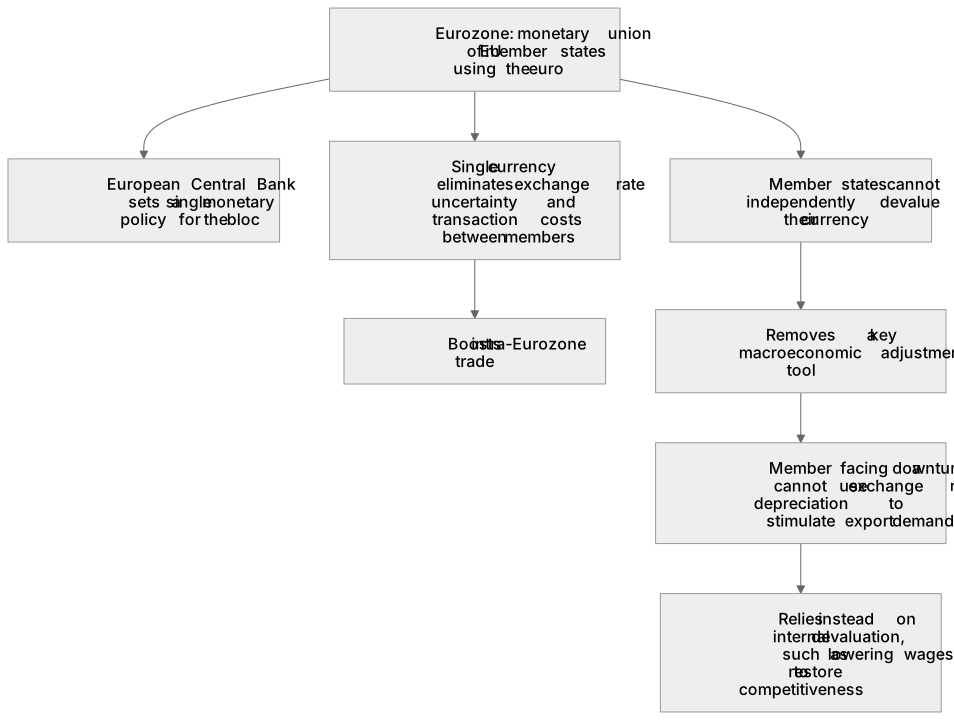
Label the diagram
Some boxes have lost their names. Pick the right name for each number.
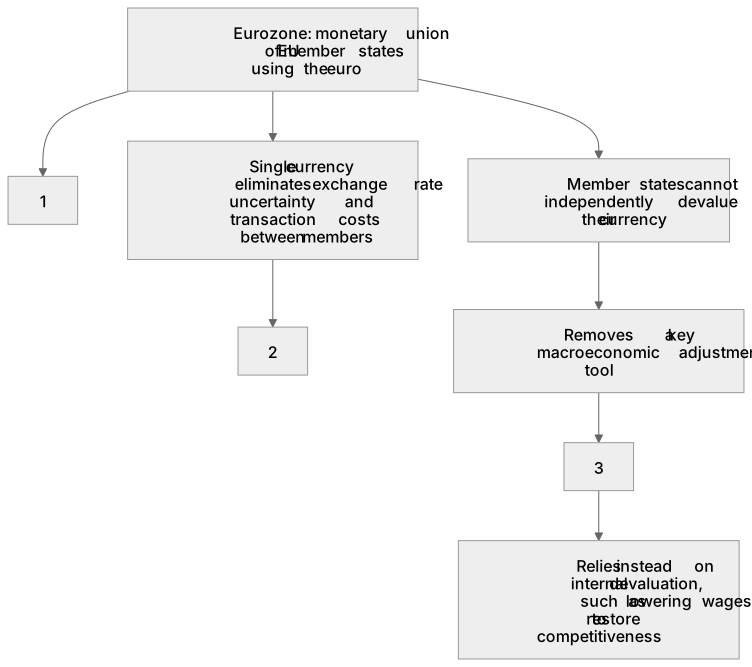
1Box 1
2Box 2
3Box 3
There is more to this lesson
The full lesson goes on to check your understanding and help you earn the marks. Create a free account to carry on, with your progress saved.
A week of Premium from your first lesson · Then the free plan continues · No card, no charge
Test your understanding of Exchange rate changes: b) The Eurozone
Active recall beats re-reading. Take an instant quiz now to test what you’ve learned and lock it into long-term memory.
A week of Premium from your first lesson · Then the free plan continues · No card, no charge