Pearson Edexcel · A-Level · Economics B
Course version: 9EB0 · Version from Sept 2015
Externalities: a) Private, external and social costs and benefits
Understanding externalities requires distinguishing private, external, and social costs and benefits.
Checked against the Pearson Edexcel 9EB0 specification (opens in a new tab) on .
- Point 1 of 3
- 4 key terms
Study notes
From the checked teaching notes for this specification point.
The idea
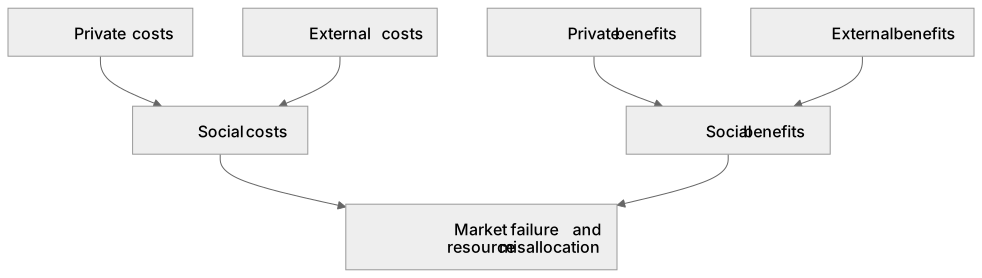
Understanding externalities requires distinguishing private, external, and social costs and benefits. Private costs are borne directly by the producer or consumer, such as raw material expenses. External costs are negative side-effects imposed on third parties, like pollution affecting health. Social costs represent the total cost to society, calculated as private plus external costs. Private benefits are direct gains, such as personal utility from education. External benefits are positive spillovers to third parties, like a more productive workforce. Social benefits equal private plus external benefits. Market failure occurs when the price mechanism only considers private values, ignoring external ones, leading to resource misallocation.
What earns the marks
- Define private costs and benefits as those directly affecting the economic agents involved in a transaction.
- Define external costs and benefits as the spillover effects on third parties not involved in the transaction.
- Calculate social costs as the sum of private and external costs, and social benefits as the sum of private and external benefits.
- Explain how the divergence between private and social costs or benefits leads to market failure and resource misallocation.
Common mistakes and how to put them right
Confusing private costs with social costs.
Put it right: Social costs include both private costs and external costs; they are only equal if there are no external costs.
Assuming external benefits only apply to public goods.
Put it right: Recognise that external benefits can arise from the consumption of merit goods, such as education and healthcare, which are private goods.
Failing to identify the third party in an externality scenario.
Put it right: Specify who the third party is, such as local residents or the healthcare system, when explaining external costs or benefits.
Exam tips
- Use clear equations, such as Social Cost = Private Cost + External Cost, to demonstrate your understanding of the relationships between these concepts.
- Always provide concrete examples of external costs, like air pollution, and external benefits, like vaccinations, when defining them.
- When analysing market failure, explicitly state whether the market is over-producing or under-producing the good relative to the socially optimum level.
Try the lesson
The start of the Externalities: a) Private, external and social costs and benefits lesson, made from checked teaching notes for this specification point.
Have a go first
A manufacturing firm produces steel, incurring costs for raw materials while also generating noise pollution for nearby residents. How is the total social cost of this steel production calculated?
Listen
Understanding externalities requires distinguishing private, external, and social costs and benefits. Private costs are borne directly by the producer or consumer, such as raw material expenses. External costs are negative side-effects imposed on third parties, like pollution affecting health. Social costs represent the total cost to society, calculated as private plus external costs. Private benefits are direct gains, such as personal utility from education. External benefits are positive spillovers to third parties, like a more productive workforce. Social benefits equal private plus external benefits. Market failure occurs when the price mechanism only considers private values, ignoring external ones, leading to resource misallocation. A strong answer earns marks for these points. Define private costs and benefits as those directly affecting the economic agents involved in a transaction. Define external costs and benefits as the spillover effects on third parties not involved in the transaction. Calculate social costs as the sum of private and external costs, and social benefits as the sum of private and external benefits. Explain how the divergence between private and social costs or benefits leads to market failure and resource misallocation. A common slip: Confusing private costs with social costs. Instead, social costs include both private costs and external costs; they are only equal if there are no external costs. Exam tip: Use clear equations, such as Social Cost = Private Cost + External Cost, to demonstrate your understanding of the relationships between these concepts.
See it
Key words
Say what each word means before you turn the card.
Market failure
Try answering aloud or in your head before turning the card.
External costs
Try answering aloud or in your head before turning the card.
Social costs
Try answering aloud or in your head before turning the card.
External benefits
Try answering aloud or in your head before turning the card.
See every definition
- Market failure
- Occurs when the price mechanism only considers private values, ignoring external ones, leading to resource misallocation.
- External costs
- Negative side-effects imposed on third parties, like pollution affecting health.
- Social costs
- The total cost to society, calculated as private plus external costs.
- External benefits
- Positive spillovers to third parties, like a more productive workforce.
Label the diagram
Some boxes have lost their names. Pick the right name for each number.
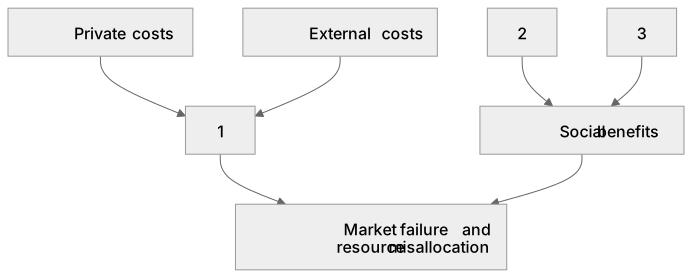
1Box 1
2Box 2
3Box 3
There is more to this lesson
The full lesson goes on to check your understanding and help you earn the marks. Create a free account to carry on, with your progress saved.
A week of Premium from your first lesson · Then the free plan continues · No card, no charge
Test your understanding of Externalities: a) Private, external and social costs and benefits
Active recall beats re-reading. Take an instant quiz now to test what you’ve learned and lock it into long-term memory.
A week of Premium from your first lesson · Then the free plan continues · No card, no charge