Pearson Edexcel · A-Level · Economics B
Course version: 9EB0 · Version from Sept 2015
Externalities: c) Environmental externalities
Environmental externalities occur when economic activities create unintended environmental costs or benefits for third parties.
Checked against the Pearson Edexcel 9EB0 specification (opens in a new tab) on .
- Point 3 of 3
- 2 key terms
Study notes
From the checked teaching notes for this specification point.
The idea
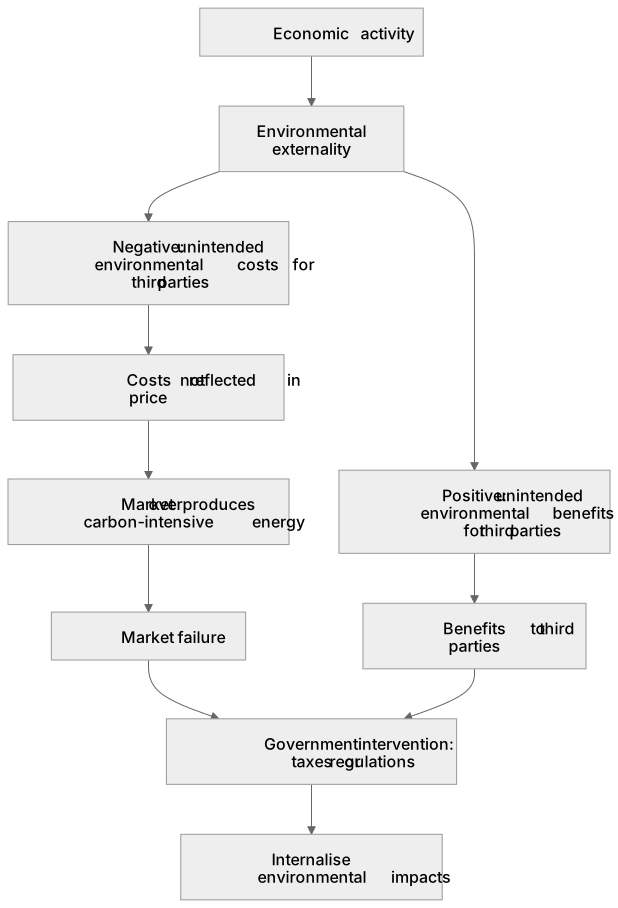
Environmental externalities occur when economic activities create unintended environmental costs or benefits for third parties. A common negative environmental externality is greenhouse gas emissions from a coal power station. The firm pays for coal and labour, but society bears the cost of climate change and poor air quality. Because these external environmental costs are not reflected in the electricity price, the market overproduces carbon-intensive energy, leading to market failure. Conversely, positive environmental externalities exist, such as a farmer planting trees that prevent soil erosion and improve local biodiversity. Governments often intervene using taxes or regulations to internalise these environmental impacts.
What earns the marks
- Definition of environmental externalities as third-party costs or benefits affecting the natural environment.
- Identification of negative environmental externalities, such as air pollution, water contamination, or carbon emissions.
- Identification of positive environmental externalities, such as reforestation improving air quality or biodiversity.
- Explanation of how negative environmental externalities lead to overproduction of polluting goods and market failure.
- Evaluation of methods to internalise environmental externalities, such as carbon taxes, subsidies, or tradable pollution permits.
Common mistakes and how to put them right
Believing that all environmental externalities are negative.
Put it right: Acknowledge that positive environmental externalities exist, such as a business creating a wetland that supports local wildlife.
Confusing the cause of the externality with the externality itself.
Put it right: The externality is the cost or benefit to the third party (e.g. health issues from smog), not the activity itself (e.g. driving a car).
Assuming environmental externalities only occur in manufacturing.
Put it right: Recognise that agriculture, transport, and even consumer behaviour (like waste disposal) generate environmental externalities.
Exam tips
- Be prepared to discuss both local environmental externalities (like noise pollution) and global ones (like climate change).
- Link environmental externalities directly to the concept of market failure and the over-allocation of resources to polluting activities.
- When discussing government intervention, evaluate the effectiveness of different policies like taxation versus regulation in reducing environmental damage.
Try the lesson
The start of the Externalities: c) Environmental externalities lesson, made from checked teaching notes for this specification point.
Have a go first
Which of the following best describes an environmental negative externality arising from the production of a good?
Listen
Environmental externalities occur when economic activities create unintended environmental costs or benefits for third parties. A common negative environmental externality is greenhouse gas emissions from a coal power station. The firm pays for coal and labour, but society bears the cost of climate change and poor air quality. Because these external environmental costs are not reflected in the electricity price, the market overproduces carbon-intensive energy, leading to market failure. Conversely, positive environmental externalities exist, such as a farmer planting trees that prevent soil erosion and improve local biodiversity. Governments often intervene using taxes or regulations to internalise these environmental impacts. A strong answer earns marks for these points. Definition of environmental externalities as third-party costs or benefits affecting the natural environment. Identification of negative environmental externalities, such as air pollution, water contamination, or carbon emissions. Identification of positive environmental externalities, such as reforestation improving air quality or biodiversity. Explanation of how negative environmental externalities lead to overproduction of polluting goods and market failure. A common slip: Believing that all environmental externalities are negative. Instead, Acknowledge that positive environmental externalities exist, such as a business creating a wetland that supports local wildlife. Exam tip: Be prepared to discuss both local environmental externalities (like noise pollution) and global ones (like climate change).
See it
Key words
Say what each word means before you turn the card.
Environmental externalities
Try answering aloud or in your head before turning the card.
Government intervention
Try answering aloud or in your head before turning the card.
See every definition
- Environmental externalities
- Unintended environmental costs or benefits that economic activities create for third parties.
- Government intervention
- Action by governments, often using taxes or regulations, to internalise environmental impacts.
Label the diagram
Some boxes have lost their names. Pick the right name for each number.
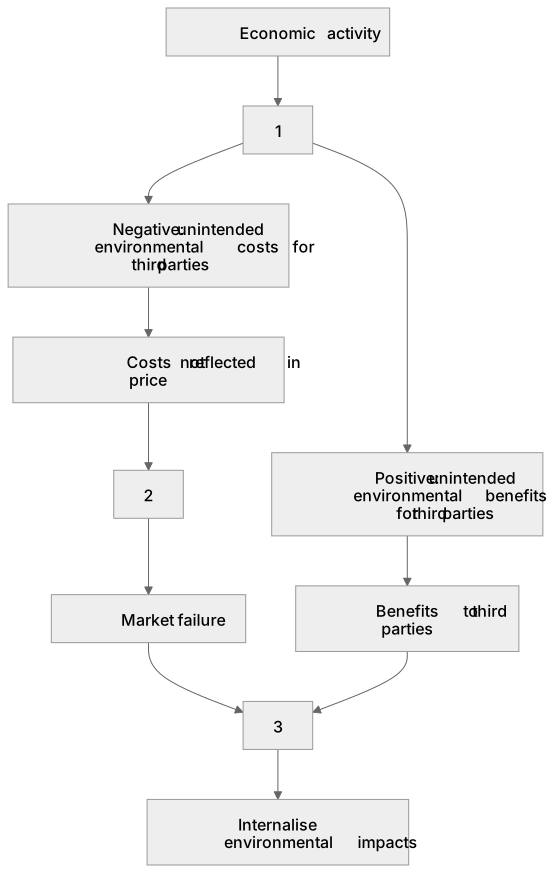
1Box 1
2Box 2
3Box 3
There is more to this lesson
The full lesson goes on to check your understanding and help you earn the marks. Create a free account to carry on, with your progress saved.
A week of Premium from your first lesson · Then the free plan continues · No card, no charge
Test your understanding of Externalities: c) Environmental externalities
Active recall beats re-reading. Take an instant quiz now to test what you’ve learned and lock it into long-term memory.
A week of Premium from your first lesson · Then the free plan continues · No card, no charge