Pearson Edexcel · A-Level · Economics B
Course version: 9EB0 · Version from Sept 2015
A) Small-firm survival in competitive markets: o product differentiation…
Full specification wording
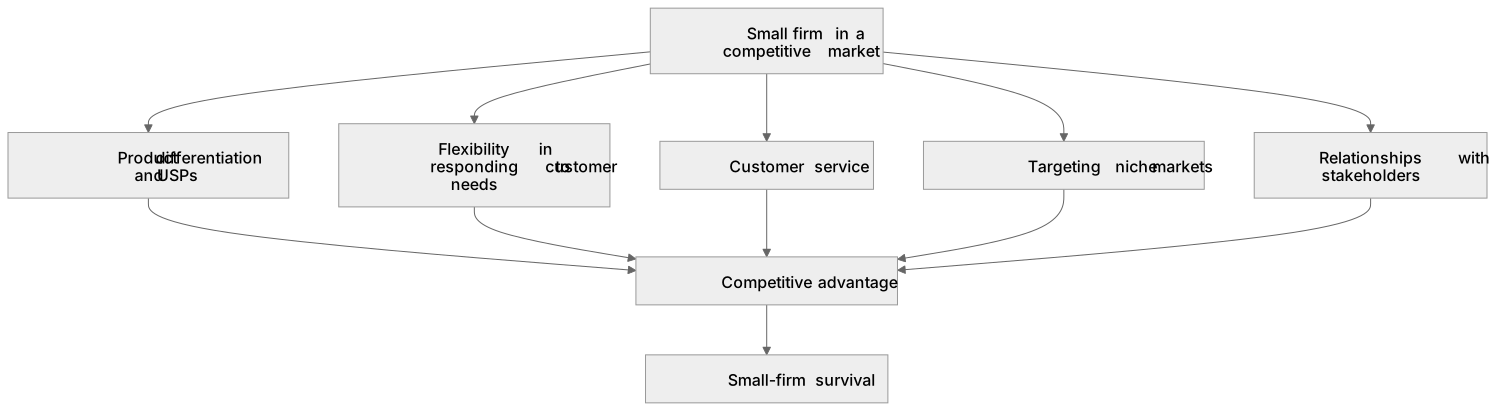
How small firms compete: a) Small-firm survival in competitive markets: o product differentiation and unique selling points (USPs) o flexibility in responding to customer needs o customer service o targeting niche markets o achieving competitive advantage through relationships with stakeholders
Small firms survive in highly competitive markets by avoiding direct price competition with larger rivals.
Checked against the Pearson Edexcel 9EB0 specification (opens in a new tab) on .
- 4 key terms
Study notes
From the checked teaching notes for this specification point.
The idea
Small firms survive in highly competitive markets by avoiding direct price competition with larger rivals. They achieve this through product differentiation and establishing strong unique selling points (USPs), such as bespoke goods. Their smaller scale allows greater flexibility in responding to customer needs, adapting product lines faster than large corporations. Exceptional, personalised customer service builds brand loyalty. By targeting niche markets, small firms cater to specific consumer preferences that mass-market producers ignore. Furthermore, they achieve a sustainable competitive advantage by cultivating close, mutually beneficial relationships with key stakeholders, including local suppliers, employees, and loyal customers.
What earns the marks
- Identify a valid unique selling point (USP) that allows a small firm to differentiate its product from mass-market competitors.
- Explain how a flat organisational structure gives small firms the flexibility to respond rapidly to changing customer needs.
- Analyse the role of personalised customer service in adding value and retaining a loyal customer base.
- Evaluate how targeting a niche market reduces the threat of competition from large-scale, dominant firms.
- Assess the benefits of strong stakeholder relationships, such as favourable credit terms from local suppliers.
Common mistakes and how to put them right
Stating that small firms compete primarily on price.
Put it right: Recognise that small firms usually cannot achieve the economies of scale required to compete on price, so they compete on quality, USP, and service.
Confusing a niche market with a small market share in a mass market.
Put it right: A niche market is a specific, well-defined segment of the market with distinct needs, not just a small slice of a generic market.
Overlooking the importance of stakeholder relationships.
Put it right: Acknowledge that close ties with suppliers, employees, and the local community provide a competitive advantage that large firms struggle to replicate.
Exam tips
- Always link a small firm's survival strategy back to its inability to exploit economies of scale compared to larger rivals.
- Use examples of bespoke or highly specialised products when illustrating product differentiation and USPs.
- Highlight how flexibility allows small firms to pivot their business model quickly without the bureaucracy that slows down large corporations.
Try the lesson
The start of the How small firms compete: a) Small-firm survival in competitive markets: o product differentiation and unique selling points (USPs) o flexibility in responding to customer needs o customer service o targeting niche markets o achieving competitive advantage through relationships with stakeholders lesson, made from checked teaching notes for this specification point.
Have a go first
Which of the following is an example of a small firm using a unique selling point (USP) to survive in a highly competitive market?
Listen
Small firms survive in highly competitive markets by avoiding direct price competition with larger rivals. They achieve this through product differentiation and establishing strong unique selling points (USPs), such as bespoke goods. Their smaller scale allows greater flexibility in responding to customer needs, adapting product lines faster than large corporations. Exceptional, personalised customer service builds brand loyalty. By targeting niche markets, small firms cater to specific consumer preferences that mass-market producers ignore. Furthermore, they achieve a sustainable competitive advantage by cultivating close, mutually beneficial relationships with key stakeholders, including local suppliers, employees, and loyal customers. A strong answer earns marks for these points. Identify a valid unique selling point (USP) that allows a small firm to differentiate its product from mass-market competitors. Explain how a flat organisational structure gives small firms the flexibility to respond rapidly to changing customer needs. Analyse the role of personalised customer service in adding value and retaining a loyal customer base. Evaluate how targeting a niche market reduces the threat of competition from large-scale, dominant firms. A common slip: Stating that small firms compete primarily on price. Instead, Recognise that small firms usually cannot achieve the economies of scale required to compete on price, so they compete on quality, USP, and service. Exam tip: Always link a small firm's survival strategy back to its inability to exploit economies of scale compared to larger rivals.
See it
Key words
Say what each word means before you turn the card.
Competitive advantage
Try answering aloud or in your head before turning the card.
Product differentiation
Try answering aloud or in your head before turning the card.
Niche markets
Try answering aloud or in your head before turning the card.
Stakeholder relationships
Try answering aloud or in your head before turning the card.
See every definition
- Competitive advantage
- A sustainable edge that small firms achieve by cultivating close, mutually beneficial relationships with key stakeholders, including local suppliers, employees and loyal customers.
- Product differentiation
- A way small firms avoid direct price competition with larger rivals by making their products distinct, for example through bespoke goods.
- Niche markets
- Specific, well-defined segments of the market with distinct needs that small firms target, catering to consumer preferences that mass-market producers ignore.
- Stakeholder relationships
- Close ties with suppliers, employees and the local community that provide a competitive advantage large firms struggle to replicate.
Label the diagram
Some boxes have lost their names. Pick the right name for each number.
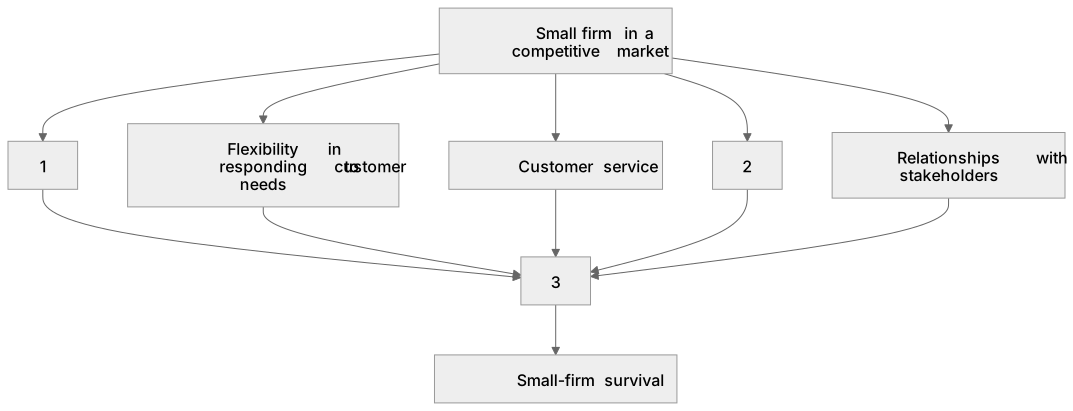
1Box 1
2Box 2
3Box 3
There is more to this lesson
The full lesson goes on to check your understanding and help you earn the marks. Create a free account to carry on, with your progress saved.
A week of Premium from your first lesson · Then the free plan continues · No card, no charge
Test your understanding of How small firms compete: a) Small-firm survival in competitive markets: o product differentiation and unique selling points (USPs) o flexibility in responding to customer needs o customer service o targeting niche markets o achieving competitive advantage through relationships with stakeholders
Active recall beats re-reading. Take an instant quiz now to test what you’ve learned and lock it into long-term memory.
A week of Premium from your first lesson · Then the free plan continues · No card, no charge