Pearson Edexcel · A-Level · Economics B
Course version: 9EB0 · Version from Sept 2015
D) The factors influencing income elasticity of demand
Full specification wording
Income elasticity of demand (YED): d) The factors influencing income elasticity of demand
The income elasticity of demand (YED) is influenced by several factors, primarily the nature of the good and consumer perceptions.
Checked against the Pearson Edexcel 9EB0 specification (opens in a new tab) on .
- Point 4 of 4
Study notes
From the checked teaching notes for this specification point.
The idea
The income elasticity of demand (YED) is influenced by several factors, primarily the nature of the good and consumer perceptions. Whether a good is viewed as a necessity or a luxury dictates its YED; basic foodstuffs typically have a low, positive YED because they are bought regardless of income fluctuations, whereas designer clothing has a high, positive YED. The current income level of consumers also matters; a good might be a luxury at lower income levels but become a necessity or an inferior good as incomes rise. Furthermore, the availability of higher-quality substitutes influences YED; if incomes rise and better alternatives exist, consumers will abandon the original product, rendering it an inferior good with a negative YED.
What earns the marks
- Identifies the degree of necessity as a primary determinant of YED.
- Explains how consumer income levels affect whether a good is perceived as normal or inferior.
- Recognises that the availability of superior substitutes can turn a normal good into an inferior good as incomes rise.
- Evaluates how changes in societal trends or branding can shift a product from a necessity to a luxury.
Common mistakes and how to put them right
Confusing factors affecting YED with those affecting PED.
Put it right: Factors like the proportion of income spent or time period primarily affect PED, whereas YED is driven by the good's status as a necessity, luxury, or inferior item.
Assuming a good's YED is static for all consumers.
Put it right: A good can be a normal good for a low-income earner but an inferior good for a high-income earner.
Believing that all goods become luxuries as income falls.
Put it right: Necessities often remain necessities with a YED between 0 and 1, regardless of minor income drops, because they are essential for survival.
Exam tips
- When evaluating YED, always consider the context of the target market's current income level.
- Use examples, such as public transport versus private car ownership, to illustrate how a good can transition from normal to inferior.
- Read multiple-choice scenarios carefully to determine if a shift in consumer perception has altered the good's YED classification.
Try the lesson
The start of the Income elasticity of demand (YED): d) The factors influencing income elasticity of demand lesson, made from checked teaching notes for this specification point.
Have a go first
Which of the following is generally considered the primary factor influencing the income elasticity of demand for a good?
Listen
The income elasticity of demand (YED) is influenced by several factors, primarily the nature of the good and consumer perceptions. Whether a good is viewed as a necessity or a luxury dictates its YED; basic foodstuffs typically have a low, positive YED because they are bought regardless of income fluctuations, whereas designer clothing has a high, positive YED. The current income level of consumers also matters; a good might be a luxury at lower income levels but become a necessity or an inferior good as incomes rise. Furthermore, the availability of higher-quality substitutes influences YED; if incomes rise and better alternatives exist, consumers will abandon the original product, rendering it an inferior good with a negative YED. A strong answer earns marks for these points. Identifies the degree of necessity as a primary determinant of YED. Explains how consumer income levels affect whether a good is perceived as normal or inferior. Recognises that the availability of superior substitutes can turn a normal good into an inferior good as incomes rise. Evaluates how changes in societal trends or branding can shift a product from a necessity to a luxury. A common slip: Confusing factors affecting YED with those affecting PED. Instead, Factors like the proportion of income spent or time period primarily affect PED, whereas YED is driven by the good's status as a necessity, luxury, or inferior item. Exam tip: When evaluating YED, always consider the context of the target market's current income level.
See it
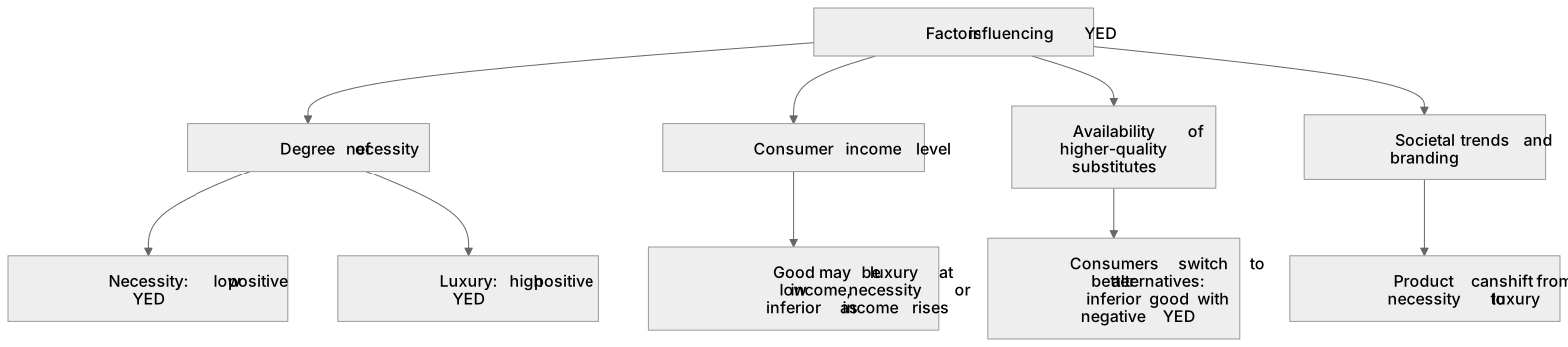
Label the diagram
Some boxes have lost their names. Pick the right name for each number.
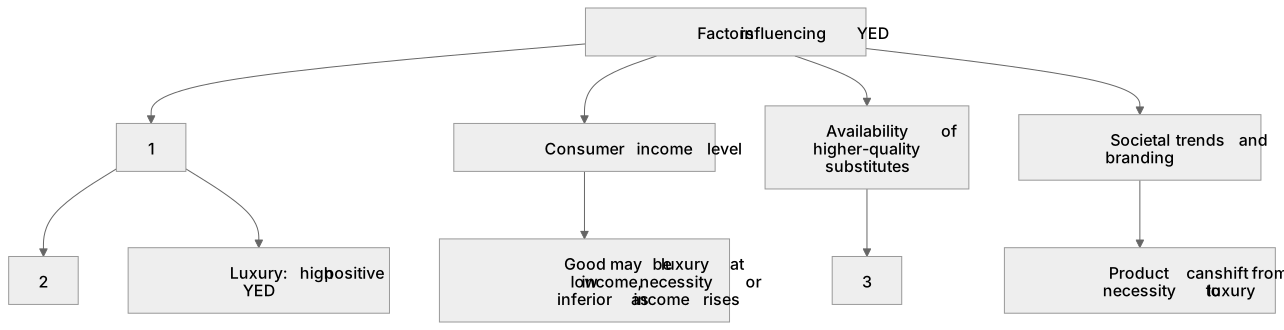
1Box 1
2Box 2
3Box 3
There is more to this lesson
The full lesson goes on to check your understanding and help you earn the marks. Create a free account to carry on, with your progress saved.
A week of Premium from your first lesson · Then the free plan continues · No card, no charge
Test your understanding of Income elasticity of demand (YED): d) The factors influencing income elasticity of demand
Active recall beats re-reading. Take an instant quiz now to test what you’ve learned and lock it into long-term memory.
A week of Premium from your first lesson · Then the free plan continues · No card, no charge