Pearson Edexcel · A-Level · Economics B
Course version: 9EB0 · Version from Sept 2015
Inflation: a) Inflation, deflation and disinflation
Inflation is the sustained increase in the general price level of goods and services in an economy over a period of time, which leads to a fall in the purchasing power of money.
Checked against the Pearson Edexcel 9EB0 specification (opens in a new tab) on .
- Point 1 of 6
- 3 key terms
Study notes
From the checked teaching notes for this specification point.
The idea
Inflation is the sustained increase in the general price level of goods and services in an economy over a period of time, which leads to a fall in the purchasing power of money. For example, if inflation is 5%, a basket of goods costing £100 will cost £105 a year later. Deflation is the opposite: a sustained decrease in the general price level, meaning the inflation rate falls below 0% (e.g. -1%). This increases the purchasing power of money but can lead to delayed consumer spending. Disinflation occurs when the rate of inflation slows down but remains positive. For instance, if the inflation rate drops from 5% to 2%, prices are still rising, but at a slower pace. Understanding these distinctions is crucial for analysing macroeconomic performance and monetary policy decisions.
What earns the marks
- Define inflation as a sustained rise in the general price level, reducing the purchasing power of money.
- Define deflation as a sustained fall in the general price level, represented by a negative inflation rate.
- Define disinflation as a fall in the rate of inflation, where prices are still rising but at a slower pace.
- Identify the correct state of the economy from a given set of inflation rate data over time.
Common mistakes and how to put them right
Confusing deflation with disinflation.
Put it right: Deflation means prices are falling (negative inflation), whereas disinflation means prices are still rising but at a slower rate.
Assuming a fall in the inflation rate means prices are falling.
Put it right: If inflation falls from 4% to 2%, prices are still increasing by 2%.
Defining inflation as an increase in the price of a single good.
Put it right: Inflation refers to a sustained increase in the general price level across the entire economy.
Exam tips
- When analysing data tables, check if the values represent the price index or the percentage change (inflation rate).
- Look for the negative sign in data to correctly identify periods of deflation.
- Use the terms disinflation and deflation precisely in written analysis to demonstrate strong macroeconomic understanding.
Try the lesson
The start of the Inflation: a) Inflation, deflation and disinflation lesson, made from checked teaching notes for this specification point.
Have a go first
Which of the following best describes an economic situation where the general price level is rising, but at a slower percentage rate than in the previous period?
Listen
Inflation is the sustained increase in the general price level of goods and services in an economy over a period of time, which leads to a fall in the purchasing power of money. For example, if inflation is 5%, a basket of goods costing £100 will cost £105 a year later. Deflation is the opposite: a sustained decrease in the general price level, meaning the inflation rate falls below 0% (e.g. -1%). This increases the purchasing power of money but can lead to delayed consumer spending. Disinflation occurs when the rate of inflation slows down but remains positive. For instance, if the inflation rate drops from 5% to 2%, prices are still rising, but at a slower pace. Understanding these distinctions is crucial for analysing macroeconomic performance and monetary policy decisions. A strong answer earns marks for these points. Define inflation as a sustained rise in the general price level, reducing the purchasing power of money. Define deflation as a sustained fall in the general price level, represented by a negative inflation rate. Define disinflation as a fall in the rate of inflation, where prices are still rising but at a slower pace. Identify the correct state of the economy from a given set of inflation rate data over time. A common slip: Confusing deflation with disinflation. Instead, Deflation means prices are falling (negative inflation), whereas disinflation means prices are still rising but at a slower rate. Exam tip: When analysing data tables, check if the values represent the price index or the percentage change (inflation rate).
See it

Key words
Say what each word means before you turn the card.
Inflation
Try answering aloud or in your head before turning the card.
Deflation
Try answering aloud or in your head before turning the card.
Disinflation
Try answering aloud or in your head before turning the card.
See every definition
- Inflation
- A sustained increase in the general price level of goods and services in an economy over a period of time, which leads to a fall in the purchasing power of money.
- Deflation
- A sustained decrease in the general price level, meaning the inflation rate falls below 0%, which increases the purchasing power of money but can lead to delayed consumer spending.
- Disinflation
- A situation where the rate of inflation slows down but remains positive, so prices are still rising, but at a slower pace.
Label the diagram
Some boxes have lost their names. Pick the right name for each number.
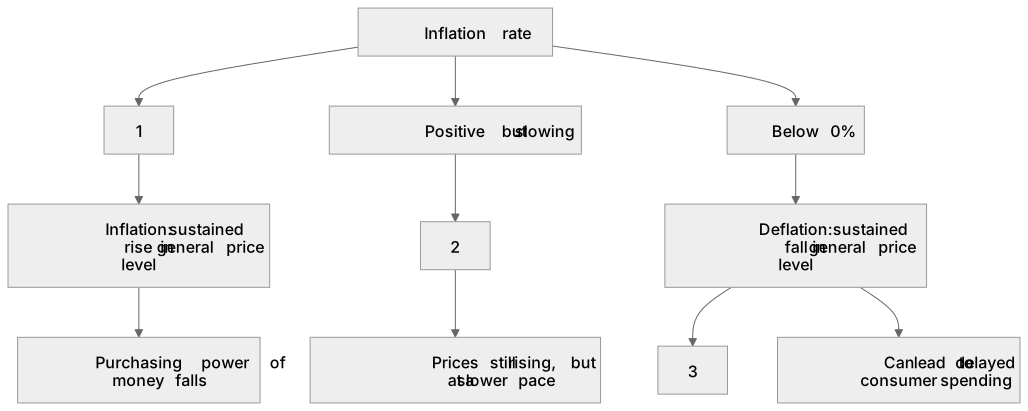
1Box 1
2Box 2
3Box 3
There is more to this lesson
The full lesson goes on to check your understanding and help you earn the marks. Create a free account to carry on, with your progress saved.
A week of Premium from your first lesson · Then the free plan continues · No card, no charge
Test your understanding of Inflation: a) Inflation, deflation and disinflation
Active recall beats re-reading. Take an instant quiz now to test what you’ve learned and lock it into long-term memory.
A week of Premium from your first lesson · Then the free plan continues · No card, no charge