Pearson Edexcel · A-Level · Economics B
Course version: 9EB0 · Version from Sept 2015
A) Significance of market power: o cartels, collusion, restrictive…
Full specification wording
Market failure: a) Significance of market power: o cartels, collusion, restrictive practices and tacit agreement o monopsony power o natural monopolies o power in the labour market
Market power causes market failure by distorting prices and output, misallocating resources.
Checked against the Pearson Edexcel 9EB0 specification (opens in a new tab) on .
- 3 key terms
Study notes
From the checked teaching notes for this specification point.
The idea
Market power causes market failure by distorting prices and output, misallocating resources. Cartels and collusion (including tacit agreements) involve firms restricting competition to act like a monopoly, raising prices and reducing consumer surplus. Restrictive practices create barriers to entry. Monopsony power occurs when a single buyer dominates, such as a large supermarket forcing down prices paid to dairy farmers. Natural monopolies exist when high fixed costs mean only one firm can fully exploit economies of scale, like a national water grid. Power in the labour market, such as trade unions or monopsony employers, distorts wage rates away from the competitive equilibrium, causing unemployment or worker exploitation.
What earns the marks
- Define the specific type of market power being assessed, such as monopsony, natural monopoly, or a cartel.
- Explain how the identified market power leads to a misallocation of resources or market failure.
- Apply the concept to a real-world example, such as supermarkets exercising monopsony power over agricultural suppliers.
- Analyse the impact on stakeholders, such as reduced consumer surplus from collusion or lower wages resulting from a monopsony employer.
- Identify restrictive practices, such as predatory pricing, that create barriers to entry and sustain market power.
Common mistakes and how to put them right
Confusing monopoly power with monopsony power.
Put it right: A monopoly is a single seller dominating a market, whereas a monopsony is a single buyer.
Assuming all monopolies are natural monopolies.
Put it right: Natural monopolies specifically arise due to continuous economies of scale and high fixed costs, not merely from having a high market share.
Believing tacit collusion involves formal agreements.
Put it right: Tacit collusion is unspoken and informal, often involving price leadership, unlike overt cartels which involve explicit agreements.
Exam tips
- Use a diagram to illustrate the welfare loss associated with monopoly or monopsony power to strengthen your analytical points.
- When discussing labour market power, contrast the effects of a trade union pushing wages up with a monopsony employer pushing wages down.
- Clearly distinguish between overt collusion (cartels) and tacit agreement, noting that overt collusion is illegal and subject to regulatory fines in most jurisdictions.
Try the lesson
The start of the Market failure: a) Significance of market power: o cartels, collusion, restrictive practices and tacit agreement o monopsony power o natural monopolies o power in the labour market lesson, made from checked teaching notes for this specification point.
Have a go first
Which of the following best describes a situation where monopsony power leads to market failure?
Listen
Market power causes market failure by distorting prices and output, misallocating resources. Cartels and collusion (including tacit agreements) involve firms restricting competition to act like a monopoly, raising prices and reducing consumer surplus. Restrictive practices create barriers to entry. Monopsony power occurs when a single buyer dominates, such as a large supermarket forcing down prices paid to dairy farmers. Natural monopolies exist when high fixed costs mean only one firm can fully exploit economies of scale, like a national water grid. Power in the labour market, such as trade unions or monopsony employers, distorts wage rates away from the competitive equilibrium, causing unemployment or worker exploitation. A strong answer earns marks for these points. Define the specific type of market power being assessed, such as monopsony, natural monopoly, or a cartel. Explain how the identified market power leads to a misallocation of resources or market failure. Apply the concept to a real-world example, such as supermarkets exercising monopsony power over agricultural suppliers. Analyse the impact on stakeholders, such as reduced consumer surplus from collusion or lower wages resulting from a monopsony employer. A common slip: Confusing monopoly power with monopsony power. Instead, a monopoly is a single seller dominating a market, whereas a monopsony is a single buyer. Exam tip: Use a diagram to illustrate the welfare loss associated with monopoly or monopsony power to strengthen your analytical points.
See it
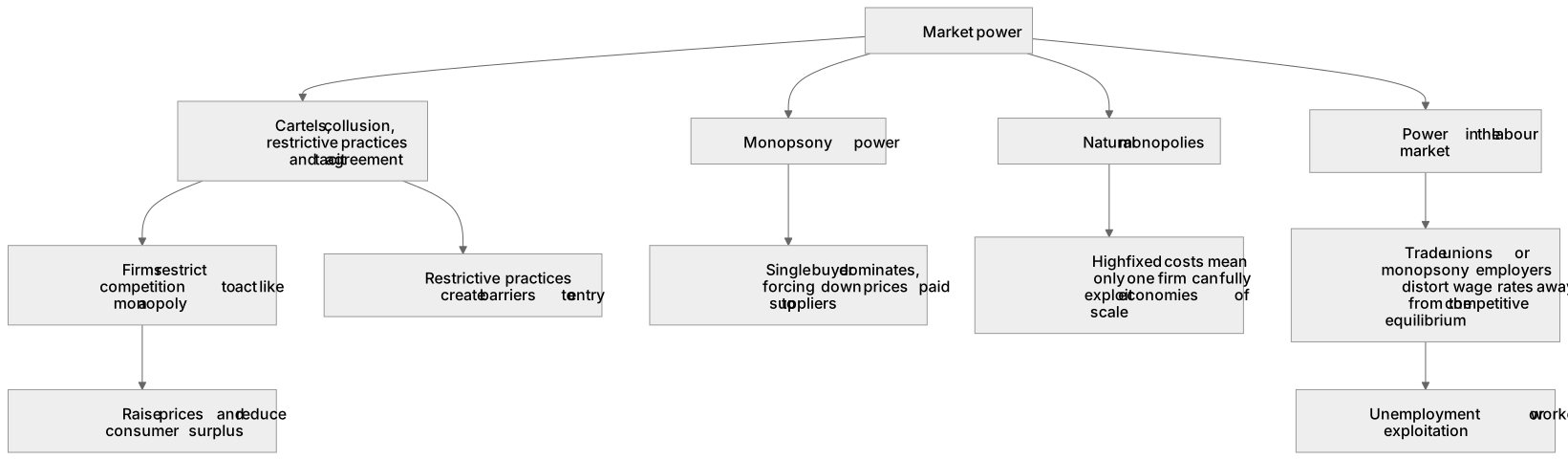
Key words
Say what each word means before you turn the card.
Cartels
Try answering aloud or in your head before turning the card.
Monopsony power
Try answering aloud or in your head before turning the card.
Natural monopolies
Try answering aloud or in your head before turning the card.
See every definition
- Cartels
- Firms that restrict competition to act like a monopoly, raising prices and reducing consumer surplus.
- Monopsony power
- Arises when a single buyer dominates, such as a large supermarket forcing down prices paid to dairy farmers.
- Natural monopolies
- Exist when high fixed costs mean only one firm can fully exploit economies of scale, like a national water grid.
Label the diagram
Some boxes have lost their names. Pick the right name for each number.
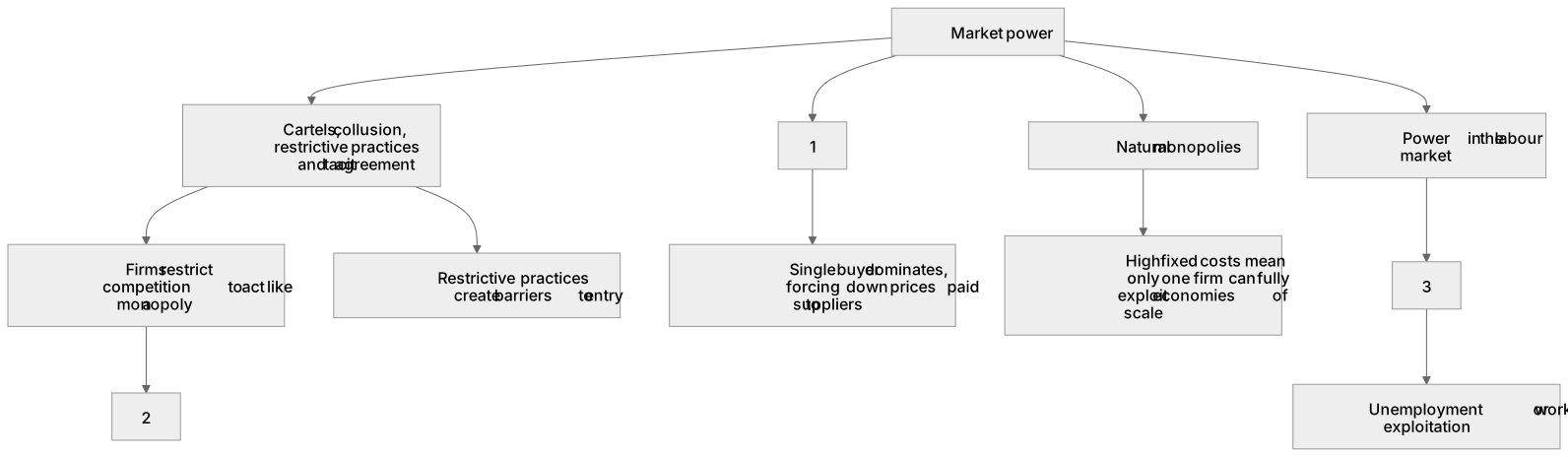
1Box 1
2Box 2
3Box 3
There is more to this lesson
The full lesson goes on to check your understanding and help you earn the marks. Create a free account to carry on, with your progress saved.
A week of Premium from your first lesson · Then the free plan continues · No card, no charge
Test your understanding of Market failure: a) Significance of market power: o cartels, collusion, restrictive practices and tacit agreement o monopsony power o natural monopolies o power in the labour market
Active recall beats re-reading. Take an instant quiz now to test what you’ve learned and lock it into long-term memory.
A week of Premium from your first lesson · Then the free plan continues · No card, no charge