Pearson Edexcel · A-Level · Economics B
Course version: 9EB0 · Version from Sept 2015
A) The consequences of under-provision and under- consumption of merit and…
Full specification wording
Market failure in society: a) The consequences of under-provision and under- consumption of merit and other goods and services
Merit goods, like education and healthcare, generate positive externalities but suffer from under-provision and under-consumption in a free market.
Checked against the Pearson Edexcel 9EB0 specification (opens in a new tab) on .
- Point 1 of 6
- 4 key terms
Study notes
From the checked teaching notes for this specification point.
The idea
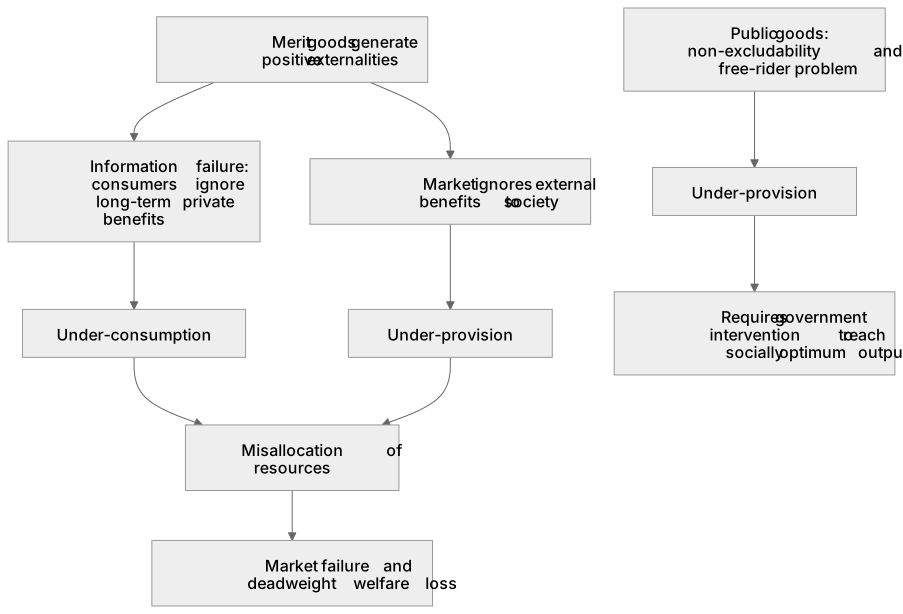
Merit goods, like education and healthcare, generate positive externalities but suffer from under-provision and under-consumption in a free market. This occurs because consumers suffer from information failure, ignoring long-term private benefits, and the market ignores external benefits to society. The consequence is a misallocation of resources, leading to market failure and a deadweight welfare loss. For example, under-consumption of vaccinations reduces herd immunity, increasing societal healthcare costs. Other goods, such as public goods, face under-provision due to the free-rider problem, requiring government intervention to achieve the socially optimum output level.
What earns the marks
- Define merit goods as those generating positive externalities and suffering from information failure.
- Identify that under-consumption occurs because individuals ignore long-term private benefits and external benefits.
- Explain that under-provision leads to a misallocation of resources and a deadweight welfare loss to society.
- Recognise that other goods, like public goods, are under-provided due to non-excludability and the free-rider problem.
Common mistakes and how to put them right
Confusing merit goods with public goods.
Put it right: Merit goods are excludable and rivalrous but under-consumed due to information failure, whereas public goods are non-excludable and non-rivalrous.
Stating that merit goods are not provided at all in a free market.
Put it right: Clarify that merit goods are under-provided relative to the socially optimum level, not entirely absent.
Forgetting to link under-consumption to information failure.
Put it right: Explain that consumers undervalue merit goods because they do not fully perceive the long-term private benefits.
Exam tips
- Use marginal analysis diagrams to show the divergence between marginal private benefit and marginal social benefit.
- Clearly distinguish between the private consequences, such as poorer individual health, and external consequences, such as lower workforce productivity.
- Apply the concept of the free-rider problem specifically when discussing the under-provision of public goods.
Try the lesson
The start of the Market failure in society: a) The consequences of under-provision and under- consumption of merit and other goods and services lesson, made from checked teaching notes for this specification point.
Have a go first
Which of the following is a direct consequence of the under-consumption of merit goods such as healthcare in a free market?
Listen
Merit goods, like education and healthcare, generate positive externalities but suffer from under-provision and under-consumption in a free market. This occurs because consumers suffer from information failure, ignoring long-term private benefits, and the market ignores external benefits to society. The consequence is a misallocation of resources, leading to market failure and a deadweight welfare loss. For example, under-consumption of vaccinations reduces herd immunity, increasing societal healthcare costs. Other goods, such as public goods, face under-provision due to the free-rider problem, requiring government intervention to achieve the socially optimum output level. A strong answer earns marks for these points. Define merit goods as those generating positive externalities and suffering from information failure. Identify that under-consumption occurs because individuals ignore long-term private benefits and external benefits. Explain that under-provision leads to a misallocation of resources and a deadweight welfare loss to society. Recognise that other goods, like public goods, are under-provided due to non-excludability and the free-rider problem. A common slip: Confusing merit goods with public goods. Instead, merit goods are excludable and rivalrous but under-consumed due to information failure, whereas public goods are non-excludable and non-rivalrous. Exam tip: Use marginal analysis diagrams to show the divergence between marginal private benefit and marginal social benefit.
See it
Key words
Say what each word means before you turn the card.
Market failure
Try answering aloud or in your head before turning the card.
Positive externalities
Try answering aloud or in your head before turning the card.
Information failure
Try answering aloud or in your head before turning the card.
Resource allocation
Try answering aloud or in your head before turning the card.
See every definition
- Market failure
- A misallocation of resources, leading to a deadweight welfare loss.
- Positive externalities
- External benefits to society that the market ignores.
- Information failure
- A situation where consumers ignore long-term private benefits because they do not fully perceive them.
- Resource allocation
- The way resources are distributed, which is misallocated when merit and other goods are under-provided.
There is more to this lesson
The full lesson goes on to check your understanding and help you earn the marks. Create a free account to carry on, with your progress saved.
A week of Premium from your first lesson · Then the free plan continues · No card, no charge
Test your understanding of Market failure in society: a) The consequences of under-provision and under- consumption of merit and other goods and services
Active recall beats re-reading. Take an instant quiz now to test what you’ve learned and lock it into long-term memory.
A week of Premium from your first lesson · Then the free plan continues · No card, no charge