Pearson Edexcel · A-Level · Economics B
Course version: 9EB0 · Version from Sept 2015
Market failure in society: f) Consequences of environmental change
Full specification wording
Market failure in society: f) Consequences of environmental change
Environmental change, such as climate change and resource depletion, has profound economic consequences that cause market failure.
Checked against the Pearson Edexcel 9EB0 specification (opens in a new tab) on .
- Point 6 of 6
Study notes
From the checked teaching notes for this specification point.
The idea
Environmental change, such as climate change and resource depletion, has profound economic consequences that cause market failure. These changes lead to the loss of natural capital, reducing an economy's productive capacity and shifting its production possibility frontier inwards. For businesses, environmental degradation increases costs, such as higher insurance premiums due to extreme weather or investments in cleaner technologies to meet regulations. Society faces negative externalities, where the social costs of production, like health issues from air pollution, exceed private costs. Furthermore, environmental change exacerbates inequality, as lower-income groups often bear a disproportionate share of negative impacts like flooding.
What earns the marks
- Identify the economic impacts of environmental change, such as resource depletion and extreme weather events.
- Explain how environmental change can shift the production possibility frontier inwards due to a loss of natural capital.
- Analyse the increased costs for businesses, including regulatory compliance and insurance against climate risks.
- Evaluate the societal consequences, such as health costs associated with pollution and the disproportionate impact on lower-income groups.
Common mistakes and how to put them right
Assuming environmental change only affects the natural environment.
Put it right: Recognise that environmental change has direct economic consequences, such as increased business costs and reduced productive capacity.
Confusing the causes of environmental change with its consequences.
Put it right: Focus on the outcomes of environmental change, such as resource scarcity and health impacts, rather than the activities that cause it.
Ignoring the distributional effects of environmental change.
Put it right: Acknowledge that the consequences of environmental change often disproportionately affect lower-income individuals and developing nations.
Exam tips
- Use specific examples, such as the impact of flooding on agricultural yields, to illustrate the economic consequences of environmental change.
- Link the consequences of environmental change to the concept of market failure, specifically negative externalities.
- Consider both the short-term and long-term economic impacts when evaluating the consequences of environmental change.
Try the lesson
The start of the Market failure in society: f) Consequences of environmental change lesson, made from checked teaching notes for this specification point.
Have a go first
Which of the following is a direct economic consequence of severe environmental change, such as increased frequency of extreme weather events?
Listen
Environmental change, such as climate change and resource depletion, has profound economic consequences that cause market failure. These changes lead to the loss of natural capital, reducing an economy's productive capacity and shifting its production possibility frontier inwards. For businesses, environmental degradation increases costs, such as higher insurance premiums due to extreme weather or investments in cleaner technologies to meet regulations. Society faces negative externalities, where the social costs of production, like health issues from air pollution, exceed private costs. Furthermore, environmental change exacerbates inequality, as lower-income groups often bear a disproportionate share of negative impacts like flooding. A strong answer earns marks for these points. Identify the economic impacts of environmental change, such as resource depletion and extreme weather events. Explain how environmental change can shift the production possibility frontier inwards due to a loss of natural capital. Analyse the increased costs for businesses, including regulatory compliance and insurance against climate risks. Evaluate the societal consequences, such as health costs associated with pollution and the disproportionate impact on lower-income groups. A common slip: Assuming environmental change only affects the natural environment. Instead, Recognise that environmental change has direct economic consequences, such as increased business costs and reduced productive capacity. Exam tip: Use specific examples, such as the impact of flooding on agricultural yields, to illustrate the economic consequences of environmental change.
See it
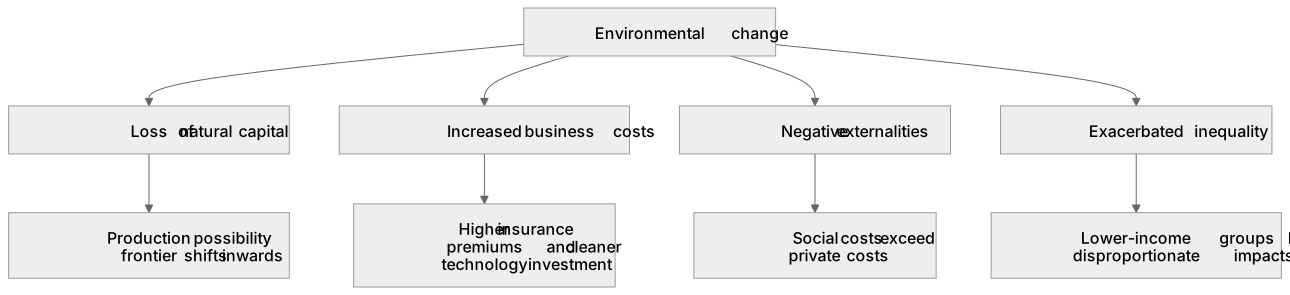
Label the diagram
Some boxes have lost their names. Pick the right name for each number.
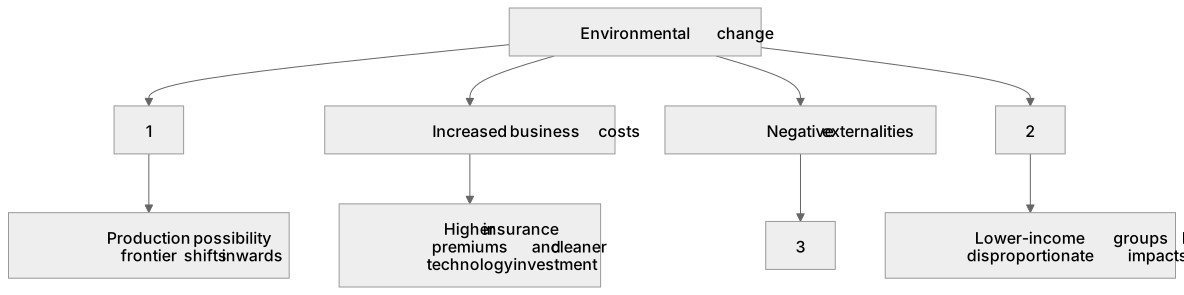
1Box 1
2Box 2
3Box 3
There is more to this lesson
The full lesson goes on to check your understanding and help you earn the marks. Create a free account to carry on, with your progress saved.
A week of Premium from your first lesson · Then the free plan continues · No card, no charge
Test your understanding of Market failure in society: f) Consequences of environmental change
Active recall beats re-reading. Take an instant quiz now to test what you’ve learned and lock it into long-term memory.
A week of Premium from your first lesson · Then the free plan continues · No card, no charge