Pearson Edexcel · A-Level · Economics B
Course version: 9EB0 · Version from Sept 2015
Oligopoly: a) Concentration ratios
A concentration ratio measures the combined market share of the largest firms in an industry, indicating the degree of market power and the underlying market structure.
Checked against the Pearson Edexcel 9EB0 specification (opens in a new tab) on .
- Point 1 of 4
- 4 key terms
Study notes
From the checked teaching notes for this specification point.
The idea
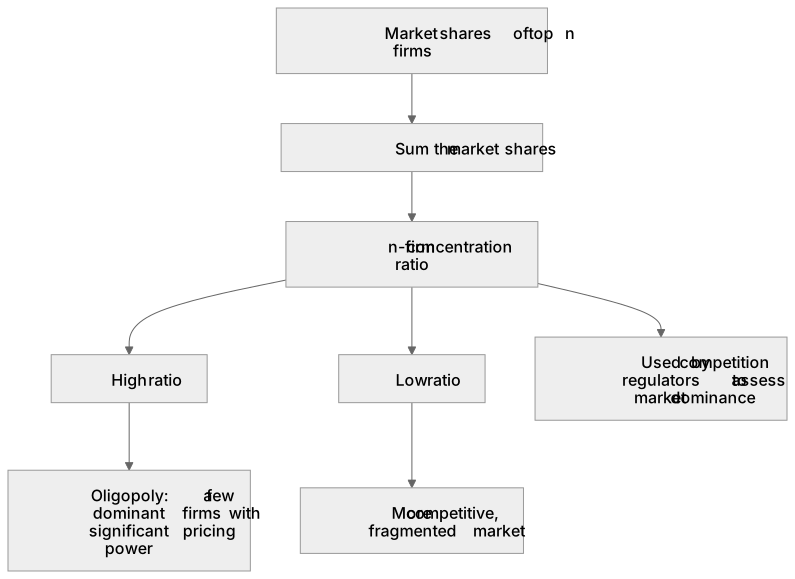
A concentration ratio measures the combined market share of the largest firms in an industry, indicating the degree of market power and the underlying market structure. It is calculated by adding the market shares, usually based on sales revenue, of the top n firms to find the n-firm concentration ratio. For example, if the top three supermarkets hold 28%, 16%, and 14% of the market, the 3-firm concentration ratio is 58%. A high concentration ratio suggests an oligopoly, where a few dominant firms have significant pricing power and influence. Conversely, a low ratio indicates a more competitive, fragmented market. Understanding these ratios helps economists and regulators assess competition levels and potential monopoly power.
What earns the marks
- Define a concentration ratio as the proportion of total market sales held by the largest firms in an industry.
- Calculate an n-firm concentration ratio by summing the market shares of the top n firms.
- Interpret a high concentration ratio as an indicator of an oligopolistic market structure with significant market power.
- Explain that concentration ratios can be used by competition regulators to assess market dominance and the potential for anti-competitive behaviour.
Common mistakes and how to put them right
Adding the market shares of all firms in the market.
Put it right: Only sum the market shares of the specified top n firms, such as the top 3 or top 5.
Confusing concentration ratio with market size.
Put it right: A concentration ratio is a percentage of the total market, not the absolute monetary value of sales.
Assuming a high concentration ratio means there are only a few firms in the entire industry.
Put it right: An industry can have hundreds of firms, but a high concentration ratio means the top few dominate the market share.
Exam tips
- Always check whether the question asks for a 3-firm, 4-firm, or 5-firm concentration ratio before calculating.
- Use concentration ratios as quantitative evidence when evaluating whether a market operates as an oligopoly.
- Remember that market share can be measured by sales revenue or volume; check the specific data provided in the stimulus material.
Try the lesson
The start of the Oligopoly: a) Concentration ratios lesson, made from checked teaching notes for this specification point.
Have a go first
A market consists of five firms with the following market shares: Firm A (40%), Firm B (25%), Firm C (15%), Firm D (10%), and Firm E (10%). What is the 3-firm concentration ratio for this market?
Listen
A concentration ratio measures the combined market share of the largest firms in an industry, indicating the degree of market power and the underlying market structure. It is calculated by adding the market shares, usually based on sales revenue, of the top n firms to find the n-firm concentration ratio. For example, if the top three supermarkets hold 28%, 16%, and 14% of the market, the 3-firm concentration ratio is 58%. A high concentration ratio suggests an oligopoly, where a few dominant firms have significant pricing power and influence. Conversely, a low ratio indicates a more competitive, fragmented market. Understanding these ratios helps economists and regulators assess competition levels and potential monopoly power. A strong answer earns marks for these points. Define a concentration ratio as the proportion of total market sales held by the largest firms in an industry. Calculate an n-firm concentration ratio by summing the market shares of the top n firms. Interpret a high concentration ratio as an indicator of an oligopolistic market structure with significant market power. Explain that concentration ratios can be used by competition regulators to assess market dominance and the potential for anti-competitive behaviour. A common slip: Adding the market shares of all firms in the market. Instead, Only sum the market shares of the specified top n firms, such as the top 3 or top 5. Exam tip: Always check whether the question asks for a 3-firm, 4-firm, or 5-firm concentration ratio before calculating.
See it
Key words
Say what each word means before you turn the card.
Concentration ratio
Try answering aloud or in your head before turning the card.
Oligopoly
Try answering aloud or in your head before turning the card.
Monopoly power
Try answering aloud or in your head before turning the card.
Competition regulation
Try answering aloud or in your head before turning the card.
See every definition
- Concentration ratio
- The proportion of total market sales held by the largest firms in an industry, found by adding the market shares of the top n firms.
- Oligopoly
- A market structure suggested by a high concentration ratio, where a few dominant firms have significant pricing power and influence.
- Monopoly power
- The potential dominance that concentration ratios help economists and regulators assess, alongside competition levels.
- Competition regulation
- The use of concentration ratios by regulators to assess market dominance and the potential for anti-competitive behaviour.
Label the diagram
Some boxes have lost their names. Pick the right name for each number.
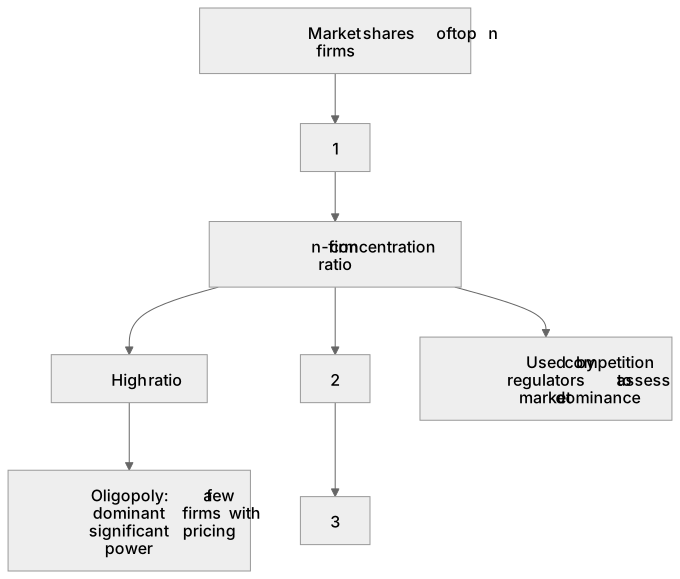
1Box 1
2Box 2
3Box 3
There is more to this lesson
The full lesson goes on to check your understanding and help you earn the marks. Create a free account to carry on, with your progress saved.
A week of Premium from your first lesson · Then the free plan continues · No card, no charge
Test your understanding of Oligopoly: a) Concentration ratios
Active recall beats re-reading. Take an instant quiz now to test what you’ve learned and lock it into long-term memory.
A week of Premium from your first lesson · Then the free plan continues · No card, no charge