Pearson Edexcel · A-Level · Economics B
Course version: 9EB0 · Version from Sept 2015
A) The provision of public and merit goods, indirect taxation of demerit…
Full specification wording
Policies to deal with market failure: a) The provision of public and merit goods, indirect taxation of demerit goods, tradable pollution permits, provision of information, legislation and regulation
Governments intervene to correct market failure using various policies.
Checked against the Pearson Edexcel 9EB0 specification (opens in a new tab) on .
- 4 key terms
Study notes
From the checked teaching notes for this specification point.
The idea
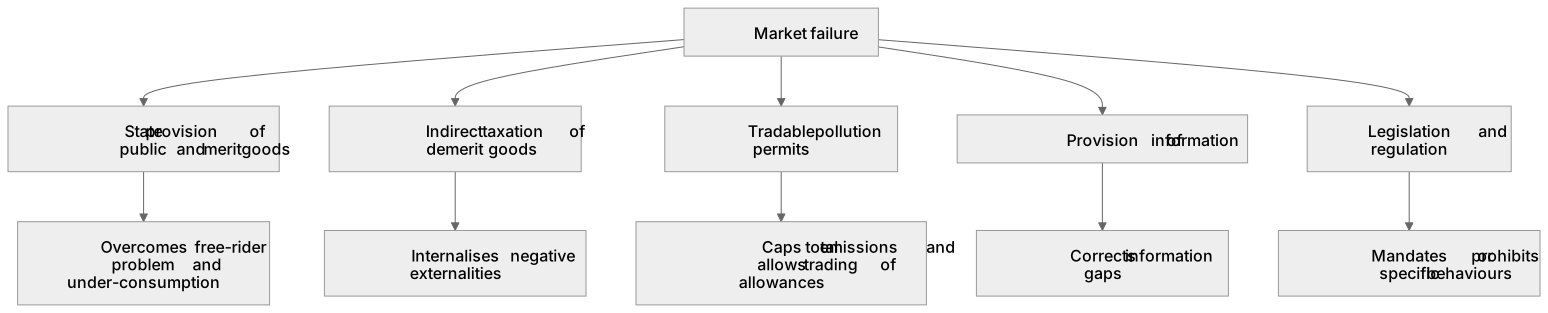
Governments intervene to correct market failure using various policies. They directly provide public goods (e.g. defence) and merit goods (e.g. education) to overcome the free-rider problem and under-consumption. Indirect taxation on demerit goods internalises negative externalities by increasing production costs, shifting supply leftwards. Tradable pollution permits cap total emissions and allow firms to trade allowances, incentivising emission reduction. The provision of information corrects information gaps, helping consumers make rational choices. Finally, legislation and regulation (such as age restrictions or emissions standards) legally mandate or prohibit specific behaviours to reduce negative externalities.
What earns the marks
- Identify that public goods are non-excludable and non-rivalrous, requiring state provision to prevent the missing market caused by the free-rider problem.
- Explain how indirect taxes on demerit goods increase the marginal private cost of production, reducing the quantity traded towards the socially optimum level.
- Describe how tradable pollution permits create a market for externalities by capping total emissions and allowing firms to trade allowances.
- Recognise that legislation and regulation can ban or limit the consumption or production of goods with negative externalities, though they require enforcement.
- Explain that providing information reduces asymmetric information, enabling consumers to maximise their utility.
Common mistakes and how to put them right
Confusing public goods with merit goods.
Put it right: Public goods are non-excludable and non-rivalrous (e.g. street lighting), whereas merit goods are excludable and rivalrous but under-consumed due to information failure or positive externalities (e.g. healthcare).
Assuming indirect taxes completely eliminate negative externalities.
Put it right: Indirect taxes aim to internalise the externality and reduce consumption to the socially optimum level, not necessarily to zero.
Misunderstanding tradable pollution permits as a tax.
Put it right: Permits are a quantitative limit (cap and trade) that creates a market for emissions, whereas a tax sets a price on emissions without a strict cap.
Exam tips
- Use supply and demand diagrams to illustrate the effect of an indirect tax on a demerit good, clearly showing the shift in the supply curve.
- When evaluating tradable permits, consider the difficulty the government faces in setting the correct cap and the cost of monitoring emissions.
- Remember to link the provision of information directly to the correction of information gaps and the resulting shift in consumer demand.
Try the lesson
The start of the Policies to deal with market failure: a) The provision of public and merit goods, indirect taxation of demerit goods, tradable pollution permits, provision of information, legislation and regulation lesson, made from checked teaching notes for this specification point.
Have a go first
Which government policy is most specifically designed to correct the market failure associated with the overconsumption of demerit goods?
Listen
Governments intervene to correct market failure using various policies. They directly provide public goods (e.g. defence) and merit goods (e.g. education) to overcome the free-rider problem and under-consumption. Indirect taxation on demerit goods internalises negative externalities by increasing production costs, shifting supply leftwards. Tradable pollution permits cap total emissions and allow firms to trade allowances, incentivising emission reduction. The provision of information corrects information gaps, helping consumers make rational choices. Finally, legislation and regulation (such as age restrictions or emissions standards) legally mandate or prohibit specific behaviours to reduce negative externalities. A strong answer earns marks for these points. Identify that public goods are non-excludable and non-rivalrous, requiring state provision to prevent the missing market caused by the free-rider problem. Explain how indirect taxes on demerit goods increase the marginal private cost of production, reducing the quantity traded towards the socially optimum level. Describe how tradable pollution permits create a market for externalities by capping total emissions and allowing firms to trade allowances. Recognise that legislation and regulation can ban or limit the consumption or production of goods with negative externalities, though they require enforcement. A common slip: Confusing public goods with merit goods. Instead, Public goods are non-excludable and non-rivalrous (e.g. street lighting), whereas merit goods are excludable and rivalrous but under-consumed due to information failure or positive externalities (e.g. healthcare). Exam tip: Use supply and demand diagrams to illustrate the effect of an indirect tax on a demerit good, clearly showing the shift in the supply curve.
See it
Key words
Say what each word means before you turn the card.
Government intervention
Try answering aloud or in your head before turning the card.
Market failure correction
Try answering aloud or in your head before turning the card.
Externalities
Try answering aloud or in your head before turning the card.
Information gaps
Try answering aloud or in your head before turning the card.
See every definition
- Government intervention
- Governments intervene to correct market failure using various policies, including provision of goods, taxation, permits, information, legislation and regulation.
- Market failure correction
- Policies such as state provision, indirect taxation, tradable permits, information and regulation are used to correct market failure.
- Externalities
- Indirect taxation internalises negative externalities by increasing production costs, and tradable permits create a market for externalities by capping total emissions.
- Information gaps
- The provision of information corrects information gaps, helping consumers make rational choices.
Label the diagram
Some boxes have lost their names. Pick the right name for each number.
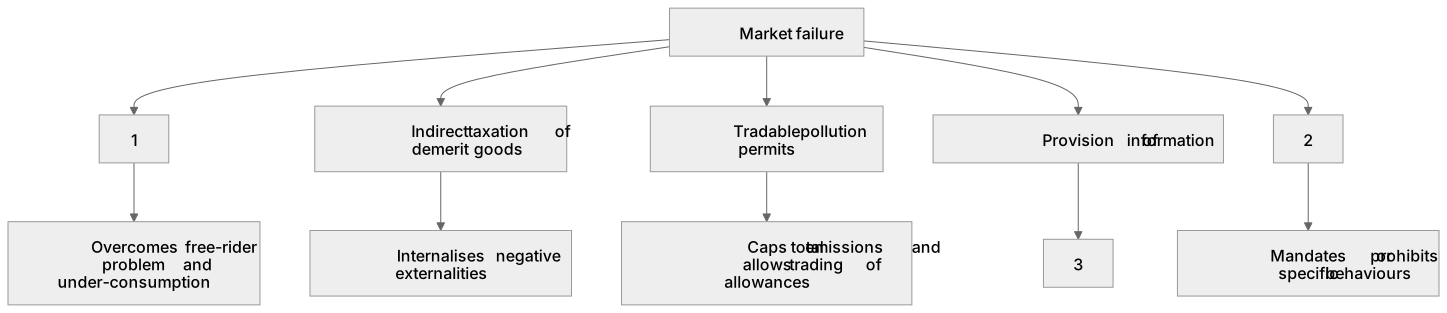
1Box 1
2Box 2
3Box 3
There is more to this lesson
The full lesson goes on to check your understanding and help you earn the marks. Create a free account to carry on, with your progress saved.
A week of Premium from your first lesson · Then the free plan continues · No card, no charge
Test your understanding of Policies to deal with market failure: a) The provision of public and merit goods, indirect taxation of demerit goods, tradable pollution permits, provision of information, legislation and regulation
Active recall beats re-reading. Take an instant quiz now to test what you’ve learned and lock it into long-term memory.
A week of Premium from your first lesson · Then the free plan continues · No card, no charge