Pearson Edexcel · A-Level · Economics B
Course version: 9EB0 · Version from Sept 2015
Potential policy conflicts and trade-offs: a) Inflation and unemployment
Full specification wording
Potential policy conflicts and trade-offs: a) Inflation and unemployment
The trade-off between inflation and unemployment is a classic macroeconomic policy conflict, often illustrated by the short-run Phillips curve.
Checked against the Pearson Edexcel 9EB0 specification (opens in a new tab) on .
- Point 1 of 2
- 4 key terms
Study notes
From the checked teaching notes for this specification point.
The idea
The trade-off between inflation and unemployment is a classic macroeconomic policy conflict, often illustrated by the short-run Phillips curve. When a government or central bank implements expansionary fiscal or monetary policy to stimulate economic growth and reduce cyclical unemployment, aggregate demand increases. As the economy approaches full capacity, this increased demand puts upward pressure on wages and prices, leading to demand-pull inflation. Conversely, if policymakers use contractionary measures to control high inflation, aggregate demand falls, which can slow economic growth and increase unemployment. Managing this trade-off requires careful balancing of policy instruments to achieve macroeconomic stability.
What earns the marks
- Explanation of the inverse relationship between unemployment and inflation in the short run.
- Application of the short-run Phillips curve to illustrate the trade-off.
- Analysis of how expansionary policies to reduce unemployment can cause demand-pull inflation.
- Evaluation of how supply-side policies might resolve the conflict by shifting the long-run aggregate supply curve.
Common mistakes and how to put them right
Assuming the trade-off between inflation and unemployment exists in the long run.
Put it right: The trade-off is generally considered a short-run phenomenon; in the long run, the Phillips curve is often viewed as vertical at the natural rate of unemployment.
Confusing demand-pull and cost-push inflation when explaining the conflict.
Put it right: The traditional trade-off caused by expansionary policy is linked to demand-pull inflation, not cost-push.
Stating that inflation and unemployment always move in opposite directions.
Put it right: Stagflation can occur, where both inflation and unemployment rise simultaneously due to adverse supply shocks.
Exam tips
- Draw a clearly labelled short-run Phillips curve or an aggregate demand and supply diagram to illustrate the conflict visually.
- Discuss how the state of the economy, such as the amount of spare capacity, influences the severity of the trade-off.
- Evaluate the use of supply-side policies as a method to reduce both unemployment and inflation simultaneously, bypassing the short-run trade-off.
Try the lesson
The start of the Potential policy conflicts and trade-offs: a) Inflation and unemployment lesson, made from checked teaching notes for this specification point.
Have a go first
Which of the following best describes the short-run trade-off typically observed between inflation and unemployment?
Listen
The trade-off between inflation and unemployment is a classic macroeconomic policy conflict, often illustrated by the short-run Phillips curve. When a government or central bank implements expansionary fiscal or monetary policy to stimulate economic growth and reduce cyclical unemployment, aggregate demand increases. As the economy approaches full capacity, this increased demand puts upward pressure on wages and prices, leading to demand-pull inflation. Conversely, if policymakers use contractionary measures to control high inflation, aggregate demand falls, which can slow economic growth and increase unemployment. Managing this trade-off requires careful balancing of policy instruments to achieve macroeconomic stability. A strong answer earns marks for these points. Explanation of the inverse relationship between unemployment and inflation in the short run. Application of the short-run Phillips curve to illustrate the trade-off. Analysis of how expansionary policies to reduce unemployment can cause demand-pull inflation. Evaluation of how supply-side policies might resolve the conflict by shifting the long-run aggregate supply curve. A common slip: Assuming the trade-off between inflation and unemployment exists in the long run. Instead, The trade-off is generally considered a short-run phenomenon; in the long run, the Phillips curve is often viewed as vertical at the natural rate of unemployment. Exam tip: Draw a clearly labelled short-run Phillips curve or an aggregate demand and supply diagram to illustrate the conflict visually.
See it

Key words
Say what each word means before you turn the card.
Policy conflicts
Try answering aloud or in your head before turning the card.
Aggregate demand
Try answering aloud or in your head before turning the card.
Demand-pull inflation
Try answering aloud or in your head before turning the card.
Economic trade-offs
Try answering aloud or in your head before turning the card.
See every definition
- Policy conflicts
- Situations where achieving one macroeconomic objective, such as reducing unemployment, works against another, such as controlling inflation.
- Aggregate demand
- Total demand in the economy, which increases when expansionary fiscal or monetary policy is used to stimulate growth and reduce cyclical unemployment.
- Demand-pull inflation
- Upward pressure on wages and prices that arises as increased aggregate demand pushes the economy towards full capacity.
- Economic trade-offs
- The balancing required between competing outcomes, such as accepting higher inflation to reduce unemployment or slower growth to control inflation.
Label the diagram
Some boxes have lost their names. Pick the right name for each number.
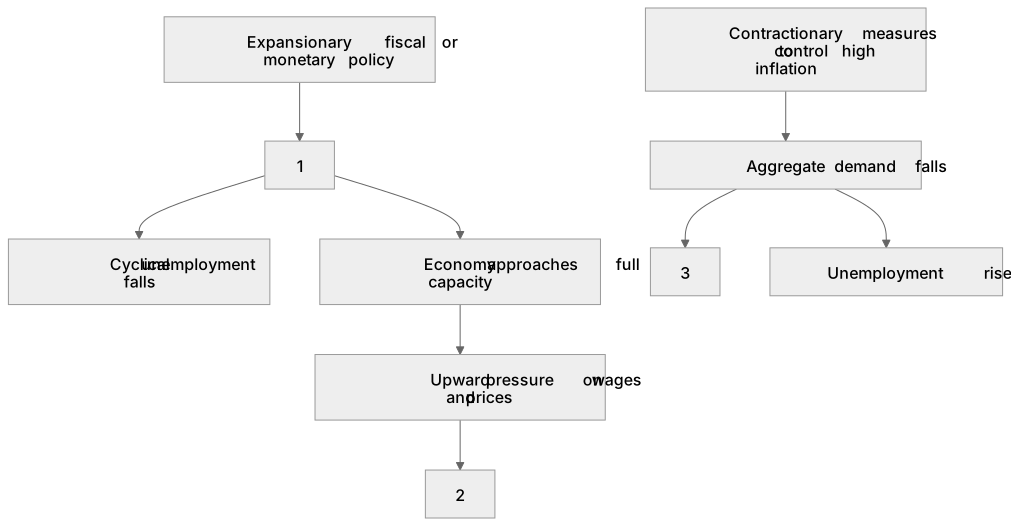
1Box 1
2Box 2
3Box 3
There is more to this lesson
The full lesson goes on to check your understanding and help you earn the marks. Create a free account to carry on, with your progress saved.
A week of Premium from your first lesson · Then the free plan continues · No card, no charge
Test your understanding of Potential policy conflicts and trade-offs: a) Inflation and unemployment
Active recall beats re-reading. Take an instant quiz now to test what you’ve learned and lock it into long-term memory.
A week of Premium from your first lesson · Then the free plan continues · No card, no charge