Pearson Edexcel · A-Level · Economics B
Course version: 9EB0 · Version from Sept 2015
A) Functions of the price mechanism to allocate resources: rationing,…
Full specification wording
Price mechanism: a) Functions of the price mechanism to allocate resources: rationing, incentives, signalling
The price mechanism allocates scarce resources efficiently through three key functions: rationing, signalling, and incentives.
Checked against the Pearson Edexcel 9EB0 specification (opens in a new tab) on .
- Point 1 of 4
- 3 key terms
Study notes
From the checked teaching notes for this specification point.
The idea
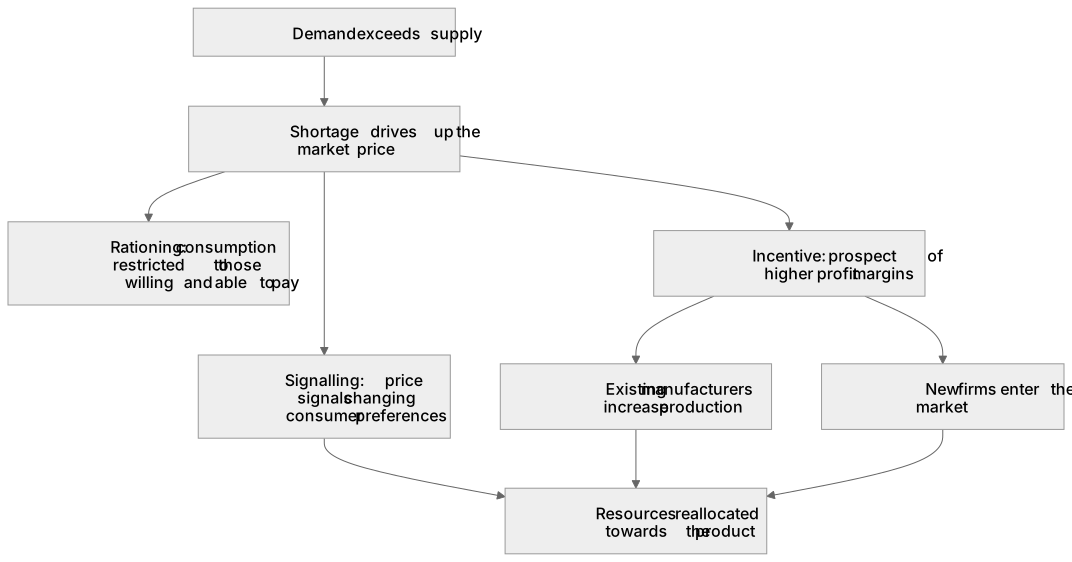
The price mechanism allocates scarce resources efficiently through three key functions: rationing, signalling, and incentives. When demand for a product, such as electric vehicles, exceeds supply, the resulting shortage drives up the market price. This higher price performs a rationing function by restricting consumption to those willing and able to pay the increased amount. Simultaneously, the rising price acts as a signal to the market that consumer preferences are changing, indicating where resources are most needed. Finally, the prospect of higher profit margins provides an incentive for existing manufacturers to increase production and for new firms to enter the market, thereby reallocating resources towards electric vehicles.
What earns the marks
- The rationing function occurs when rising prices limit demand to only those consumers who are willing and able to pay.
- The signalling function involves prices communicating vital information to producers and consumers about changing market conditions and preferences.
- The incentive function provides the financial motivation for producers to increase output due to the prospect of higher profit margins.
- In a free market, the combination of rationing, signalling, and incentives automatically reallocates scarce resources without the need for government intervention.
Common mistakes and how to put them right
Confusing the signalling and incentive functions.
Put it right: Signalling provides information about market changes, whereas incentives provide the financial motivation to act on that information.
Assuming rationing only occurs through government intervention.
Put it right: In a free market, the price mechanism itself rations scarce goods by allocating them to consumers willing to pay the equilibrium price.
Failing to link the functions to the allocation of resources.
Put it right: Explain how the combination of rationing, signalling, and incentives ultimately shifts the factors of production towards goods with higher demand.
Exam tips
- Use a step-by-step logical chain when explaining the price mechanism: start with a shift in demand or supply, then explain the price change, and finally detail the rationing, signalling, and incentive effects.
- When analysing a market diagram, explicitly state how the movement along the supply curve represents the incentive function for producers.
- Ensure you clearly distinguish between the impact of the price mechanism on consumers (rationing) and producers (incentives).
Try the lesson
The start of the Price mechanism: a) Functions of the price mechanism to allocate resources: rationing, incentives, signalling lesson, made from checked teaching notes for this specification point.
Have a go first
Which of the following best describes the signalling function of the price mechanism in a market economy?
Listen
The price mechanism allocates scarce resources efficiently through three key functions: rationing, signalling, and incentives. When demand for a product, such as electric vehicles, exceeds supply, the resulting shortage drives up the market price. This higher price performs a rationing function by restricting consumption to those willing and able to pay the increased amount. Simultaneously, the rising price acts as a signal to the market that consumer preferences are changing, indicating where resources are most needed. Finally, the prospect of higher profit margins provides an incentive for existing manufacturers to increase production and for new firms to enter the market, thereby reallocating resources towards electric vehicles. A strong answer earns marks for these points. The rationing function occurs when rising prices limit demand to only those consumers who are willing and able to pay. The signalling function involves prices communicating vital information to producers and consumers about changing market conditions and preferences. The incentive function provides the financial motivation for producers to increase output due to the prospect of higher profit margins. In a free market, the combination of rationing, signalling, and incentives automatically reallocates scarce resources without the need for government intervention. A common slip: Confusing the signalling and incentive functions. Instead, Signalling provides information about market changes, whereas incentives provide the financial motivation to act on that information. Exam tip: Use a step-by-step logical chain when explaining the price mechanism: start with a shift in demand or supply, then explain the price change, and finally detail the rationing, signalling, and incentive effects.
See it
Key words
Say what each word means before you turn the card.
Resource allocation
Try answering aloud or in your head before turning the card.
Scarcity
Try answering aloud or in your head before turning the card.
Profit motive
Try answering aloud or in your head before turning the card.
See every definition
- Resource allocation
- The process by which scarce resources are distributed, which the price mechanism performs through rationing, signalling and incentives.
- Scarcity
- The condition of limited resources that the price mechanism allocates through its rationing, signalling and incentive functions.
- Profit motive
- The prospect of higher profit margins that provides an incentive for producers to increase output and for new firms to enter the market.
Label the diagram
Some boxes have lost their names. Pick the right name for each number.
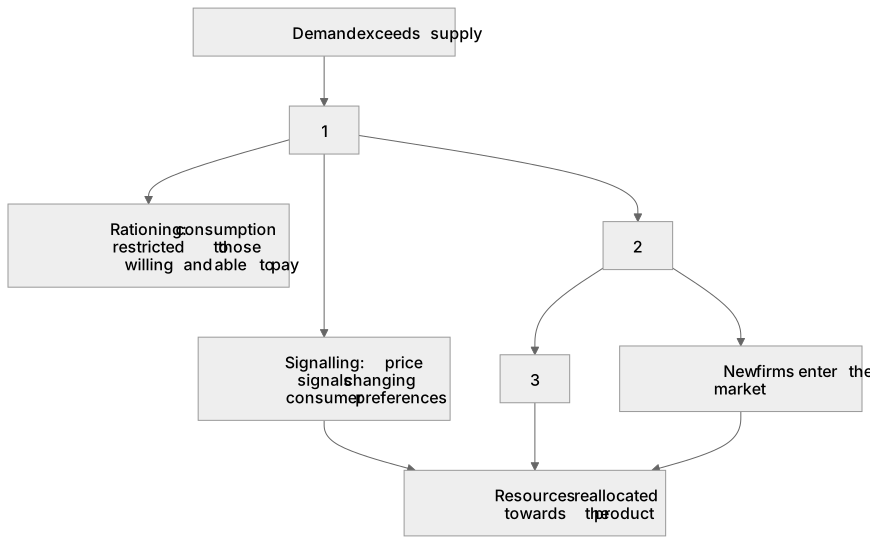
1Box 1
2Box 2
3Box 3
There is more to this lesson
The full lesson goes on to check your understanding and help you earn the marks. Create a free account to carry on, with your progress saved.
A week of Premium from your first lesson · Then the free plan continues · No card, no charge
Test your understanding of Price mechanism: a) Functions of the price mechanism to allocate resources: rationing, incentives, signalling
Active recall beats re-reading. Take an instant quiz now to test what you’ve learned and lock it into long-term memory.
A week of Premium from your first lesson · Then the free plan continues · No card, no charge