Pearson Edexcel · A-Level · Economics B
Course version: 9EB0 · Version from Sept 2015
Price mechanism: d) Potential market growth
Potential market growth refers to the estimated future increase in the size or value of a market.
Checked against the Pearson Edexcel 9EB0 specification (opens in a new tab) on .
- Point 4 of 4
- 4 key terms
Study notes
From the checked teaching notes for this specification point.
The idea
Potential market growth refers to the estimated future increase in the size or value of a market. The price mechanism plays a crucial role in signalling this potential to firms and investors. When demand for a product rises due to changing consumer trends or rising incomes, the price mechanism signals this through higher prices. This acts as an incentive for existing firms to expand capacity and for new entrants to join the market, driving market growth. For example, growing demand for electric vehicles has led to higher prices and profits, incentivising massive investment in battery technology. Understanding potential market growth helps businesses allocate resources efficiently to capture future market share and emerging opportunities.
What earns the marks
- Define potential market growth as the expected future increase in market size or value.
- Explain how rising prices signal potential market growth to producers and investors.
- Analyse the incentive function encouraging new entrants and investment in growing markets.
- Evaluate how potential market growth influences long-term business resource allocation.
Common mistakes and how to put them right
Confusing market growth with market share.
Put it right: Market growth refers to the expansion of the entire market, whereas market share is the proportion of that market controlled by a single firm.
Assuming past growth guarantees future potential growth.
Put it right: Potential market growth is an estimate and can be affected by unforeseen external shocks or changes in consumer preferences.
Ignoring the role of the price mechanism.
Put it right: Ensure that explanations of market growth explicitly reference how price signals and incentives drive resource reallocation.
Exam tips
- Be prepared to interpret potential market growth from data provided in a case study.
- Link potential market growth to the incentive function of the price mechanism, explaining how it attracts new firms.
- Consider the risks associated with estimating potential market growth, such as technological changes or economic downturns.
Try the lesson
The start of the Price mechanism: d) Potential market growth lesson, made from checked teaching notes for this specification point.
Have a go first
What role does the price mechanism play when there is potential market growth in a specific sector?
Listen
Potential market growth refers to the estimated future increase in the size or value of a market. The price mechanism plays a crucial role in signalling this potential to firms and investors. When demand for a product rises due to changing consumer trends or rising incomes, the price mechanism signals this through higher prices. This acts as an incentive for existing firms to expand capacity and for new entrants to join the market, driving market growth. For example, growing demand for electric vehicles has led to higher prices and profits, incentivising massive investment in battery technology. Understanding potential market growth helps businesses allocate resources efficiently to capture future market share and emerging opportunities. A strong answer earns marks for these points. Define potential market growth as the expected future increase in market size or value. Explain how rising prices signal potential market growth to producers and investors. Analyse the incentive function encouraging new entrants and investment in growing markets. Evaluate how potential market growth influences long-term business resource allocation. A common slip: Confusing market growth with market share. Instead, Market growth refers to the expansion of the entire market, whereas market share is the proportion of that market controlled by a single firm. Exam tip: Be prepared to interpret potential market growth from data provided in a case study.
See it
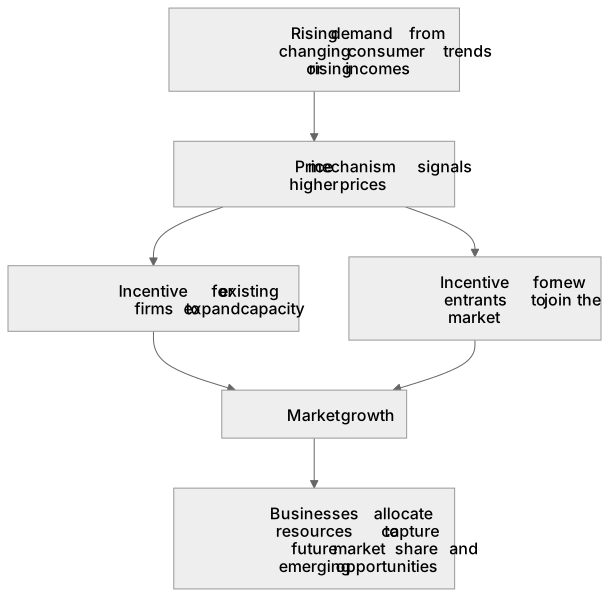
Key words
Say what each word means before you turn the card.
Potential market growth
Try answering aloud or in your head before turning the card.
Price mechanism
Try answering aloud or in your head before turning the card.
Resource allocation
Try answering aloud or in your head before turning the card.
Investment decisions
Try answering aloud or in your head before turning the card.
See every definition
- Potential market growth
- The estimated future increase in the size or value of a market.
- Price mechanism
- Signals potential market growth to firms and investors, for example through higher prices when demand rises.
- Resource allocation
- How businesses distribute resources efficiently to capture future market share and emerging opportunities.
- Investment decisions
- Choices businesses make using potential market growth, which higher prices and profits can incentivise.
Label the diagram
Some boxes have lost their names. Pick the right name for each number.
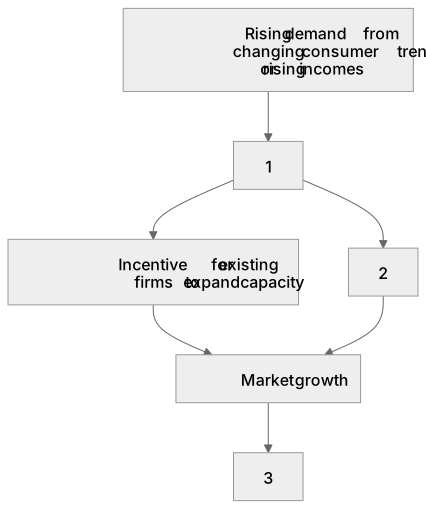
1Box 1
2Box 2
3Box 3
There is more to this lesson
The full lesson goes on to check your understanding and help you earn the marks. Create a free account to carry on, with your progress saved.
A week of Premium from your first lesson · Then the free plan continues · No card, no charge
Test your understanding of Price mechanism: d) Potential market growth
Active recall beats re-reading. Take an instant quiz now to test what you’ve learned and lock it into long-term memory.
A week of Premium from your first lesson · Then the free plan continues · No card, no charge